Search This Blog

Friday, September 08, 2006

Those Stalinist Democrats

This post over at The American Thinker is rather revealing. It states that:

Senate Democrats are now making not-so-veiled threats against ABC if it goes ahead and runs The Path to 9/11.
A letter sent to ABC by these Senators makes this not so veiled threat:

The Communications Act of 1934 provides your network with a free broadcast license predicated on the fundamental understanding of your principle obligation to act as a trustee of the public airwaves in serving the public interest.
The post concludes with this:

Nixon was a piker. This is a threat far more direct than ever made by the Nixon Administration on the TV licenses of the Washignton Post about which so much was made in the Watergate affair. But it is just business as usual for the party that thinks they can do what they want without consequence. If this had been issued by the Nixon Administration, we would still be reading about in it the history books as the next-to-last step to a fascist takeover of the Republic.
Tolerance and free speech for me but not for thee? In touch with their inner-tyrannt.

More on Who's Getting Richer

There's a really excellent post by Russell Roberts at Cafe Hayek today on the cost of living versus the standard of living related to the recent flurry of pontification on stagnating median incomes. There's no particular excerpt that does it justice, so I'll just heartily endorse it and provide the link.

Wednesday, September 06, 2006

Fodder for the NY Times

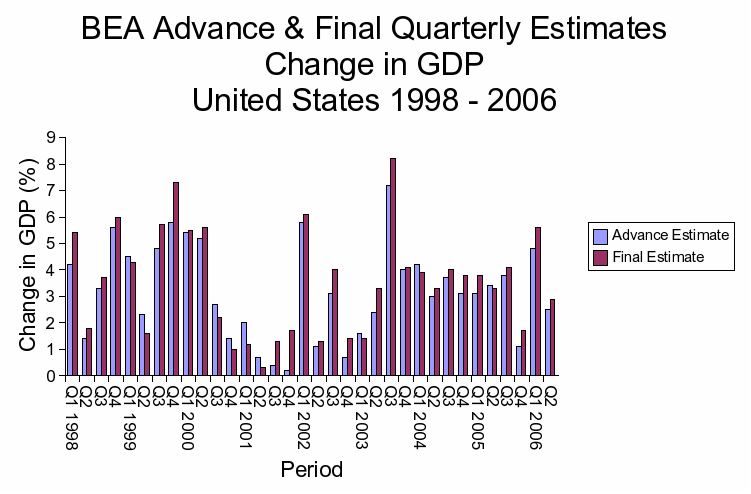
Second quarter GDP growth was revised upward last week to 2.9% from 2.5%. At nearly three percent, that's pretty respectable growth. It was yet another upward revision and it left me wondering just how often GDP growth estimates are revised upwards and how often they're revised downwards. So I decided to do a bit of investigation.

The BEA (Bureau of Economic Analysis) releases three estimates of GDP growth for each quarter. The "advance" estimate comes out toward the end of the first month after the quarter, the "preliminary" estimate comes out toward the end of the second month after the quarter, and the "final" estimate comes out toward the end of the third month after the quarter. Each estimate incorporates additional information as it becomes available and, in theory, should be more accurate.

When comparing the advance estimate to the final estimate, one might think that the difference between the two estimates would be more or less randomly distributed. In particular, one might think that about half of the time the advance estimate would be higher than the final estimate and the other half of the time the final estimate would be higher and that the averages of the estimates would be about the same.


But, as the graph above shows (click to enlarge), that's not the case. In the last 34 periods, the advance estimate has been lower than the final estimate 25 times, while being higher only 9 times. The advance estimate average is approximately 11.3% below the average of the final estimates which represents a delta of 0.34% of GDP. While I haven't run any formal statistical tests on these data, I'm very confident that the delta between the averages and the discrepency between the number of upward and downward revisions is statistically significant given the sample size.

So the BEA's advanced estimate is usually too low. This is apparently built into the formulae used by the BEA to calculate these estimates. I'm sure they follow their methodology consistently and rigidly each and every quarter and that's certainly their job.

But there are a couple things that are interesting here (I'm sure you were hoping something in this rather dry analysis would be interesting). The first is that when you read an article containing an advance estimate, adding 0.34 to it will give you a better estimate approximately 74% of the time (25/34). The BEA could do this same calculation to enhance their estimates, but consistency in the method of calculating the estimate is more important than accuracy. It's easy enough for us to take their estimate and modify it accordingly to make it more accurate.

The second thing of interest to me is that the consistent underestimates coupled with the estimate reporting calendar gives the NY Times and other liberal media yet another opportunity to describe the economy as weakening. Each time the advance estimate comes out, they can compare it to the final estimate for the previous quarter. Because the advance estimate is lower than it should be, on the surface it always looks like the economy is starting to soften more than it actually is (by 0.34% of GDP). So the next time you see a statement in the NY Times that comes out just after the advance estimate becomes available which claims that the economy is starting to soften or that the economy is losing steam, and their evidence for this claim is based on a comparison of the advance estimate and the previous quarter's final estimate, you should probably heavily discount that.

Tuesday, September 05, 2006

Who's Getting Richer

There's been a flurry of activity lately on the topic of the income disparity between the rich and the poor. It was started by a New York Times article titled "Real Wages Fail to Match a Rise in Productivity" which basically argues that wages for most people have stagnated for many years, even decades. This article sparked heavy debate between socialist and free market economists and pundits. I tend to line up pretty closely with the free market crowd and their analysis is pretty comprehensive. Here are some excerpts:

In TCSDaily, David Henderson argues that wage statistics don't mean squat and that people are better off regardless of what the wage statistics tell us:
Take home ownership. In the first quarter of 1965, the first date I could find quickly, 62.9 percent of American households owned their homes. That was during Meyerson's golden era. In the second quarter of this year, the "dead middle-class era," it was 68.7 percent, an all-time high. Cars? What's relevant, as with homeownership, is the percent of the population that owns cars. And this has boomed. In 1970, presumably near the peak of Meyerson's golden era, there were 108.4 million vehicles registered in the United States; by 2003, this had soared to 231.4 million, an increase of 113.5 percent, while the population had risen by only 42.4 percent. And note that Meyerson doesn't even mention air travel, which, due to deregulation and technological improvement, has become so much cheaper that even poor Americans, let alone middle-class ones, can now afford to fly. How about college? In 1970, only 10.7 percent of the population 25 years old or more had a college degree; by 2004, this was up to an all-time high of 27.7 percent.
Nicholas Eberstadt argues in the Washington Post that income is meaningless - the measure to focus on is spending:
Among low-income households in the United States, the gap between reported income and reported spending has widened gradually since the 1960s and now has taken on chasm-like dimensions. In the early 1960s, the poorest quarter of U.S. households spent 12 percent more than their annual incomes. In 1973, spending by America's poorest fifth surpassed their income by almost 40 percent. And in 2004, spending by the poorest fifth of American families exceeded income by a whopping 95 percent; in effect, spending was nearly twice as much as income.
Don Boudreaux at Cafe Hayek poses a thought experiment:
But I ask: would you prefer to live in 1967 with today’s real median household income ($46,326) or live today with 1967’s real median household income ($35,379)? (These figures are expressed in 2005 dollars, by the way.)

He answers his own question:

Given these two options, I’d choose to live today with only 1967’s real median household income. The reason is that the economy today offers so very many more options than did the economy in 1967 – or even the economy of that halcyon year, 1973. Today I can buy cell-phone service; today I can buy cable television with hundreds of channels, including ones that specialize in sports, cooking, history, and science; today even the cheapest automobiles are safer and more reliable than were the finest cars for sale in 1967; today I can buy telephone answering machines (with caller-ID), microwave ovens, CDs, personal computers, Internet service, and MP3 players. Today I can watch movies in my own home – in color – whenever I want without having to wait for one of the three or four available television stations to telecast a movie for viewing on a black-and-white television...
And Don continues on and on and on with all things new and improved.

Other factors that mitigate the wage statistics include general measurement errors. For example, many economists think inflation is overstated by over one percent per year. If so, wages and compensation increases since 1960 are actually pretty impressive.

But the other side does have a couple of good points. First, the value of wages is subjective. It's my observation, that for some people, the value to them of everything while living under leadership of the Democrats is much higher than the value of everything while living under Republican leadership. Thus, considering Professor Boudreaux's thought experiment above, they would subjectively (and rationally) choose the today's median income in 1967, when the drugs were good and the love was flowin'. I suspect this description happens to at least partly describe many NY Times readers, so they really are worse off now - since there is no "objective" economic sense, only their subjective perceptions.

Also, even to me, all other things being equal (including GDP per capita, GDP growth, etc.), I would prefer a system that was more egalitarian. I personally wouldn't put that preference ahead of GDP per capita growth, and since I don't personally believe that we could have a more egalitarian system and maintain the current rate of growth, I'm willing to let the egalitarian preference slide. But to many people, they would simply rather be poorer (and even have the poor be poorer in the future) and have a more egalitarian system. Once again, the value of everything to them under such a system would be higher and it would make up for lower wealth and income.

Both of these last two concepts draw heavily from an emotional, intuitive point of view, but that's not to say they aren't valid. They're certainly, in my opinion, valid enough to act on (or vote on). Trying to show why they're rational is a little tougher. Economist Brad DeLong tries by positing:

I'm enough of a touchy-feely sociology-lover to believe that a good chunk of the utility the rich derive from their conspicuous consumption is transferred to them from the poor.

In other words, the rich can put on their diamonds and look down their noses at the poor while feeling superior and "a good chunk" of the value of being rich comes from that. This implies that it's hardly worthwhile being rich if you can't do that. I find this a little tough to believe. But let's assume that it's true. If one is a utilitarian (one who wants to maximize overall utility of the economy to society), it may turn into an argument to try and increase the disparity between rich and poor. After all, the rich now have additional utility for their wealth (the feeling of superiority), yet this extra utility doesn't cost the non-rich anything at all! In other words, not being rich, it doesn't cost me anything for the rich to feel superior to me - all the more power to them as far as I'm concerned. I'm not worse off because of it.

Yet I have a hunch status does have something to do with DeLong's statement. Let's say there were no rich and therefore status had nothing to do with wealth. Then people would derive status from other traits: beauty, strength, height, intelligence, and job, to name a few. Brad DeLong, though short on beauty, strength, and height (relative to girth), would still get a bigger share of status from his exclusive job as an economics professor at UC Berkeley and the supposed intelligence that got him that position.

So it's interesting that in the zero sum gain of status, many of those belaboring income inequality and trying to increase the taxes on the rich have the most to gain.

Friday, September 01, 2006

Climate Change Problems Endured

Paco, a commenter on Tim Blair's blog, is having a rough time with climate change!
Climate chaos; tell me about it! I was shoveling snow from around the saguaro cactus in front of my home in Richmond, VA, and as soon as I finished, a fissure opened in the earth and a steam geyser sprayed hot water all over the place. All that work for nothing! If it hadn’t been for the fact that torrential rains had created so much humidity that the doors to the gun cabinet had swollen shut, I probably would have shot myself. Instead, I just chilled a few beers in the frozen goldfish pond, grilled some burgers over the creek full of magma that flows by the back fence, and settled down to enjoy the bright green sunset.
He must've been watching too many of those climate disaster movies!

Thursday, August 31, 2006

Ignorance

I had intended to create a post titled "uncertainty - the Rodney Dangerfield of concepts" - it don't get no respect. The plan was to take poetic license and lump together uncertainty about future outcomes along with uncertainty as to the correctness of facts, knowledge and beliefs that each of us think are true in any and all realms: social, scientific or other. When I saw a note on this stock service which I subscribe to by someone calling themselves Sir Bigfoot, well bingo! Here are some excerpts edited to be more general in application.

We live in ignorance all day, every day. Ignorance is our common state, not rationality. Although rationality is something that may pop up now and then in our lives, it does not do so consistently and may fail us altogether at critical junctures.

If your reptilian brain can be convinced of its almighty ignorance, it may turn out to be the most rational thing it has ever acceded to. We live in ignorance. We can't know ever so many things, let alone what is going to happen to a stock's price in the next week. Ignorance is far different from stupidity. It's stupid to think you can know something that is not knowable, but it is far from stupid to recognize your own ignorance when faced with the unknowable. Indeed, knowing your own ignorance is intelligence.

...if your energy is not corrupted and depleted by a continuous attempt "to be right, to be smart, to know more, and most deadly, to want to be better," then your energy for seeing reality becomes vastly increased.

...if we get caught up in thinking that we can know the future if only we are just "good enough" and can gather more facts, or the right ones, and can then take the risk out of everything we do, then we are lost because we are living a lie. On the other hand, if we labor in ignorance as a matter of course, we are not then invested in this lie at all, but only in what is going on. This is freedom. You are no longer tyrannized by a mind that is overwhelmingly concerned with appearing smart to itself. The mind will act rationally when it is does not burden itself with trying to be something it is not. We live with "I don't know." So if we don't know, what do we do? Mitigate risk is the rational thing to do.(This is more trading specific) Ah, at times, when we are relaxed, we can be rational! Hooray for evolution! And so ignorance leads to brilliance, but had we started out wanting to be brilliant, all would have been lost and the Holy Grail would still be hidden from our sight.

Experimenting with rules on a contingent basis to allow for the better functioning of the evolving spontaneous formations of the extended order of human cooperation simply works better than any grand plan. By embracing our ignorance we can be brilliant!

Self-inflicted wounds?

This summer while at a social gathering in Massachusetts I heard someone commenting on the bad economy. This person had ties to Connecticut and I had the impression they were referring more specifically to that locale, although I can't be sure. The national economy has been pretty darn good but I had no need to inquire further and trigger the Bush-bash that was likely to follow. In light of this, Dan Mitchell's post at the freedom and prosperity blog caught my attention. He remarks:
Politicians promised in the early 1990s that an income tax was the only way to stabilize Connecticut's budget and help the economy. Not surprisingly, the results have been just the opposite.

...then goes on to excerpt a report from the Yankee Institute:

Today, even after adjusting for both inflation and population, Connecticut spends more tax revenue and has more employees on its payroll than it did in 1991. ...Since Connecticut began to tax working, net job creation has ground to a halt. Economists, politicians, and reporters frequently cite the fact that Connecticut has yet to regain the number of jobs it had at its period of peak employment in the summer of 2000. But a recent Federal Deposit Insurance Corporation report revealed that the problem goes back even further -- since the early 1990s, "no other state in the country has had such stagnation in employment." ...Between 1991 and 2004, the most recent figure available from the U.S. Census Bureau, median household income in the Nutmeg State fell by almost $3,300. In contrast, the national figure rose by almost $2,800. ...In the 1990s, Connecticut was one of only two states to lose population. That should not have come as a surprise. Research shows that high-tax states such as Connecticut have been losing population to low-tax states for decades. ...
Obviously the complexity of other factors contributing to this state of affairs makes it difficult to say or prove anything. But it sure makes you think!

Wednesday, August 30, 2006

Raising the Dead

As time passes, I trust the media less and less. If my trust gets much lower, I'll end up assuming the opposite of what I read. During the latest mideast conflict between Lebanon and Israel, the main stream media was caught manipulating photographs and photographic sequences numerous times (here and here, for example). Indeed, the new term fauxtography has been coined to cover all these frauds.

So, when I read about the police crack down on striptease funerals in China, I immediately assumed that it was just a joke. While I suppose that striptease is one way to put the "fun" in "fun-eral", I figured some gullible reporter was hoodwinked by some Asian prankster, and it didn't actually happen. But I've now waited a week for Snopes to discredit the story and there's still no mention of it.

It's not just the general concept that's unbelievable. The world's a big place and there are a lot of cultural viewpoints, so the striptease funeral concept sounds (barely) plausible to me. What's even more unlikely to me is the name of the place in which the striptease happened: Donghai (pronounced Dong High). I mean really, what are the odds of that?

But it gets worse (or better, depending on how you look at it). According to Wikipedia:
In Chinese mythology, Donghai is the domain of the Donghai Longwang (东海龍王), or "the Dragon King of the Eastern Sea"
Donghai Longwang? So let me get this straight. They were using striptease to raise [support for] the dead in Donghai which is the center of Donghai Longwang. A remarkable convergence of names and places for this story, don't you think?

Friday, August 25, 2006

Did You Say Woof?

Israel's predicament of being surrounded by neighbors that fervently want to destroy it reminds me of "The Story of the Czar, the Rabbi, and the Dog":
The Czar appointed a brutal and ruthless minister to govern an area in western Russia. The minister learned that there was a highly esteemed rabbi in one of the Jewish communities in his area, and wishing to assert control over that community via intimidation, called in the revered and elderly rabbi. "If you are so wise," taunted the minister, "how about teaching my dog to talk? If you succeed, I'll let you live. If you fail, I'll have to kill you." The rabbi replied, "I accept your challenge. I can teach your dog to talk in a year."

When the rabbi later told his wife and students about his decision, they were astounded: "How could you say you could teach the dog to talk?"

The rabbi's answer was definitive: "A lot can happen in a year. In a year, the minister could die. In a year, the Czar might replace the minister. In a year, I could die. In a year, the dog could die. In a year, I could teach the dog to talk."
As a quick aside, as an entrepreneur, I know of several small companies (not any of mine, of course) in dire circumstances that have used similar reasoning to make future promises that they almost certainly would not be able to keep, because hey, a lot can happen in a year.

In the middle east, the rabbi represents Israel, the Czar is Israel's muslim neighbors, getting the dog to talk represents getting Israel's neighbors to accept its existence, the minister represents Iran, and the year represents the time until Iran has a sufficient nuclear arsenal to critically damage Israel.

In case you think that Israel might be safe if Iran had nuclear weapons, lets consider some statements made by Iran's President Ahmadinejad.
From the Washington Post regarding the conflict in Lebanon: "Although the main solution is for the elimination of the Zionist regime, at this stage an immediate cease-fire must be implemented,"

From CBS News: "So we are asking why the American government is blindly supporting this murderous regime [Israel]."

From the New York Times: "Our dear Imam said that the occupying regime [Israel] must be wiped off the map and this was a very wise statement."
It looks to me like these statements are representative not only of President Ahmadinejad, but of a majority of the people in power in Iran. Possibly even worse, President Ahmadinejad believes in the 12th Imam, a messianic figure, who will "return to save the world when it had descended into chaos", and "that humans can stir up chaos to encourage him to return." Bombing Israel with nukes and the expected retaliation by Israel might be just what the doctor ordered in order to stir up adequate chaos to get Mr. Twelve Imam (aka Muhammed al-Mahdi) to save the world. To be clear here, the expected retaliation by Israel is a feature of, not a bug in, the plan.

But since Israel cannot conquer the entire middle east, it has little choice but to hope it can teach the dog to talk. After all, a lot can happen in the remaining time. In that time, Ahmadinejad and the believers in Mr. 12th could die. In that time, Iran might be replaced by someone else as the regional hegemon. In that time, the current citizens of Israel might die of old age (and many of them are childless, so what do they care what happens after that?). In that time, Iran's nuclear weapon program might be dismantled by shrewd European negotiation. In that time, maybe Israel's neighbors will learn to be willing to live in peace with it.

In that time, maybe Israel could teach the dog to talk.

Tuesday, August 08, 2006

Arab Rules

To be hawkish or dovish? Or, for Israel, to be or not to be? But which is which? That is the question. Whether tis nobler to suffer the rockets and mortars of outrageous fortune or to take arms against a sea of Hezbollum?

The dovish approach didn't seem to work so well. The Israelis withdrew from Lebanon, withdrew from Gaza, were preparing to withdraw from the West Bank, but still the rockets came down. Bummer!

What about a hawkish approach? Even more fundamentally, what is a viable hawkish approach to the problem? A "proportionate" response doesn't seem useful. Hezbollah fires a few missiles into random population centers in Israel, so Israel fires a few missiles randomly back into Lebanon? Nah, doesn't cut it.

The more intense response that we're currently witnessing doesn't strike me as working particularly well either. What's the end game? How can Israel finish this war and end up with a lasting peace? I can't imagine how that can happen, but it could be that I'm just short on imagination.

I've seen a number of articles calling for the end of Israeli restraint. Fight fire with fire they say. A good example of this genre is contained in an editorial from Arutz Sheva (Israel National News.com) by Ellen Horowitz:
The Western concepts of fair play, moral equivalency, proportional response and restraint seem more suitable for a sporting event than for a war against an enemy who deems such concepts as absurd. Israel's timeout for an investigation must seem downright laughable to an adversary who would litter any playing or battlefield with penalty flags and fouls. The UN referees best pack-up and go home, because any whistle-blowing will fall on deaf ears.

Nobody understands that better than Dutch attorney and former UNHCR official Johan Rhodius. Last week, I had the opportunity to exchange thoughts on Israel's predicament with him.

Mr. Rhodius asserts that the very existential nature of Israel's wars make the Western concepts of proportionality and restraint irrelevant. And by insisting on the Jewish State's adherence to such notions, the Western world demonstrates a lack of moral clarity and endangers itself by weakening Israel. [...]

Mr. Rhodius goes on to say that the Western concept of restraint has permeated the Israeli justice system and weakened Israel's state of security. Terrorism, by its very nature, knows no restraint: "It's not moderate, proportionate, objective or unprejudiced."
Her concluding sentence?
Israel best ... learn to play by Arab rules, and get the job done.
But I think this last sentence is an awkward way to conclude. What sorts of actions should be taken in order to play by Arab rules? Since the Arabs (especially Hamas and Hezbollah) would love to slaughter every last Jew in Israel if they could, does that mean that Israel should attempt to perpetrate a mass genocide against Arabs? Does it mean that Israel should indiscriminately target civilians? Should Israel enter treaties and then ignore them? Aren't these the sorts of things that playing by Arab rules implies? Or is there something less horrific that still qualifies as playing by Arab rules and will somehow help the situation?

I'm starting to suffer from Stanley Kurtz "Hawkish Gloom". It's not just Israel that's in trouble:
This means that the entire Western world now stands in a position roughly analogous to that of Israel: locked in an essentially permanent struggle with a foe it is impossible either to placate, or to entirely destroy — a foe who demands our own destruction, and whose problems are so deep they would not be solved even by victory.
There seems to be no satisfactory outcome possible, especially with regards to Iran:
The West is on a collision course with Iran. There will either be a preemptive war against Iran’s nuclear program, or an endless series of hot-and-cold war crises following Iran’s acquisition of a bomb. And an Iranian bomb means further nuclear proliferation to Egypt and Saudi Arabia, as a balancing move by the big Sunni states. With all those Islamic bombs floating around, what are the chances the U.S. will avoid a nuclear terrorist strike over the long-term?
My current prediction, and I obviously hope that I'm very, very wrong, is that we'll do nothing of significance to address the problem - primarily because there's nothing that can be done that a civilized society can or should be willing to do - until we suffer horrific damage (nukes or otherwise) at the hands of terrorists.

Then we will no longer be a civilized society and we will be willing to play by Arab Rules.

Monday, August 07, 2006

What's Going On?

I've heard of the concept of the "fog of war" and I'm no expert and not very knowledgeable about the execution of wars, but I'm bewildered at how hard it is to get a reading that I can have any confidence about regarding the current conflict between Israel and Hezbollah (primarily) and Hamas (secondarily). According to the various information sources that I've been reading, there is a huge range of possibilities in what's going on. Israel's military is either performing incompetently or is making good progress. Hezbollah is standing firm or is hurting. The Israelis are deliberately targeting civilians or they are carefully minimizing damage to the civilian population and infrastructure. Qana was a massacre or it was a hoax. A cease fire is imminent or the fighting will continue.

I fully understand why it's so difficult to get information. Events in the middle east seem to always elicit a tremendously emotional response from just about everybody which tends to limit objective viewpoints. As a result, journalists from both sides publish intensely biased stuff. As an example, Reuters is now facing a bit of a scandal because a number of their headline photographs turned out to have been doctored in an anti-Israel fashion. Even if journalists wanted to be perfectly objective, it would still be difficult since both Israel and Hezbollah are, understandably, putting out fake news as part of disinformation and psy-ops campaigns. As a result, the amount of real, verifiable, non-contested information is extremely limited.

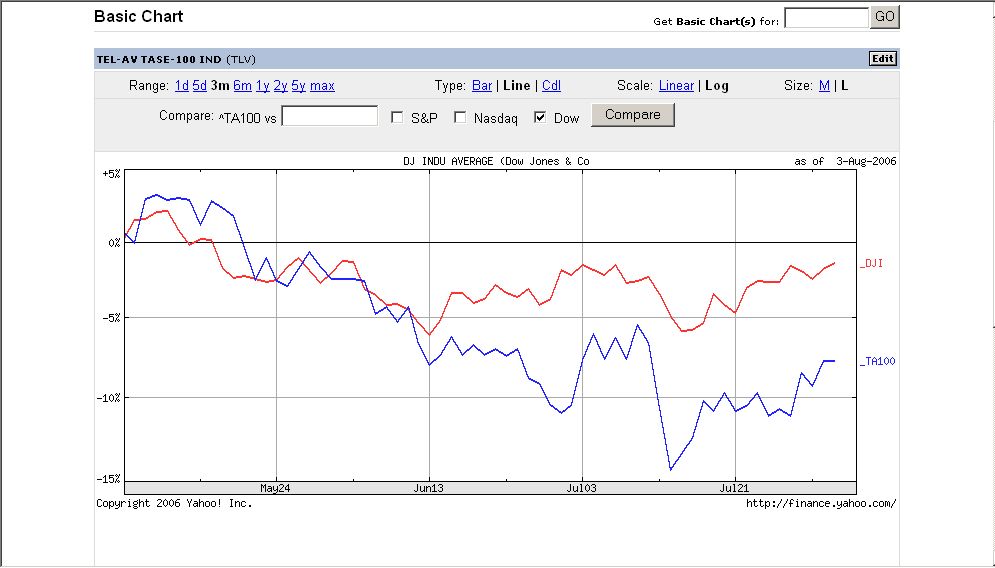
With the available information sources providing what is essentially random information (basically covering all possibilities), I decided to try and find an objective proxy that might reflect the overall status of the conflict. Conveniently, Tigerhawk posts a comparison of the Tel Aviv Stock Exchange 100 (TA100) versus the Dow over the last few months.

Tigerhawk's analysis of the graph is that the TA100 "sold off broadly at the start of the crisis, but the progress has been impressive since Israel began its campaign to disarm Hezbollah. If you believe in the distributive wisdom of the financial markets in assessing geopolitical risk, Israel is improving its position." He further asks, "The two indices traded essentially in tandem, but started to diverge significantly in mid-June, a month before Hezbollah made its move and almost two weeks before Hamas kidnapped Gilad Shalit. Did the market "know" that Israel was on the brink of some security crisis ... ?"

I personally don't think these markets are anywhere nearly strongly correlated enough to make such strong statements or put forth such questions. On the other hand, the fact the the TA100 isn't plunging does, I think, support rather more modest assertions. For example, I do think the market is saying that the near to mid term consequences of this war for Israel's economy will be at most marginally negative. The market is therefore saying that all factors, including world opinion (plus resulting embargoes against Israel, if any), infrastructure damage, and the security of Israel (including the results of inflaming its Arab neighbors), will likely not have all that big of an impact.

Israel looks likely to survive the next few years, anyway.

Thursday, August 03, 2006

Developing World

I currently consider the world broken down into three groups economically: the developed world, which consists of countries like the Anglosphere and Europe; the poor but rapidly developing countries such as China, India, and the other Asian Tigers; and the basket case countries such as South America and Africa. This last group has not made much progress, well, ever.

As a result, much is being made of the fact the world economy is booming. And, better yet, the poorest countries such as those in my basket case group, have had very strong increases in GDP per capita. The claim is that the poor are finally getting richer faster than the rich!

Unfortunately, I'm afraid the claim is probably too strong. Because the rich are still getting richer, demand for commodities such as energy and metals has been increasing, driving up prices, really for the first time in decades. Those poorest countries have no other source of income and wealth except exporting commodities. So, by sheer luck, their GDP per capita is increasing nicely at the moment, especially since they have very little other income.

But I wouldn't bet on sustained increases in commodity prices in the long term. As a result, I predict the basket case nations will find that their GDP per capita levels off and stagnates once again within the next few years.

Firm Beliefs

I started writing on this blog for a variety of reasons. One of those was to "enlighten" others on a variety of topics, particularly in matters of economics. I've think I may have had some positive effect in some non-contentious areas of economics, but I've had absolutely no effect regarding subtopics like the effect of taxation and deficits on growth and wealth creation. It seems that everyone has their preconceived notions (fortunately, a few people actually agree with my preconceived notions), and nobody is willing to abandon their beliefs regardless of the evidence.

A recent article in the Washington Post explains some of the mechanisms that ensure that people hold on to their beliefs despite the evidence.

Psychological experiments in recent years have shown that people are not evenhanded when they process information, even though they believe they are. (When people are asked whether they are biased, they say no. But when asked whether they think other people are biased, they say yes.) Partisans who watch presidential debates invariably think their guy won. When talking heads provide opinions after the debate, partisans regularly feel the people with whom they agree are making careful, reasoned arguments, whereas the people they disagree with sound like they have cloth for brains.

Unvaryingly, partisans also believe that partisans on the other side are far more ideologically extreme than they actually are, said Stanford University psychologist Mark Lepper, who has studied how people watch presidential debates. [...]

In an experiment that pols may want to note closely, researchers recently plopped 10 Republicans and 10 Democrats into scanners that measure changes in brain-blood oxygenation. Such changes are thought to be linked to increases or decreases in particular areas of brain activity.

Each of the partisans was repeatedly shown images of President Bush and 2004 Democratic challenger John F. Kerry.

When Republicans saw Kerry (or Democrats saw Bush) there was increased activation in brain areas called the dorsolateral prefrontal cortex, which is near the temple, and the anterior cingulate cortex, which is in the middle of the head. Both these regions are involved in regulating emotions. (If you are eating an ice cream cone on a hot day and your ice cream falls on the sidewalk and you get upset, these areas of your brain remind you that it is only an ice cream, that not eating the ice cream can help keep those pounds off, and similar rationalizations.) More straightforwardly, Republicans and Democrats also showed activation in two other brain areas involved in negative emotion, the insula and the temporal pole. It makes perfect sense, of course, why partisans would feel negatively about the candidate they dislike, but what explains the activation of the cognitive regulatory system?

Turns out, rather than turning down their negative feelings as they might do with the fallen ice cream, partisans turn up their negative emotional response when they see a photo of the opposing candidate, said Jonas Kaplan, a psychologist at the University of California at Los Angeles. [...]

The result reflects a larger phenomenon in which people routinely discount information that threatens their preexisting beliefs, said Emory University psychologist Drew Westen, who has conducted brain-scan experiments that show partisans swiftly spot hypocrisy and inconsistencies -- but only in the opposing candidate.

When presented with evidence showing the flaws of their candidate, the same brain regions that Kaplan studied lighted up -- only this time partisans were unconsciously turning down feelings of aversion and unpleasantness.

This study is certainly closely aligned with my experiences on this blog and also commenting on other blogs (not to mention my experiences in actual, real live, face-to-face conversations). Obviously, being human, I must suffer from the same problem, so my worldview is also based on partisan thinking and y'all should ignore whatever I say. Researchers are probably also prone to this effect. Of course, if the researchers who did the research referred to by the Washington Post article were also affected by this, then the results of their research is bogus, and such an effect doesn't actually exist. But, if it doesn't exist, then they weren't affected, so their research is valid, so it does exist. But if it does exist ...

And so we end up with paradox.

Wednesday, July 26, 2006

I've Been Wondering

Peace
What percentage of the time, thoughout history, when given the choice between fighting or opting for peace while being confronted by an aggressor known for breaking his (or its) word, has choosing "peace" worked out well? From the playground bully to the genocidal dictator, how often has it worked out well to submit to their demands? From Philip of Macedon's story to the ancient Greeks of "don't worry, I'll never invade your lands," to Hitler's "don't worry, I'm just reuniting the German peoples," are there many (any?) examples of things turning out well for all (or at least most) of the parties when peace was chosen?

The "Give Peace a Chance" theme has been with us for a long time, but what is the empirical evidence that this is, on average, a good idea?

Civilians
When it comes to a long (intergenerational) war, why does the term civilian have any meaning at all? For illustration, consider me. I've never been in the military. Yet I consider myself a completely legitimate military target. I've worked on a number of sophisticated and highly deadly weapon systems during my career (which have been deployed with great effect). Right now I work on autonomous robots, and while none of them are for military purposes, the technology could easily be converted for intensely effective military applications. It would be effective, perhaps even more effective than killing a soldier, to kill someone like me, an enabler of soldiers.

Anyone with my skills could easily be redirected to work on military applications at any time, so as a preemptive strike, killing technical people seems fair enough to me. And killing the people who support such people seems justified to me as well. And if they weren't even born - all the better, so kill the mothers too, or at least get them when they're children. After all, in a long war, one day they'll grow up to try to kill you.

Especially in a democracy, such as the United States, or Israel, or Lebanon, I consider the entire populace to be supporting the military, and as a result, are fair game as military targets.

Clearly, Hezbollah agrees with me. What I'm wondering is why no one else does? It seems insane to me not to hit an enemy in a long war wherever, whenever, and however you can.

Antisemitic
Why do various intellectuals bristle when their comments and advocacy regarding Israeli policy, that if actually implemented will clearly lead to more dead jews, are called antisemitic? Even if their comments are well intentioned, or even fair and just, the comments are still antisemitic, aren't they?

Wednesday, July 12, 2006

Everybody's an Environmentalist...

... unless it costs them something.

Let's start with a simple assertion. If climate stability is a primary goal, rapidly injecting gazillions of tons of CO2 into the atmosphere isn't a great idea. I think most climate change scientists would probably more or less agree with that assertion. I think that most engineers would agree that significantly tweaking a variable can easily lead to instability. And I think it has a nice, intuitive feel to it. It might even be true.

But should climate stability be a primary goal? For instance, should it be more important than providing clean water, public health, primary education, and dietary improvements for the impoverished masses of the world? This is an important question. Here's one answer:

Two years ago, a group of the world's most respected economists, including Nobel Laureate and FREE's 2003 Summer Scholar Thomas Schelling, were posed with a question: Given significant but finite resources, what are the best investments for improving our world? They chose clean water, public health, primary education (especially of girls), and inexpensive dietary improvements.

Addressing global warming didn't make the cut. Why not? It could consume all the funds while producing uncertain rewards in the far distant future. Instead, these funds could be invested in developing economies. By attracting foreign capital, poor nations could gain economic resiliency, the surest route to a better future.

The experiment with economists was recently replicated by John Bolton, U.S. Ambassador to the UN. Not one to shrink from controversy, he empanelled UN diplomats from seven emerging nations, including India and China, to prioritize the issues. After hearing from experts in the problem areas, they ranked global crises ranging from climate change to migration. The top four were again health care, water and sanitation, education, and child nutrition. Climate change was, of course, dead last. No honest policy analyst would be surprised by these rankings.

While most agree that climate change is occurring, many proposed "solutions" are monumentally expensive, uncertain, and distant. They are, in sum, the sorriest of investments. Providing vitamin A, on the other hand, costs less than $1 per person per year, saves lives, and prevents childhood blindness. Encouraging breast feeding cheaply and effectively promotes infant health.

That's my view. The return on investment for combating climate change, especially when discounted for the uncertainty inherent in any ultra long term investment, is extremely poor. And let's face it. We're not going to spend the money to completely solve any of these other problems either.

Climate change needs to go to the back of the line and wait.

Tuesday, June 27, 2006

2007 Financial Crisis

I predict a major financial crisis and severe depression in 2007.

It's likely that JK Rowling plans to kill off Harry Potter in Book 7 (title still unknown):
Harry, others may die in the end, J.K. Rowling says

Author J.K. Rowling said two characters will die in the last installment of her boy wizard series, and hinted Harry Potter may not survive, either.

"I have never been tempted to kill him off before the final because I've always planned seven books, and I want to finish seven books," Rowling said Monday on London TV.
"I can completely understand, however, the mentality of an author who thinks, 'Well, I'm gonna kill them off because that means there can be no non-author-written sequels. So it will end with me, and after I'm dead and gone they won't be able to bring back the character.' "

Rowling declined to commit herself about Harry, saying she doesn't want to receive hate mail.
That will drive tens of millions of people in developed countries into deep depression. They won't buy anything, won't work nearly as hard, and the shock to the demand side will cause the global economic system to go unstable.

I've seen this effect in person with my nine (almost ten) year old daughter. In the very excellent Bartimaeus trilogy, a beloved character dies in the last paragraph. My daughter was significantly depressed for a long time. She kept reading the last chapter over and over again hoping it would turn out different.

The problem with Harry Potter is that ten to twenty million people will read it during the 72 hour period after it comes out. The overall depression of that large a group of people all at once will have a profound impact on the economy.

Friday, June 09, 2006

Reading tealeaves

I'm often amused when I hear people complain that there is too much information available or that it is hard to be informed or that they are being mislead. It simply doesn't occur to them that they need to try and develop an approach to sorting, sifting and analyzing what is abundantly available. In addition to refining their approach they can also pickup on subtle clues.

This article in the WSJ caught my attention, not because of the main thrust but because of this opening section:

It wasn't so long ago that insurers were pronouncing terrorism "uninsurable." But ask any insurer: Aon's Paul Bassett recently noted that the global war on terror had greatly reduced the threat of megaplots on the scale of Sept. 11, 2001.

Yes, suicide bombers and car bombs remain a threat, but not to the industry's capital base. Hurricanes are the new "uninsurable" now.


One reason for being on the offensive against Radical Islamists and their enablers is to reduce their effectiveness in supporting cells that might hatch a megaplot here at home. Critics who are sure that this policy is wrong exhibit thinking that is at odds with people who obsess about that risk for a living. Who's view would you lean towards: someone with an emotion laden approach (likely a sufferer of BDS) or a professional trying to take a clear eyed approach?

Wednesday, June 07, 2006

Spontaneous Order

I thought that this article by economist Daniel Klein was a nice followup to Bret's post about the superiority of self-organizing systems. Excerpts below:

At a roller rink you can see something that holds insights into great questions of politics and society.

"How are 100 people supposed to skate around the arena without guidance or direction? Each skater traces out a pattern, and the patterns must mesh so skaters avoid injury. That's a complex problem. It would require smart leadership. But it won't get solved! The arena will be a scene of collision, injury, and stagnation. Who will pay for that?!"

Intuition leads us to think that complex problems require complex, deliberate solutions. In a roller rink, the social good depends on getting the patterns to mesh. But no one is minding that good. As your friend describes the business idea, not even the owner intends to look after it. How can the social good be achieved if no one is looking after it?

Suppose you and I step into roller-skates and join the other skaters on the floor of the rink. In skating, I do not aim to solve the big problem of coordinating all the skaters. I do not try to get all 100 patterns to mesh. I show common courtesy, but basically I am out for myself. I want to have fun, and so certainly don't want to get hurt. Looking out for myself, I promote my interest in avoiding collision with you.

An important quality of collision is mutuality. If I collide with you, then you collide with me. And if I don't collide with you, you don't collide with me. In promoting my interest in avoiding collision with you, I also promote your interest in avoiding collision with me.

The key to social order at the roller rink is this coincidence of interest. I do not intend to promote your interest. I am not necessarily even aware of it. Still, by looking out for myself I am to that extent also looking out for you. My actions promote your interest.

Skating on the floor of the roller rink is an example of what Friedrich Hayek called spontaneous order. The process is beneficial and orderly, but also spontaneous. No one plans or directs the overall order. Decision making is left to the individual skater. It is decentralized.

The contrast is centralized decision making. Again, intuition tells us that the only way the complex social good can be achieved is by central planning. Yet Hayek tells us that sometimes another way it can work is "decentral" planning. He tells us, in fact, that, often, decentral planning is the only way it can work.

Suppose the social good on the floor of the roller rink were entrusted to central planning. The rink owner appoints a really smart, really nice guy to look out for the social good. He hires a man with the reputation of a saint, and with two PhDs from Yale, one in Civil Engineering and one in Ethics. This smart saint stands in the organ booth, holds a bullhorn up to his mouth, and calls out directions: "You in the blue jacket, speed up and veer to the left." "You in the black overalls, I want you to slow down and move toward the inside." And so on.

The results would be terrible. The smart saint could not come close to achieve the brisk dynamic order that spontaneous skating achieves. The main reason he could not is that he lacks knowledge of individual conditions. Using his Yale learning, he looks closely and does his best. But he has 100 skaters to watch, and the conditions of each are changing moment by moment. The planner's college knowledge is useless in informing him of the particular conditions of your situation. The planner tries to apply engineering principles, but each skater has principles of motion all his own: Do I feel like going faster? Am I losing my balance? Can I handle this turn? Do I have to go to the bathroom? Am I content to follow the planner's directions?

Your local conditions—your opportunities, constraints, and aspirations—are best known by you. No one else comes close. College knowledge is no substitute for what Hayek called local knowledge.

Moreover, even if somehow the smart saint from Yale has all the local knowledge of the individual skaters, what would he do with it? How would he interpret it? How would he integrate it? And if he came up with orders for how to direct our skating, how would he communicate those orders to 100 people simultaneously?

Being smart and saintly, the planner would recognize his limitations and just slow things down. To prevent collisions, he would have to impose regimentation. Skating would be slow and simple. Skaters would be bored. Moreover, they would not find the joy and dignity that come from making one's own course.

On the floor of the roller rink, the social good can only be achieved by spontaneous order. As Hayek explained, the case for leaving action spontaneous is stronger the more complex social affairs are, because greater complexity only exacerbates the planner's knowledge problems. When the situation is simple, central planning can succeed. If there were just four skaters on the floor of the rink, central planning might not be so bad. But with 100 skaters, it is preposterous.

If, besides being smart and saintly, the planner were also wise, he would beseech the rink owner to relieve him of his assigned task. He would renounce central planning. He would recommend spontaneous order.

The principles find direct application in economics. Just as we want to discourage collisions, we want to encourage voluntary exchange. In both cases, the key is mutuality. Gains from trade are mutual, giving rise to coincidence of interest: In promoting my interest in gaining in a voluntary exchange with you, I also promote your interest in gaining in a voluntary exchange with me. You would not enter into the exchange if you did not stand to gain.

Once again, actors buzz about spontaneously to advance their own interest, but in the process advancing the social good. As merchants, we garner the honest dollar by serving our customers—that is, by serving society. As consumers, we obtain stuff by rewarding suppliers for services rendered.

Again, if someone were to presume to plan the economy, the result would be disaster. The social patterns in an economy are fabulously complex, making decentral planning all the more necessary.

In economics, the substance of "spontaneous" is liberty. Liberty means freedom from others messing with your stuff, including yourself, your person. When the government tells you that you can't enter certain contracts, can't use your property in certain ways, and can't keep 35 percent of your earnings, it treads on your liberty. It is making affairs less spontaneous and more centrally directed or controlled.

It sounds self-centered—freedom from others messing with your stuff. But the principle would go for everyone, so it also requires you not to mess with others' stuff. Liberty implies not only security and freedom in ownership, but duties to respect ownership by others.

But more importantly, we live in a world of mutualities. I want others not to mess with my stuff so that I can use my stuff to best participate in mutual relationships. The point is not self-centeredness; it is to center control over stuff in the owner, so that action draws on local conditions and advances mutual betterment. The bonds of mutual relationships form the vast network of society, and when its members are individually empowered and motivated to advance those bonds, we have a society that is well cared for.

Spontaneous-order principles argue against full-fledged central planning, but do they condemn all incursions on liberty? The key is coincidence of interest. In some activities, such as polluting the air, maybe there isn't coincidence of interest. Maybe there is conflict of interest. In cases like that there is less of a case for spontaneous arrangements.

Likewise, in the roller rink, there are occasions for simple rules, such as signaling to skaters when the direction for skating is to be reversed, or when the floor is open only to ladies, or only to couples. These rules are largely self-enforcing.

But in the great roller rink of human society, many government restrictions are more like the central planner imposing foolish restrictions on ordinary skating. Spontaneous-order principles ought to have more purchase than they do.

The principle of spontaneity, of liberty, is not an all-or-nothing proposition. But the principles of local knowledge, coincidence of interest, and spontaneous adaptation have much more power than is generally recognized. People have a hard time understanding how spontaneous order works, or even that it exists. At a roller rink, spontaneous order happens before our very eyes. But in the great rink of society, each of us is immersed deep within the spontaneous order, focused on our own particular situation. Each has no window on the whole, not even a glimpse. Although economics cannot make the whole actually visible to us, it can help us see the principles at work.

Jonathan Swift said that vision is the art of seeing things invisible. In that sense, economics gives us vision.

Saturday, June 03, 2006

Calling out Progressives

JUST SAY NO...
...to yet another class of victims. That's Heather Mac Donald's advice, anyway; and I think it very sound:... So says Dr. Sanity over at her terrific blog. She continues:
I especially like her idea of overthrowing the progressive pedagogy which is at the root of the attempt to feminize boys and eliminate any masculine "taint" to learning (e.g. competition).

...victimhood is still "in", having replaced personal responsibility and hard work as the means of getting ahead in the world. Try to change that and you will be accused by the progressive lot (see here) as being either Racist, Sexist, Homophobic, Islamophobic, Imperialist, Bigoted, or--worse of all --Intolerant or Insensitive.

That's what it has come down to. Either you do it the "progressive" way; or they will label you as vermin and attack you with all the firepower of their rhetorical armament. "Progressives" aren't really interested in what works to achieve the desired result in the real world; they are more interested in what makes them feel virtuous.
She goes on to list 10 commandment of multiculturalism and then concludes:
The only way we can rid ourselves of these toxic commandments; and free the millions held hostage in our own country by the virulent victimhood cult of the left; is to expose progressive pedagogy for what it is--totalitarian propaganda that disables free will; individuality and personal responsibiity; replacing them with "an oppressive tyranny sincerely exercised for the good of its perpetual victims." (C.S. Lewis, again)
Once again the good Doctor is on fire! - see the archives too

Friday, June 02, 2006

Culture Matters

The title of this post covers so much ground that someone should write a book on the subject!
(re linked to book: This collection of essays addresses a difficult question: Are some cultures better than others at creating freedom, prosperity, and justice? Although Culture Matters offers varying responses to this politically incorrect question, its editors, Lawrence E. Harrison and Samuel P. Huntington, as well as the bulk of its contributors, answer in some form of the affirmative.)

Culture is our evolutionary hyperdrive. Even aside from the impact of our biology, culture shapes us and we shape our culture. It is a vessel containing intangible elements of what makes civilization.

In my usual style of intellectual parambulations, I stumbled upon this article by James Q. Wilson which touches upon many important ideas and demonstrates the richness one encounters when tracing lines of thought through the complexity of a cultural issue. Heavily excerpted here, the full article is worth a read.

WHY WE DON’T MARRY

Everyone knows that the rising proportion of women who bear and raise children out of wedlock has greatly weakened the American family system. This phenomenon, once thought limited to African Americans, now affects whites as well, so much so that the rate at which white children are born to an unmarried mother is now as high as the rate for black children in the mid-1960s, when Daniel Patrick Moynihan issued his famous report on the Negro family. For whites the rate is one-fifth; for blacks it is over one-half.

Almost everyone—a few retrograde scholars excepted—agrees that children in mother-only homes suffer harmful consequences: the best studies show that these youngsters are more likely than those in two-parent families to be suspended from school, have emotional problems, become delinquent, suffer from abuse, and take drugs. Some of these problems may arise from the economic circumstances of these one-parent families, but the best studies, such as those by Sara McLanahan and Gary Sandefur, show that low income can explain, at most, about half of the differences between single-parent and two-parent families. The rest of the difference is explained by a mother living without a husband.


And even the income explanation is a bit misleading, because single moms, by virtue of being single, are more likely to be poor than are married moms. Now that our social security and pension systems have dramatically reduced poverty among the elderly, growing up with only one parent has dramatically increased poverty among children. In this country we have managed to shift poverty from old folks to young folks. Former Clinton advisor William Galston sums up the matter this way: you need only do three things in this country to avoid poverty—finish high school, marry before having a child, and marry after the age of 20. Only 8 percent of the families who do this are poor; 79 percent of those who fail to do this are poor.


... comparing single-parent families and average spending levels neglects the real issue: how attractive is welfare to a low-income unmarried woman in a given locality? When economist Mark Rosenzweig asked this question of women who are part of the National Longitudinal Survey of Youth—a panel study of people that has been going on since 1979—he found that a 10 percent increase in welfare benefits made the chances that a poor young woman would have a baby out of wedlock before the age of 22 go up by 12 percent. And this was true for whites as well as blacks. Soon other scholars were confirming Rosenzweig’s findings. Welfare made a difference.

But how big a difference? AFDC began in 1935, but by 1960 only 4 percent of the children getting welfare had a mother who had never been married; the rest had mothers who were widows or had been separated from their husbands. By 1996 that had changed dramatically: now approximately two-thirds of welfare children had an unmarried mom, and hardly any were the offspring of widows.

To explain the staggering increase in unmarried mothers, we must turn to culture. In this context, what I mean by culture is simply that being an unmarried mother and living on welfare has lost its stigma. At one time living on the dole was shameful; now it is much less so. As this may not be obvious to some people, let me add some facts that will support it.

Women in rural communities who go on welfare leave it much sooner than the same kind of women who take welfare in big cities, and this is true for both whites and blacks and regardless of the size of their families. The studies that show this outcome offer a simple explanation for it. In a small town, everyone knows who is on welfare, and welfare recipients do not have many friends in the same situation with whom they can associate. But in a big city, welfare recipients are not known to everyone, and each one can easily associate with other women living the same way. In the small town, welfare recipients tell interviewers the same story: “I always felt like I was being watched”; “they treat us like welfare cattle”; people “make nasty comments.” But in a big city, recipients had a different story: Everyone “is in the same boat I am”; people “don’t look down on you.”

How did stigma get weakened by practice and undercut by law, when Americans—no less than Brits, Canadians, and Australians—favor marriage and are skeptical of welfare?

Let me suggest that beneath the popular support for marriage there has slowly developed, almost unnoticed, a subversion of it, which can be summarized this way: whereas marriage was once thought to be about a social union, it is now about personal preferences. Formerly, law and opinion enforced the desirability of marriage without asking what went on in that union; today, law and opinion enforce the desirability of personal happiness without worrying much about maintaining a formal relationship. Marriage was once a sacrament, then it became a contract, and now it is an arrangement. Once religion provided the sacrament, then the law enforced the contract, and now personal preferences define the arrangement.

The cultural change that made this happen was the same one that gave us science, technology, freedom, and capitalism: the Enlightenment. The Enlightenment—that extraordinary intellectual development that began in eighteenth-century England, Scotland, Holland, and Germany—made human reason the measure of all things, throwing off ancient rules if they fell short. What the king once ordered, what bishops once enforced, what tradition once required was to be set aside in the name of scientific knowledge and personal self-discovery. The Enlightenment’s great spokesmen were David Hume, Adam Smith, and Immanuel Kant; its greatest accomplishment was the creation of the United States of America.

I am a great admirer of the Enlightenment. But it entailed costs. I take great pride in the vast expansion in human freedom that the Enlightenment conferred on so many people, but I also know that the Enlightenment spent little time worrying about those cultural habits that make freedom meaningful and constructive. The family was one of these.

But why did the Enlightenment have its greatest effect on the English-speaking world and on northwestern Europe? I think it was because life in those countries had for so long been arranged in ways that provided fertile ground in which human reason and personal freedom could take root and prosper. Alan Macfarlane, the great English anthropologist, has shown that land in England was individually owned as far back as the thirteenth century and possibly even earlier. There, and in similar countries in northwestern Europe, land ownership had established the basis for a slow assertion of human rights and legal defenses. If you own the land, you have a right to keep, sell, or bequeath it, and you have access to courts that will defend those rights and, in defending them, will slowly add more rights.

The Enlightenment did not change the family immediately, because everyone took family life for granted. The most important Enlightenment thinkers assumed marriage and denounced divorce. That assumption—and in time that denunciation—slowly lost force, as people gradually experienced the widening of human freedom.

The laws, until well into the twentieth century, made it crystal clear that, though a child might be conceived by an unmarried couple, once born it had to have two parents. There was no provision for the state to pay for a single-parent child, and public opinion strongly and unanimously endorsed that policy.

The sixties reinstated trends begun half a century earlier, but now without effective opposition. No-fault divorce laws were passed throughout most of the West, the pill and liberalized abortion laws dramatically reduced the chances of unwanted pregnancies, and popular entertainment focused on pleasing the young.

As a result, family law, in Carl Schneider’s term, lost its moral basis. It was easier to get out of a marriage than a mortgage. This change in culture was made crystal clear by court decisions. At the end of the nineteenth century, the Supreme Court referred to marriage as a “holy estate” and a “sacred obligation.” By 1965 the same court described marriage as “an association of two individuals.”

People still value marriage; but it is only that value—and very little social pressure or legal obligation—that sustains it.

But there remains at least one more puzzle to solve. Culture has shaped how we produce and raise children, but that culture surely had its greatest impact on how educated people think. Yet the problem of weak, single-parent families is greatest among the least educated people. Why should a culture that is so powerfully shaped by upper-middle-class beliefs have so profound an effect on poor people? If some intellectuals have devalued marriage, why should ordinary people do so? If white culture has weakened marriage, why should black culture follow suit?

I suspect that the answer may be found in Myron Magnet’s book The Dream and the Nightmare. When the haves remake a culture, the people who pay the price are the have-nots. Let me restate his argument with my own metaphor. Imagine a game of crack-the-whip, in which a line of children, holding hands, starts running in a circle. The first few children have no problem keeping up, but near the end of the line the last few must run so fast that many fall down. Those children who did not begin the turning suffer most from the turn.

There are countless examples of our cultural crack-the-whip. Heroin and cocaine use started among elites and then spread down the social scale. When the elites wanted to stop, they could hire doctors and therapists; when the poor wanted to stop, they could not hire anybody. The elites endorsed community-based centers to treat mental illness, and so mental hospitals were closed down. The elites hired psychiatrists; the poor slept on the streets. People who practiced contraception endorsed loose sexuality in writing and movies; the poor practiced loose sexuality without contraception. Divorce is more common among the affluent than the poor. The latter, who can’t afford divorce, deal with unhappy marriages by not getting married in the first place. My only trivial quarrel with Magnet is that I believe these changes began a century ago and even then built on more profound changes that date back centuries.

Now you probably expect me to tell you what we can do about this, but if you believe, as I do, in the power of culture, you will realize that there is very little one can do. As a University of Chicago professor once put it, if you succeed in explaining why something is so, you have probably succeeded in explaining why it must be so. He implied what is in fact often the case: change is very hard.

One could imagine an effort to change our culture, but one must recognize that there are many aspects of it that no one, least of all I, wants to change. We do not want fewer freedoms or less democracy. Most of us, myself included, do not want to change any of the gains women have made in establishing their moral and legal standing as independent actors with all the rights that men once enjoyed alone. We can talk about tighter divorce laws, but it is not easy to design one that both protects people from ending a marriage too quickly with an easy divorce and at the same time makes divorce for a good cause readily available.

The right and best way for a culture to restore itself is for it to be rebuilt, not from the top down by government policies, but from the bottom up by personal decisions. On the side of that effort, we can find churches—or at least many of them—and the common experience of adults that the essence of marriage is not sex, or money, or even children: it is commitment.