Search This Blog

Tuesday, October 24, 2006

Wikipedia and the Speed of the Internet

Scott Adams, the cartoonist/humorist who created the Dilbert comic strip and has written numerous books, has a condition called Spasmodic Dysphonia. This condition prevents him from normal speaking. He could speak in public and he could sing, but he couldn't speak normally.

He has a blog, and in today's post (October 24, 2006) on that blog, he writes: "I asked my doctor – a specialist for this condition – how many people have ever gotten better. Answer: zero." Bummer!

But there's good news. Scott goes on to write in the same post that "The day before yesterday, while helping on a homework assignment, I noticed I could speak perfectly in rhyme... I still don’t know if this is permanent. But I do know that for one day I got to speak normally."

Congrats to Scott.

However, this post isn't really about Scott and Spasmodic Dysphonia. It's about the propagation of information on the Internet. Only "the day before yesterday" (October 22, 2006) he discovered a possible path to a cure, the first person ever to do so (and reveal it publicly). Within two days, on October 24, Wikipedia has this information incorporated in its entry on Spasmodic Dysphonia within a few hours of when Scott first published the information on his blog:
There is currently no cure for spasmodic dysphonia. [...]

Scott Adams, the creator of the famous cartoon Dilbert, has had Spasmodic dysphonia up till mid-October, 2006. He developed a method to work around the disorder and has been able to speak normally since. Full story on his weblog [1], no scientific proof yet.
It's amazing to me that an encyclopedia can objectively incorporate information that's just hours old. I've heard a lot of complaints of the objectivity of articles in Wikipedia, but I've found that as long as you discount articles addressing contentious issues (such as Evolution, Religion, etc.), it's stunningly accurate and stunningly up-to-date.

This sort of example has convinced me that some time in the next twenty to fifty years, the Mainstream Media (MSM), especially of the print variety, will cease to exist (or exist just as a novelty). I don't usually make this opinion of mine public because most people just laugh, but the speed of the Internet and the humans monitoring it are something that I don't think the MSM can compete with.

An encyclopedia with information that is never more than a few hours old. Amazing!

Saturday, October 21, 2006

Thou Shalt Not Steal

You're at the library, between the rows and rows of books, and at one of the study tables you see someone studying. Except he's not. He's actually asleep. Sound asleep. In fact, he's snoring - not too loudly, but every indication is that he's in a very, very deep sleep.

Sitting next to him on the table is $100 in cash. Nobody else can see you, the sleeping person, or the money.

Would you take the money?

I'd bet that for virtually everyone reading this blog post (all six of you) or even anyone who would ever read a blog such as this one, the answer is no. The answer is no whether rich or poor, theist or atheist, male or female. In fact, I'd also bet that taking the money wouldn't even cross most of our minds in the first place. By not taking the money, we're essentially following the "thou shalt not steal" commandment, whether or not we directly subscribe to the religious version of it.

That's important because following "thou shalt not steal" coupled with the commandment about not coveting thy neighbors stuff forms the basis of western society's property rights. Property rights have enabled prosperity on a scale unimaginable when these commandments first evolved. On the other hand, communists threw out these commandments and ushered in an era of misery on a scale also unprecedented in human history.

For society as a whole, I believe it's incredibly important that these commandments are followed in aggregate, most of the time. For society as a whole, it's a rational thing to do. But it's much less clear that it's rational for a given individual.

For theists, at least of the Judeo-Christian heritage, it's perfectly rational not to take it. After all, God is always watching, and come judgment day, stealing $100 is just not worth it.

But for materialists? It's seems quite irrational to leave the money sitting there. Yet they won't take the money either. Why?

It can't be a directly genetic phenomenon. If it was, there wouldn't be a commandment about stealing. After all, there aren't any commandments like "Thou shalt breathe" or "Thou shalt lust after every pretty girl who walks by". If it's a natural behavior (or lack of behavior), God doesn't need to command it. Also, the soviets were able to toss out the commandments regarding stealing and coveting in one fell swoop with a large segment of the population going along with it.

It also can't be inherent respect for the laws of man. I'm sure y'all have exceeded the speed limit purposely and rolled through at least a few stop signs. Perhaps there was a little recreational drug use in college or maybe you pushed the legal limit of drinking while driving. I suspect that most of us who wouldn't dream of stealing the money in the library have broken numerous other laws of man. If the laws of man were written as commandments, they'd go something like "thou shall not speed unless you can get away with it or the penalty if caught isn't too big".

Even the golden rule doesn't provide a good explanation. One could always make the argument that if you're so stupid as to fall asleep with $100 out in the open in public, you would want someone to steal it to teach you a lesson. Besides, following the golden rule itself is irrational for a materialist (though pretending to follow it is not).

My explanation is that people are genetically predisposed to accept the mores of the greater culture even if they don't accept the beliefs. In this case, materialists accept the "thou shalt not steal" commandment even though they don't believe in God. I'm an agnostic who believes that it's extraordinarily unlikely that some supernatural deity has the inclination to track my every move (or any move for that matter) so I fall in the same boat as the materialists for the purpose of this discussion.

So I would leave the money on the table because I'm a stupid, irrational git. Fortunately for society in aggregate, most of us who are not religious are stupid, irrational gits. We have adopted the mores of the society around us even though it is irrational for us to do so given our beliefs.

Here's one interesting point. Our society is prosperous because most of us believe either in a God who has given commandments regarding property (which I think is most likely an irrational belief), or we've irrationally adopted the mores of those who do, or we've somehow otherwise irrationally adopted this set of mores. In any case, our society is prosperous because we are mostly all irrational one way or another. There has to be an irrational premise or conclusion somewhere in our chain of reasoning for there to be a prosperous society. Thank God for irrationality! Maybe I'll adopt that as my new motto!

I'd like to address one objection to the preceding statements immediately. You may argue that it's rational not to steal because if everybody did it, society would be less prosperous. True, but you would still be better off performing riskless thefts while pretending that you never did such things. Therefore, it's still irrational not to take the money in the library if you don't believe in God and the commandments.

So let's say we all became materialists tomorrow. Nobody thinks God's watching them anymore. Nobody thinks that the commandments are being enforced by God. The commandments are now just rules (or "guidelines" to paraphrase Captain Barbados in Pirates of the Caribbean) of man.

I suspect that we would then evolve towards the collectivists view of property rights (i.e. no property rights) and lots of theft. Already in the Netherlands, which is a fairly non-religious society, pretty much anything that isn't actually in your hand or carefully locked up disappears in fairly short order. Bicycle owners are instructed to use two different types of locks, each of which needs to simultaneously lock the bicycle to some stationary object. Even then, with as much bicycling as the Dutch do, you don't see very many nice bicycles.

This is one reason I have qualms about materialists wanting to weaken the religious infrastructure of the United States. I think our prosperity might depend on it. The irrational concept of a God watching us and potentially punishing us come judgment day if we violate His rules serves us well.

Of course the problem remains that many of God's rules are a bit out-of-date. It would be quite helpful if God would repeal the "thou shalt kill infidels" and a variety of other directives that some variants of religion have attributed to God. But we don't need to throw out the bearded baby with the bathwater. We just need to constantly lobby the spokespersons for God in their various religions to have a new vision about God's word. Indeed, for this one example, the spokepersons could just revert to boosting the priority of one of God's other commandments: "Thou shalt not kill."

Wednesday, October 18, 2006

You don't know Johan? - well you should

Writer and thinktank fellow Johan Norberg recently had this article published in the WSJ. He is a very articulate spokesman for the role of globalization and free market capitalism in raising untold numbers of people out of poverty.

We tend to take our opportunities for granted, but our ancestors could not have imagined what we now have. In the last 100 years, we have created more wealth than in the 100,000 years before that, and not because we work more.

The people we should thank are the innovators and entrepreneurs, the individuals who see new opportunities and risk exploring them -- the people who find new markets, create new products, think out new ways to handle commodities commercially, organize work in new ways, design new technology or transfer capital to more productive uses. The entrepreneur is an explorer, who ventures into uncharted territory and opens up the new routes along which we will all be traveling soon enough. Simply to look around is to understand that entrepreneurs have filled our lives with everyday miracles.

Entrepreneurs are serial problem-solvers who search out inefficiencies and find more practical ways of connecting possible supply with potential demand. In that way, they constantly revolutionize our economy, and have made it possible for average people today to live longer and healthier lives, with more access to technology than the kings had in previous generations.


Change is very disruptive. People want the benefits but not the cost of such disruption.

The ingratitude toward those who have given us almost everything seems strange. But perhaps there is a historical explanation. Wealth and innovation are recent phenomena. During about 3,999,800 of the perhaps 400 million years that hominians have existed, life has been a zero-sum game for most people.
Actually, with economic freedom and the industrial revolution innovation accelerated dramatically.

Today we live in a very different world. The system of reward in the free market is the complete opposite. You don't gain by stealing from others, but by giving them goods and services that they want. Our suspicion and our envy, however, remain the same. What was once a way to avoid being exploited by brutes, kings and knights now becomes a way of exploiting those who create new value.

So we are probably not well adapted to understand the modern economy. Whenever we see wealth we have gotten used to thinking that someone somewhere else has lost out. The history of socialism can be interpreted in this light. Marx said that the wealth of the capitalists came at the expense of the workers.

That the anticapitalists' particular concerns have been proven wrong again and again doesn't help for long, because soon they find a new excuse to condemn free markets. The latest variety is Marx on his head: He said that capitalism is bad because it actually creates poverty and slavery. Today, critics say that capitalism creates wealth and freedom -- but this is bad for well-being because we become stressed up, frustrated by the constant demand to choose, working too hard and consuming too much to keep up with the Joneses.

Don't expect the critics of capitalism to change their minds any time soon. As long as they don't believe in the creative ability of mankind or that the market is a plus-sum game, they will continue to think that someone, somewhere, is victimized whenever and wherever we see growth and innovation. Unless this disparagement of entrepreneurs is tamed, people will allow government, with its arsenal of taxes and regulations, to take their place.

You might also check the podcast linked to on this page. In it Norberg covers a lot of ground and demonstrates a tremendous range of knowledge including several little gems.


Tuesday, October 17, 2006

Ridiculous notions

In this recent post Bret bemoans the gullibility of many people. In earlier posts I commented upon the problem of ignorance especially in the realm of social science such as political economy. We are all limited by our beliefs and knowledge and our willingness to put forth efforts to alter and extend such. In light of these observations, this Julian Simon quote displayed at the FreedomKeys website, caught my attention.

"All of us necessarily hold many casual opinions that are ludicrously wrong simply because life is far too short for us to think through even a small fraction of the topics that we come across." -- Julian Simon

In my experience, neither intelligence nor formal education provide innoculation against this condition. We are all at risk of being trapped by things we parrot without understanding or beliefs, false premises or "facts" we use to construct a worldview. Very few people seem willing to put forth the effort required to chip away at their own ignorance.

Monday, October 16, 2006

Gullible

I remember watching the movie "The Wizard of Oz" when I was five years old and being so terrified of the wicked witch of the west that I don't think I fell asleep at all that night. She was the very embodiment of evil and wickedness that preys on the fears in a young child's mind.

I was thus quite surprised while in New York last week to learn from the Broadway play "Wicked" that the witch really was nothing more than a misunderstood and almost cuddly animal rights activist whose only crime was speaking truth to power. Indeed, it was truly impressive how the screenplay writers were able to revise the famous story only very slightly and paint a picture that was nearly exactly opposite of the one created by Frank Baum (author of "The Wizard of Oz").

It's a convincing picture too. Though I personally remember too many nightmares to be convinced, both of my daughters (ten and seven years old) now believe that the wicked witch is actually good, the good witch of the north (Glinda) is actually suspect, and the wizard is actually as evil as they come (far worse than the mere humbug that Baum created). The fact that this witch can really sing helps make her seem less wicked, but still, how can my children be so gullible?

Ahhh, but then I think of adults and politics (and other topics) where gullibility seems to know no limits and then I can forgive my kids. My eyes have certainly been opened to how effective a little spin can be. Indeed, the "Wicked" screenplay writers would do quite well to write for politicians who often seem to try and tell me that west is north, green is white, and wicked is good.

Tuesday, October 03, 2006

The Search for Dark Matter

You might guess from the title that this post is about physics and the universe. It turns out you'd be wrong. As you'll see, it's actually a post about trade.

If governments don't meddle, trade imbalances are usually nearly instantly eliminated by changes in exchange rates caused by market forces. In fact, if governments don't meddle, it's almost (but not quite) safe to say that there is no such thing as a trade imbalance. The exchange rate immediately finds the point that balances trade.

That's not to say that a country can't be a net importer of goods. But if it is, it has to, by definition, be a net exporter of investment, where foreign entities have created such a demand for that investment that the country has little choice but to be a net importer of goods. Another way of saying this is that a trade deficit equals an investment surplus. Generally, a small investment surplus is a good thing.

The United States currently has quite a large trade deficit/investment surplus. Around 7% of GDP, it's so large that it's hard to believe that there's not some sort of government meddling or trade imbalance. Any simple model would show that this level of investment surplus is not sustainable and is likely to have an unhappy ending.

But, as is often the case, the simple models may be, well, simply too simple. Ricardo Hausmann and Federic Sturzenegger from the Kennedy School of Government at Harvard University have come up with an explanation for the current situation which looks quite plausible to me. They believe it has to do "Dark Matter":
Let's look at some more facts. The Bureau of Economic Analysis (BEA) indicates that in 1980 the US had about 365 billion dollars of net foreign assets (that is the difference between the foreign assets owned abroad and the local assets owned by foreigners). These assets rendered a net return of about 30 billion dollars. Between 1980 and 2004, the US accumulated a current account deficit of 4.5 trillion dollars. You would expect the net foreign assets of the US to fall by that amount, to say, minus 4.1 trillion. If it paid 5 percent on that debt, the net return on its financial position should have moved from a surplus of 30 billion in 1982 to minus 210 billion dollars a year in 2004. Right? After all, debtors need to service their debt.

So let's look at how much is the actual return on the US net financial position. The number for 2004 is, yes, you've guessed it, still a positive 30 billion, just like in 1982! The US has spent 4.5 trillion dollars more than it has earned (which is what the cumulative current account deficit implies) for free! [...]

There is a large difference between our view of the US as a net creditor with assets of about 600 billion US dollars and BEA's view of the US as a net debtor with total net debt of 2.5 trillion. We call the difference between these two equally arbitrary estimates dark matter, because it corresponds to assets that we know exist, since they generate revenue but cannot be seen (or, better said, cannot be properly measured). The name is taken from a term used in physics to account for the fact that the world is more stable than you would think if it were held together only by the gravity emanating from visible matter. In our measure the US owns about 3.1 trillion of unaccounted net foreign assets. This is big. Before analyzing where this comes from, we may point out that no methodological minutiae will reconcile the facts with the statistics. We can discuss the numbers but we cannot contest the existence of dark matter.
The bottom line is that the measuring the current account is an act of accounting. Accounting has rules that are designed to be logical and consistent. Unfortunately, the rules don't always give perfect insight into what's actually going on. That lack of insight is Dark Matter. Here is one example of dark matter given by the authors:
Imagine the construction of EuroDisney at the cost of 100 million (the numbers are imaginary). Imagine also, for the sake of the argument that these resources were borrowed abroad at, say, a 5% rate of return. Once EuroDisney is in operation it yields 20 cents on the dollar. The investment generates a net income flow of 15 cents on the dollar but the BEA would say that the net foreign assets position would be equal to zero. We would say that EuroDisney in reality is not worth 100 million (what BEA would value it) but four times that (the capitalized value at our 5% rate of the 20 million per year that it earns). BEA is missing this and therefore grossly understates net assets. Why can EuroDisney earn such a return? Because the investment comes with a substantial amount of know-how, brand recognition, expertise, research and development and also with our good friends Mickey and Donald. This know-how is a source of dark matter. It explains why the US can earn more on its assets than it pays on its liabilities and why foreigners cannot do the same. We would say that the US exported 300 million in dark matter and is making a 5 percent return on it. The point is that in the accounting of FDI [Foreign Direct Investment], the know-how that makes investments particularly productive is poorly accounted for.
There are other examples as well given in the paper, but they all involve accounting arcana. It's not a bad read if you're so inclined, but I won't get into it here. The paper ends by trying to answer the question "Can dark matter be trusted?":
In a nut shell our story is very simple. The income generated by a country's financial position is a good measure of the true value of its assets. Once assets are valued accordingly, the US appears to be a net creditor, not a net debtor and its net foreign asset position appears to have been fairly stable over the last 20 years. The bulk of the difference with the official story comes from the unaccounted export of knowhow carried out by US corporations through their investments abroad, explaining why the US appears to be a consistently smarter investor, making more money on its assets than it pays on its liabilities and why the rest of the world cannot wise up. In addition, the value of this dark matter seems to be rather stable, indicating that they are likely to continue to compensate for the measured trade deficit.

Globalization has made the flows of dark matter a very significant part of the story and the traditional measures of current account balances paint a very distorted picture of reality. In particular, it points towards imbalances that are not really there, making analysts predict crises that, for good reason, remain elusive.
Currency traders seem to agree. I believe that's why, with fairly minimal government meddling, the exchange rates are remarkably constant in the face of supposedly huge trade deficits (investment surpluses). Those deficits are an illusion and the market knows it.

Wednesday, September 27, 2006

Social Science and Our Ignorance part III

In these earlier posts I and II the difficulties of social science and distinctions from physical science were touched upon. Turning once again to one of the finest thinkers in a broad array of areas, we draw upon this book review of a Bruce Caldwell intellectual biography of F.A.Hayek to look at matters in the social science of political economy.


In the 1937 essay "Economics and Knowledge," Hayek formulated the "knowledge problem" this way: "How can the combination of fragments of knowledge existing in different minds bring about results which, if they were to be brought about deliberately, would require a knowledge on the part of the directing mind which no single person can possess?" Hayek's answer was that market institutions manage to gather the "fragments of knowledge" and coordinate individuals toward efficient outcomes. No one knows just what combination of production inputs will minimize costs and produce the quantity of goods that satisfies demand. But the operations of the market, in which prices are not fixed but respond to changes in supply and demand, are a "discovery procedure" (as Hayek would later put it) for such information.
This discovery process gives us a means of coping with ignorance and uncertainty.

Lest that sound like a small insight — the stuff of an introductory economics textbook — note how Hayek's answer diverges from standard neoclassical economic theory. In the textbook version, individuals are assumed to have perfect rationality and foresight. They then unfailingly make decisions about the allocation of their resources that maximize their utility. While this model no doubt has its uses, its unrealistic assumptions are often seized upon to discredit laissez-faire economics.

Hayek, like many of his peers (and the Austrians in particular), was also inclined toward skepticism of the elusive, perfectly rational homo economicus. But rather than take the apparent implausibility of the standard model as a reason to reject free markets, Hayek saw that free markets helped compensate for the limitations of human knowledge and rationality. By spontaneously gathering dispersed information and coordinating it through the setting of prices, markets make the choices of individual men both better informed and more rational than they would otherwise be. Hayek also understood — long before most, and to his great credit — that the incompleteness of any individual's knowledge makes central economic planning both impossible and undesirable. (Undesirable in that the planner must, as Hayek explained in the 1939 pamphlet "Freedom and the Economic System," "impose upon the people the detailed code of values that is lacking" — paving a path toward despotism.)


Caldwell goes on to show how Hayek's reflection on the knowledge problem led him to conclusions about the methodology of economics. Just as no central planner knows enough to bring about an efficient economic outcome, no economist knows enough to make precise forecasts. Instead, economists must content themselves with offering general explanations of the principles by which economic outcomes arise, and making predictions about the pattern of future events (rather than predicting specific outcomes). This skepticism continues to rub economists of a positivist persuasion — which is to say nearly the entire field — the wrong way.
The nearly obsessive focus on mathematical models in economics may have past a peak, but the positivist bent still remains.

According to Caldwell, Hayek's main message concerned "the limits that we face as analysts of social phenomena." In this vein, Caldwell ends with a plea for a renewed interest in the study of economic history — a field that has been almost entirely displaced by economists' ever-increasing interest in mathematical models and empirical analysis. The positivist hope has been that such work would establish law-like relations between events and economic outcomes; but for Hayek — and, as is clear by the end of the book, for Caldwell too — such ambitions smack of hubris.

None of which is to say that empirical work should be abandoned. Hayek's call is for modesty in the profession's aims, not for complete asceticism. But one doesn't have to be an economist — or a political philosopher, or a cognitive psychologist, or anything else — to reflect on the last century and see the catastrophes to which overly sanguine economic planners can lead. For this reason alone, Hayek's challenge is worth remembering, and Bruce Caldwell has done a great service by reminding us of it.
As a further reminder of what we're up against there is this reminder from Marty Fridson.

Whether or not seers have insight into future conditions is a testable proposition. If it turns out that they don't, governmental attempts to guide the economy also come into question. Such efforts, after all, rely on forecasts generated by the same methodology that private-sector economists utilize.


The imprecision of economic forecasts isn't a comment on the forecasters' intelligence or work ethic. Rather, it demonstrates that the economy is too complex a system to be adequately captured by existing modeling techniques. The rational response to this realization is a combination of caution and humility.


We can debate and discuss ideas but in the world of policy it's usually best to proceed incrementally and on a contingent basis.

The Inflation Tax

Congress is considering legislation to subtract out the inflation portion of capital gains prior to Taxation:

The old fight over indexing the basis for the capital gains tax is starting up again, and this is shaping up to be the best chance ever to finally end the unfair tax on inflationary gains. Legislation sponsored by Reps. Mike Pence of Indiana and Eric Cantor of Virginia, H.R. 6057, would use the Gross Domestic Product implicit price deflator to index the capital gains tax basis for inflation, ending one of the most egregious practices of our tax system. Perhaps more encouraging, it may be possible for the president to introduce indexing administratively, without the passage of any legislation.

The capital gains tax is currently applied to the difference between the sale price of an asset and its acquisition price, adjusting for any capital improvements, but not for inflation. Because there is no inflation adjustment, for a long-held asset, the capital gains tax is largely an inflation tax. When the government levies a tax on assets that have depreciated in real terms, it is actually confiscating assets, which is a violation of basic principles of fairness.

The article then goes on to describe lots of reasons why the inflation tax is bad and how it hurts the economy and I agree with that analysis.

Yet, I still think that getting rid of the inflation tax is a bad idea. While inflation is a monetary phenomena, I'm wondering if there are certain near crisis situations where an increased inflation rate coupled with the inflation tax may be beneficial. In a deep recession, where both the economy and government revenues are shrinking in real terms, increasing the rate of inflation to keep nominal GDP growth positive may enable a quicker recovery, basically by diluting existing debt, allowing continued government spending without raising income tax rates, and stimulating demand (since investment becomes less desirable in such an environment). In the early years of the Great Depression, this was not done and look what happened. In the 1970s, this was done (unwittingly), and though the stagflation was considered to be very bad thing for the economy, I have a snearking suspicion (unprovable) that the economy needed to go through a restructuring, and that part of the subsequent 25 years of high growth was partially enabled by the 1970s' stagflation. I realize that I'm about the only person on earth to think this, but I never let little things like that bother me.

The best way to keep the inflation tax low is to keep inflation at a manageable level. I think we should keep the inflation tax.

Tuesday, September 26, 2006

Climate Change and the Media

This is a very good compendium of the problem with media coverage of the issue of global climate change.

Thursday, September 21, 2006

Willing to learn

Interesting post over at tcsdaily.

The centre-right four-party Alliance won the elections in Sweden this Sunday, ending 12 years of Social Democrat rule. The Alliance promised to do stepwise market-oriented reforms, as opposed to the Social Democrats promise to do nothing.


In sum, Sweden became internationally known as the country that went from rags to riches with the second highest growth rate in the world between 1890 and 1950. Then, economic policy took a more socialist turn and it became a prime example of a society with a big state taking care of people from the cradle to the grave - using their own money. And in the 1990s, there was quite a lot of attention around the Swedish market-oriented reforms.

The summary of Swedish success and failure is a story of markets against the state. Every time Sweden has taken a step towards freer markets, it has been very successful. And every time it has increased the size and power of the state, success has sooner or later faded away.

In fact, the tax pressure rose only from 10 to 20 per cent of GDP between 1890 and 1950.

This seems to be a workable tax take most places around the world.

During the socialist phase, however, the size of the state exploded. The tax pressure increased to 50 per cent of GDP during the three decades up to 1980. Many companies were socialised by the state. The state interference in markets grew and the ultimate aim was a more centrally planned economy.

This tends to result in stagnation eventually...

Where does that put Sweden today? A neo-liberal country that became socialist and then embarked on market-oriented reforms in several areas. Today, Sweden contains both socialism and free markets. But the same truth as before applies: where there has been free-market reform, there is success, and where there is socialism, there are problems.

The labour market is probably the best example of Sweden's problems. McKinsey estimated the total unemployment rate to be 15 per cent. Sweden has decreased the size of the labour force more than any other European country during the last 15 years, shuffling away hundreds of thousands of people from being called "unemployed" to "early retired". In EU-15, between 1995 and 2003, employment grew more in 11 countries than in Sweden. Youth unemployment is 22 per cent, the fifth highest in EU-25, and the number of people under the age of 30 that are "early retired" has increased from 13, 000 to 22,000 during the last six years.

Again, hard to prove things in social science, but there seem to be some general patterns.


Wednesday, September 20, 2006

Song remains the same

In this earlier post I wondered if politicians in Connecticut contributed to their own woes through bad policy choices. This Rich Lowry column makes me ask, might the same question apply to Michigan?

Liberals dissatisfied with the Bush economy have, through the wonders of federalism, an alternative. They can move to Michigan. The state represents a rough approximation of ideal liberal economic policy. It is heavily unionized, taxed, and regulated in a failed attempt to close its eyes to the dynamic forces of the market and globalization all around it.

This stew has helped make Michigan the economic sick man of the Midwest. It is suffering from a one-state recession all its own, mostly because it has failed to foster the most profound economic force in the universe — opportunity.

...
Michigan was the only state in the country not hit by Hurricane Katrina to lose jobs between September 2004 and September 2005.

Michael LaFaive of the Mackinac Center calls Michigan “the France of North America.” Economically competitive states might have a personal income tax, or corporate income tax, or sales tax — Michigan has all three. It has long been the only state with a European-style, value-added tax — the Single Business Tax.

The state still insists on trying to target tax incentives and other special breaks to favored businesses, in a doomed replay of 1970s-era industrial policy.

It used to be that unions could force unnaturally high wages and benefits on U.S. manufacturers, and the costs would be passed along to consumers. Those were the days prior to globalization when the U.S. auto industry had a lock on the domestic market and experienced little international competition. It was inevitable that Michigan would find the new competition disruptive, but not that it would react to it so poorly.

The way to thrive in a globalized environment is to create a low-tax economy without the rigidities that come with heavy unionization and regulation. For those who disagree, Michigan beckons.

The story sure seems familiar.

Friday, September 15, 2006

Skeptical Optimist Watch: Wake-up Call

I'm starting a new category of post which I'll affectionately call "The Skeptical Optimist Watch." I find the Skeptical Optimist blog, run by Steve Conover, one of the most frustrating I've ever encountered for two reasons: (1) I reach many of the same conclusions as he does but I believe some of his logic is deeply flawed (my logic, of course, is always perfect); and (2) he doesn't support a comment forum where I can point out those flaws (in all fairness, the few times I've emailed him, he's been quite responsive, but it's not the same as having a comment forum). The only reason I follow his site at all is that I know many of the readers of this site read it.

Today, I'll start with his post Wake-up call to Concord: It’s not about the money. The Concord Group is for limiting spending and government deficits. As I've written before, my belief is that the current federal government deficit of a bit over 2% of GDP is both sustainable and desirable and Steve Conover seems to agree with that. The first statement of his that gives me pause is:
My career in corporate finance taught me that if a given investment meets or beats the risk/reward criteria (“what we get for the money”), it should be funded—period.

I think that the concept of equating corporate and government finance is flawed for a variety of reasons. A critical portion of the above sentence is "risk/reward criteria." I'm one of the management/founders in a small business and I have a variety of pending investments that meet or beat my risk/reward criteria. Yet they're not funded. Why? Because those with funds are not willing to lend me money to fund those projects. Why? Because lending me that money doesn't meet their risk/reward criteria.

The first point is that there are important checks and balances in the corporate world that help ensure that money is efficiently allocated while balancing risk and reward for all of the stakeholders. For the most part, that's either missing or much more indirect at the level of the federal government. Whose risk/reward criteria are we using at the federal level? A bunch of older congressmen who are interested in being re-elected at any cost and who will die before the impact of their poor investment decisions affects us all?

The second point is that the results are much more measurable in the corporate world. You know, the old "bottom line". After being funded, did the investment increase profitability? Again, this is often much harder to measure at the federal level. It's hard to know the effect of large, national projects because there's nothing to compare it to - there's generally no control group. Did those education dollars really provide a good return on investment? Did the extra money spent on defense really help? Who knows?

The third point is that Conover is a little too confident in (not Skeptical enough of?) his own analysis. I think the combination of folks like the Concord Group and Conover and everybody else ends up arriving at a reasonable balance. Part of that balance includes the dialog between Conover and the Concord Group so I have no interest at all in stifling that debate. I just want to point out some problems in his argument.

The other excerpt from Conover's post is this:
I am a Peacenik—correction, a PeaceThruStrengthNik—and I am willing to continue purchasing Treasury bonds to help fund the necessary national security investments.

I would claim this concept doesn't quite work either. To actually have a strong military, you need to fight wars. I think an illuminating metaphor is the concept of buying weights in order to be strong. Buying the weights isn't enough. You actually have to use them to get strong. Buying military equipment isn't enough. You actually have to fight wars to have a strong military. I'm completely convinced that our military is hugely stronger because of its experiences in Afghanistan and Iraq. But once you support the fighting wars, you're not any sort of Peacknik. You're a hawk, though there's not necessarily anything wrong with that in my opinion.

Saturday, September 09, 2006

Amazing Webtool for Bloggers

There are a variety of different blog posting styles that I use. Some of my posts are essentially just links to some other webpage (this is Instapundit's main operating mode). Other posts are completely standalone - that is, they contain no links whatsoever. But by far, my most common post format is what I call the excerpt format. I excerpt (with a link) a significant portion of some other document and then provide an analysis or opinion regarding that excerpt and the article that contains it.

But the process of creating an excerpt post has, up till now, been inefficient for me. Typically, I'll see an article that I'm interested in analyzing and commenting on. Usually a particular passage catches my eye. I usually don't have time to blog about it right then, so I bookmark it. Then it sits in my bookmarks, but the title of the bookmark doesn't remind me of why I bookmarked it in the first place, so it languishes forever. I add more and more bookmarks and my bookmarks become unmanageble. I then delete them all to start with a clean slate only to later realize that I've deleted something important.

But now there's a new tool called Diigo. It automates the bookmarking process, allowing a user to highlight specific passages of a webpage and add comments to specific excerpts. The bookmark contains not only the title, but the highlighted information and all of the users' comments. With this functionality, Diigo is essentially providing highlighter and post-it capabilities for the Internet.

But it doesn't stop there. With a single click it will post all of that information to your blog (or blogs) via an editing window. That bookmarked information can also contain the images.

Hopefully, with this new tool my blogging frequency and quality will go up substantially. I also highly encourage my team blogger (that'd be you, Howie) to install Diigo. Comments and highlights can be made public which means that others can see them so we can have more interactive comments on our posts. Of course, I also highly encourage the rest of the post-Judd alliance to at least check it out and see what you think.

I don't have a lot of experience yet, but I've played with it and I'm amazed! I'll give a second report in a few weeks after I have more experience so you can wait till then to check it out and/or install it if you like.

Friday, September 08, 2006

Social Science and Our Ignorance part II

Beyond the inherent difficulty of dealing with the complex phenomena that are such a large part of the social sciences there came to be an adoption of methodologically flawed approaches of study. Initially arising in the Age of Reason, they constituted the abuse of reason. This fine book review captures some of the important elements of this abuse.

In his The Counter-Revolution of Science, first published in 1952, Hayek carefully dissects and systematically analyzes positivism and historicism—two sociological doctrines which helped provide the basis for modern socialistic theories. This critique is profound and well worth the while of anyone seriously interested in the methodology of the social sciences and the history of economic thought.

It is not very surprising, therefore, that it became fashionable to try to adapt the physical science methods to almost every discipline. However, they are completely inappropriate to the study of human action and society. Explaining why this is the case is the subject of Hayek’s book.

Hayek points out that all science starts with classification. In the physical sciences, objects are classified by unchanging characteristics that are both measurable and distinguishable by controlled and objective tests. But not in the social sciences. The social sciences deal with the actions of men. And men are not automatons. Men think. They have different values, varied goals and many purposes. Men choose among alternatives. They act purposively. Their actions cannot be classified without reference to their subjective (personal) ideas, values and goals. The results of their actions cannot be quantified, measured or predicted in advance. Moreover, changes are always taking place. The ideas, values, aims, choices and actions of men vary from time to time, depending on actual conditions and the knowledge available to them.

Individuals Ignored

Modern socialists, and their intellectual predecessors whose doctrines Hayek examines, sought to analyze and plan society as a whole. In doing this, they ignored individuals and their ideas, values and purposes. And they also overlooked the inevitability of change. Yet many professors and authors, whose teachings and books are widely respected today, are still influenced by the fallacies Hayek criticizes, which stem from the belief that society may be analyzed and planned by using the methods of the physical sciences—observation, experimentation and measurement.

Those who seek to reform society and cope with social problems must learn to appreciate the role of freedom in the evolution of useful, if unplanned, social institutions.

This book should help readers recognize the impossibility of successful central planning and of trying to create social institutions by design. It will also explain to serious scholars the important distinctions between the methodologies of the physical and social sciences.

Social Science and Our Ignorance part I

In light of some of the recent posts and the highlighted problems of economic measurement, much less prediction or policy prescription I offer a series of posts.

This column by Don Boudreaux is primarily about the minimum wage. I find this excerpt to be highly relevant:
Empirical research in economics is notoriously difficult because wages, prices, unemployment rates, product qualities, and all other data of the social sciences are, as Friedrich Hayek said, "complex phenomena." Having so very much constantly going on in the real world, having no laboratory in which reliably to isolate more than a handful of these phenomena at any one time, and unable to read directly the minds of the many persons whose perceptions and choices combine to generate social outcomes, empirical researchers can easily overlook or misread important variables.

This situation distinguishes the social sciences from the physical sciences in two notable ways. First, a higher proportion of empirical research in the social sciences is subject to legitimate -- oftentimes irresolvable -- dispute. Second, as a consequence, in the social sciences theoretical considerations inevitably play a larger role in navigating around these disputes and in forming judgments about desirable public policies.
The data problems can be worked on and the theory can be grappled with as well. Ultimately, this problem points to the appropriateness of less ambitious objectives in the realm of social science.

Those Stalinist Democrats

This post over at The American Thinker is rather revealing. It states that:

Senate Democrats are now making not-so-veiled threats against ABC if it goes ahead and runs The Path to 9/11.
A letter sent to ABC by these Senators makes this not so veiled threat:

The Communications Act of 1934 provides your network with a free broadcast license predicated on the fundamental understanding of your principle obligation to act as a trustee of the public airwaves in serving the public interest.
The post concludes with this:

Nixon was a piker. This is a threat far more direct than ever made by the Nixon Administration on the TV licenses of the Washignton Post about which so much was made in the Watergate affair. But it is just business as usual for the party that thinks they can do what they want without consequence. If this had been issued by the Nixon Administration, we would still be reading about in it the history books as the next-to-last step to a fascist takeover of the Republic.
Tolerance and free speech for me but not for thee? In touch with their inner-tyrannt.

More on Who's Getting Richer

There's a really excellent post by Russell Roberts at Cafe Hayek today on the cost of living versus the standard of living related to the recent flurry of pontification on stagnating median incomes. There's no particular excerpt that does it justice, so I'll just heartily endorse it and provide the link.

Wednesday, September 06, 2006

Fodder for the NY Times

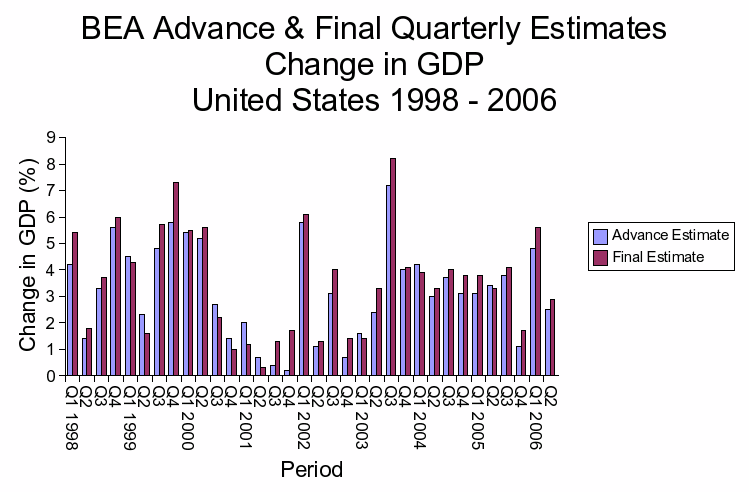
Second quarter GDP growth was revised upward last week to 2.9% from 2.5%. At nearly three percent, that's pretty respectable growth. It was yet another upward revision and it left me wondering just how often GDP growth estimates are revised upwards and how often they're revised downwards. So I decided to do a bit of investigation.

The BEA (Bureau of Economic Analysis) releases three estimates of GDP growth for each quarter. The "advance" estimate comes out toward the end of the first month after the quarter, the "preliminary" estimate comes out toward the end of the second month after the quarter, and the "final" estimate comes out toward the end of the third month after the quarter. Each estimate incorporates additional information as it becomes available and, in theory, should be more accurate.

When comparing the advance estimate to the final estimate, one might think that the difference between the two estimates would be more or less randomly distributed. In particular, one might think that about half of the time the advance estimate would be higher than the final estimate and the other half of the time the final estimate would be higher and that the averages of the estimates would be about the same.


But, as the graph above shows (click to enlarge), that's not the case. In the last 34 periods, the advance estimate has been lower than the final estimate 25 times, while being higher only 9 times. The advance estimate average is approximately 11.3% below the average of the final estimates which represents a delta of 0.34% of GDP. While I haven't run any formal statistical tests on these data, I'm very confident that the delta between the averages and the discrepency between the number of upward and downward revisions is statistically significant given the sample size.

So the BEA's advanced estimate is usually too low. This is apparently built into the formulae used by the BEA to calculate these estimates. I'm sure they follow their methodology consistently and rigidly each and every quarter and that's certainly their job.

But there are a couple things that are interesting here (I'm sure you were hoping something in this rather dry analysis would be interesting). The first is that when you read an article containing an advance estimate, adding 0.34 to it will give you a better estimate approximately 74% of the time (25/34). The BEA could do this same calculation to enhance their estimates, but consistency in the method of calculating the estimate is more important than accuracy. It's easy enough for us to take their estimate and modify it accordingly to make it more accurate.

The second thing of interest to me is that the consistent underestimates coupled with the estimate reporting calendar gives the NY Times and other liberal media yet another opportunity to describe the economy as weakening. Each time the advance estimate comes out, they can compare it to the final estimate for the previous quarter. Because the advance estimate is lower than it should be, on the surface it always looks like the economy is starting to soften more than it actually is (by 0.34% of GDP). So the next time you see a statement in the NY Times that comes out just after the advance estimate becomes available which claims that the economy is starting to soften or that the economy is losing steam, and their evidence for this claim is based on a comparison of the advance estimate and the previous quarter's final estimate, you should probably heavily discount that.

Tuesday, September 05, 2006

Who's Getting Richer

There's been a flurry of activity lately on the topic of the income disparity between the rich and the poor. It was started by a New York Times article titled "Real Wages Fail to Match a Rise in Productivity" which basically argues that wages for most people have stagnated for many years, even decades. This article sparked heavy debate between socialist and free market economists and pundits. I tend to line up pretty closely with the free market crowd and their analysis is pretty comprehensive. Here are some excerpts:

In TCSDaily, David Henderson argues that wage statistics don't mean squat and that people are better off regardless of what the wage statistics tell us:
Take home ownership. In the first quarter of 1965, the first date I could find quickly, 62.9 percent of American households owned their homes. That was during Meyerson's golden era. In the second quarter of this year, the "dead middle-class era," it was 68.7 percent, an all-time high. Cars? What's relevant, as with homeownership, is the percent of the population that owns cars. And this has boomed. In 1970, presumably near the peak of Meyerson's golden era, there were 108.4 million vehicles registered in the United States; by 2003, this had soared to 231.4 million, an increase of 113.5 percent, while the population had risen by only 42.4 percent. And note that Meyerson doesn't even mention air travel, which, due to deregulation and technological improvement, has become so much cheaper that even poor Americans, let alone middle-class ones, can now afford to fly. How about college? In 1970, only 10.7 percent of the population 25 years old or more had a college degree; by 2004, this was up to an all-time high of 27.7 percent.
Nicholas Eberstadt argues in the Washington Post that income is meaningless - the measure to focus on is spending:
Among low-income households in the United States, the gap between reported income and reported spending has widened gradually since the 1960s and now has taken on chasm-like dimensions. In the early 1960s, the poorest quarter of U.S. households spent 12 percent more than their annual incomes. In 1973, spending by America's poorest fifth surpassed their income by almost 40 percent. And in 2004, spending by the poorest fifth of American families exceeded income by a whopping 95 percent; in effect, spending was nearly twice as much as income.
Don Boudreaux at Cafe Hayek poses a thought experiment:
But I ask: would you prefer to live in 1967 with today’s real median household income ($46,326) or live today with 1967’s real median household income ($35,379)? (These figures are expressed in 2005 dollars, by the way.)

He answers his own question:

Given these two options, I’d choose to live today with only 1967’s real median household income. The reason is that the economy today offers so very many more options than did the economy in 1967 – or even the economy of that halcyon year, 1973. Today I can buy cell-phone service; today I can buy cable television with hundreds of channels, including ones that specialize in sports, cooking, history, and science; today even the cheapest automobiles are safer and more reliable than were the finest cars for sale in 1967; today I can buy telephone answering machines (with caller-ID), microwave ovens, CDs, personal computers, Internet service, and MP3 players. Today I can watch movies in my own home – in color – whenever I want without having to wait for one of the three or four available television stations to telecast a movie for viewing on a black-and-white television...
And Don continues on and on and on with all things new and improved.

Other factors that mitigate the wage statistics include general measurement errors. For example, many economists think inflation is overstated by over one percent per year. If so, wages and compensation increases since 1960 are actually pretty impressive.

But the other side does have a couple of good points. First, the value of wages is subjective. It's my observation, that for some people, the value to them of everything while living under leadership of the Democrats is much higher than the value of everything while living under Republican leadership. Thus, considering Professor Boudreaux's thought experiment above, they would subjectively (and rationally) choose the today's median income in 1967, when the drugs were good and the love was flowin'. I suspect this description happens to at least partly describe many NY Times readers, so they really are worse off now - since there is no "objective" economic sense, only their subjective perceptions.

Also, even to me, all other things being equal (including GDP per capita, GDP growth, etc.), I would prefer a system that was more egalitarian. I personally wouldn't put that preference ahead of GDP per capita growth, and since I don't personally believe that we could have a more egalitarian system and maintain the current rate of growth, I'm willing to let the egalitarian preference slide. But to many people, they would simply rather be poorer (and even have the poor be poorer in the future) and have a more egalitarian system. Once again, the value of everything to them under such a system would be higher and it would make up for lower wealth and income.

Both of these last two concepts draw heavily from an emotional, intuitive point of view, but that's not to say they aren't valid. They're certainly, in my opinion, valid enough to act on (or vote on). Trying to show why they're rational is a little tougher. Economist Brad DeLong tries by positing:

I'm enough of a touchy-feely sociology-lover to believe that a good chunk of the utility the rich derive from their conspicuous consumption is transferred to them from the poor.

In other words, the rich can put on their diamonds and look down their noses at the poor while feeling superior and "a good chunk" of the value of being rich comes from that. This implies that it's hardly worthwhile being rich if you can't do that. I find this a little tough to believe. But let's assume that it's true. If one is a utilitarian (one who wants to maximize overall utility of the economy to society), it may turn into an argument to try and increase the disparity between rich and poor. After all, the rich now have additional utility for their wealth (the feeling of superiority), yet this extra utility doesn't cost the non-rich anything at all! In other words, not being rich, it doesn't cost me anything for the rich to feel superior to me - all the more power to them as far as I'm concerned. I'm not worse off because of it.

Yet I have a hunch status does have something to do with DeLong's statement. Let's say there were no rich and therefore status had nothing to do with wealth. Then people would derive status from other traits: beauty, strength, height, intelligence, and job, to name a few. Brad DeLong, though short on beauty, strength, and height (relative to girth), would still get a bigger share of status from his exclusive job as an economics professor at UC Berkeley and the supposed intelligence that got him that position.

So it's interesting that in the zero sum gain of status, many of those belaboring income inequality and trying to increase the taxes on the rich have the most to gain.

Friday, September 01, 2006

Climate Change Problems Endured

Paco, a commenter on Tim Blair's blog, is having a rough time with climate change!
Climate chaos; tell me about it! I was shoveling snow from around the saguaro cactus in front of my home in Richmond, VA, and as soon as I finished, a fissure opened in the earth and a steam geyser sprayed hot water all over the place. All that work for nothing! If it hadn’t been for the fact that torrential rains had created so much humidity that the doors to the gun cabinet had swollen shut, I probably would have shot myself. Instead, I just chilled a few beers in the frozen goldfish pond, grilled some burgers over the creek full of magma that flows by the back fence, and settled down to enjoy the bright green sunset.
He must've been watching too many of those climate disaster movies!