Search This Blog

Thursday, April 20, 2006

Tax Cuts and Revenue Gains

A tax rate cut was enacted in the United States in 2003, yet tax revenues from capital gains were better than predicted. Many supply siders and Laffer curve enthusiasts are loving it. For example, Don Luskin wrote in the National Review:
[I]nstead of costing the government $27 billion in revenues, the tax cuts actually earned the government $26 billion extra.

CBO's estimate of the "cost" of the tax cut was virtually 180 degrees wrong. The Laffer curve lives!

Unfortunately, while the numbers Don refers to are correct, his analysis has some serious problems.

Don't get me wrong, I'd love it if Don's analysis was correct. I'm all for low tax rates because in the long run, due to the increased economic growth that coincides with lower taxes, everybody will be better off, rich and poor alike. Even the government will have more to spend in absolute terms.

There are several things in Don's analysis that have problems, but in this post I will focus on the biggest, yet simplest, problem: you can't compare predicted revenues with later actual revenues unless you have a high degree of confidence that the predictions are accurate. That simply isn't true for CBO predictions of revenues from taxes on capital gains.

First of all, the CBO knows that it has a terrible record predicting such revenues. On page 56 of "THE BUDGET AND ECONOMIC OUTLOOK: FISCAL YEARS 2001-2010" the CBO states:
Capital gains realizations, which are often considered relevant to the accuracy of forecasts, are notoriously difficult to predict. They constitute a relatively small percentage of individual tax receipts, however, and errors in forecasting them are unlikely to play a large role in errors in revenue forecasts.
In other words, they know that they're very bad at predicting capital gains revenues and they're not going to try to improve. And true to form, the CBO's predictions have been truly terrible. As and example, the following table shows the CBO's prediction of capital gains liabilities for 2001 through 2005 and the actual revenues:
Year   Predicted   Actual
-------------------------
2001: 129 61
2002: 95 47
2003: 54 47
2004: 46 71
2005: 58 81
The estimate for the predicted revenues was reported at the beginning of the year. The actual revenues were reported two years after that to allow the dust to settle, except for 2005 which was reported at the beginning of 2006. As you can see, being off by a factor of two is par for the course.

Therefore, you can assign very little meaning to the fact that revenues after the tax rate cuts were higher than predicted by the CBO.

Saturday, April 15, 2006

The Invisible Heart

I just finished reading The Invisible Heart: An Economic Romance by Russ Roberts, an economist at GMU and blogger at Cafe Hayek. I'm now reading it to my 9 year old daughter who has definitely enjoyed the first three chapters and I have to heartily recommend the book for the purpose of introducing children to libertarian economics. It's an easy read, with lots of examples of economic issues. It's remarkably humerous given the subject matter, so it keeps the attention of those who generally fall asleep at the mere mention of economics. The plot has an interesting and surprising twist. The romance part is a little lame, but at least it's not steamy, so I can read it to my daughter without any worries.

All in all, I consider this obscure little book a real gem, especially for those who want to introduce younger folk to economics.

Sunday, April 09, 2006

Being There: Part II

Being There was a movie starring Peter Sellers:
"Adapted by Jerzy Kozinsky from his own novel, the movie's about a simple-minded, middle-aged gardener who, after a lifetime of seclusion and safety in a Washington, D.C. townhouse, gets his first exposure to reality beyond the walls of his sheltered existence. His only reference to the world is through his childlike addiction to television, and when a chance encounter brings him into the inner fold of a dying billionaire (Melvyn Douglas), he suddenly finds himself the toast of Washington's political elite. His simple phrases about gardening are misinterpreted as anything from economic predictions to sage political advice..."
I'm watching a version of "Being There" play out right before my very eyes. I have a friend, Francine Busby, who is running for Congress as a Democrat in a heavily Republican district. She also ran during the 2004 elections and got less than 40% of the vote. Indeed, for the last election, it was so certain that the incumbent, Randy "Duke" Cunningham, would win the election, that pretty much anybody could get the democratic nomination, so it was Francine's for the asking. Francine has limited political experience (her only experience is that she sits on a school board), but it didn't matter since she (or any other Democrat) was going to lose anyway.

Duke Cunningham is now in jail for soliciting and accepting $2.4 million in bribes from Defense Contractors. There is a special election Tuesday to fill his empty seat in the house of representatives. Since Francine was the Democratic candidate in 2004, the Democratic party has decided to stick with her. Indeed, they've sent the best campaign managers and strategists, she's been able to raise more than $1 million for this election, and volunteers from all over the country are working around the clock for her campaign. She's running against 16 Republican candidates. The top vote getter from each party will progress to a second election in June. However, if someone gets more than 50% of the vote on Tuesday, they will immediately be installed as the representative for California's 50th district, and the June election will be cancelled.

The Republican party assumed that there was no way Francine would have a chance at 50%. As a result, until last week, they were happy to let the 16 Republican candidates "Duke" it out (so to speak), and have put no money or organizational support into this election. And it's too late now.

So last week, a poll came out showing Francine getting over 50% of the vote. The Republican party freaked and starting putting out attack ads. But the ads, put out by the national organization which doesn't understand our local politics, have generally helped Francine. For example, one ad claimed that Francine had taken money from "Defense Contractors" just like Duke Cunningham. They even listed some names of those people who worked for "Defense Contractors" that had donated to Francine's campaign.

One of those people is Irwin Jacobs. Irwin Jacobs is a highly respected and well liked person in San Diego. The companies that he's founded, including Qualcomm, have provided tens of thousands of excellent high-tech jobs here in San Diego. He has donated tens of millions of dollars to many charitable causes such as the San Diego Symphony. You couldn't get a better endorsement that having Irwin Jacobs support you. So one of the stupidest things the Republican could have done is to point out that Irwin Jacobs supports Francine. And that's exactly what they did. Most of their other attack ads weren't thought out all that well either.

If Francine wins on Tuesday, her luck will have been phenomenal every step of the way, from Duke being thrown in jail to incredibly incompetent attack ads by the Republicans. It's remarkably like the gardiner's luck in "Being There."

Saturday, April 08, 2006

Wretchard Goes Gloomy

I rarely write about our involvement in Iraq. It's not that I don't think that it's important, it's just that I readily acknowledge that I have nowhere near enough data and understanding to do any sort of analysis or recommendations. I thought it was a bad idea to invade Iraq before we started, but here we are, and, like most other people, I'm mostly along for the ride.

I've noticed a tremendous range in assessments of the various events in Iraq. One one hand, you have the military gung-ho types like Austin Bay, Ralph Peters of the New York Post, and Victor Davis Hanson of the Hoover Institution. On the other hand, there's the more negative reporting and analysis by the New York Times and several other mainstream newspapers and magazines. There's also even more extreme opinion on both sides, but I won't even go there.

We're either doing swimmingly well or civilization in Iraq and around the world is about to collapse, depending on who you read. When confronted with a situation like this one, where there is clearly huge uncertainty, I look at the predictions and analysis of the various media and then remember those predictions and see how well they hold up as more data becomes available.

Nobody has anywhere near a perfect score. But when I look across all of the media and pundits, one has really stood out in being more accurate than the rest in his predictions and analysis: a writer who goes by the pseudonym of "Wretchard the Cat" at the The Belmont Club. I think his track record has been quite impressive.

Wretchard has been generally more positive about our involvement in Iraq and the war on terror than most of the media sources but has recently "gone gloomy" and that has me worried. His commenters pointed this out and here is his response:

I'm somewhat bemused by reports that Wretchard has gone "gloomy". I think it's important not to understate what the Coalition has achieved so far. It's been historic and probably unprecedented. But it's also important never to underrate the difficulties and to describe them as accurately as possible. Analysis should be persuasive on the basis of facts and reasoning and not on emotions.

Some time back there was a shift from the "insurgency" theme to the "civil war" theme. All the old names -- remember Fallujah? Tal Afar? Mosul? -- have gone to page 2. My guess is that we have gone into a new kind of game or endgame. It's important to recognize this. For some people it's always 2004 and everything is an undifferentiated soup, without phases and without developments. It's important to look at the new situation closely precisely because Act I may have ended and Act II Scene I about to begin.

And also:
A realistic assessment should include what has already been gained and what is left to gain. Some people think the Belmont Club is guilty of unwonted optimism simply because it is willing to accept what Zarqawi has practically admitted: that the Sunni insurgency is militarily beaten -- and that the struggle for the political outcome is now underway. And some readers may believe that I've gone all "gloomy" because I think the political outcome still hangs in the balance. But that is nothing more than stating a fact.
A rather unfortunate fact if it can't be made to work. It's certainly been a lot of effort wasted if we can't succeed in the final step of creating a workable political system in Iraq. Nonetheless, I'm not anywhere near thinking we should bail. We simply owe continuing support to the Iraqis, without which, the odds of civil war escalate. We shouldn't leave until it's clear that most of them want us too. David Ignatius of the Washington Post summarized my sentiments when he wrote:
As Prince Turki al-Faisal, the Saudi ambassador to Washington, remarked this week: "America came to Iraq uninvited. You should not leave uninvited."

Tuesday, March 28, 2006

Doesn't even know what he doesn't know

Running true to form, Al Gore has a column in today's WSJ pointing the way to earthly redemption. Mr. Gore does understand that there are such things as "externalities", but beyond that there are some flawed assumptions about how the world works. Pete Du Pont has a different take. Over at Econopundit, Steve Antler deals with the matter by showing more restraint than I would. He juxstaposes excerpts with his own comments.

Capitalism and sustainability are deeply and increasingly interrelated. After all, our economic activity is based on the use of natural and human resources. Not until we more broadly "price in" the external costs of investment decisions across all sectors will we have a sustainable economy and society.

The crux of the argument is right here. Capitalism can't bring you "sustainability" but heroic social engineers like Al Gore can. The problem is in that word "sustainability." It's religion.


Externalities are costs created by industry but paid for by society. For example, pollution is an externality which is sometimes taxed by government in order to make the entity responsible "internalize" the full costs of production. Over the past century, companies have been rewarded financially for maximizing externalities in order to minimize costs.

No, externalities are costs paid for by someone else -- not always by "society as a whole." Companies often shift costs onto other companies. The earliest examples using the Coase theorem had to do with upstream businesses issuing effluents which raised the costs of downstream water-using businesses.

Only the doctrinaire public service technocrat sees all costs of pollution borne by the "public" and all benefits borne by the business community. This is a kind of class analysis most modern economists no longer accept.

There's plenty more to see over at Econopundit. If Mr. Gore could set aside his beliefs long enough to study three books: The Fatal Conceit, The Bottomless Well and The Singularity is Near, he might relax. But it's not going to happen. As we go racing towards the singularity, more energy options will be available and sustainability will be a natural outgrowth of our freedom to innovate and adapt!

Saturday, March 25, 2006

Work and Retirement

People are living longer. Life expectancy has been creeping up over the last couple of decades, but with upcoming technology, I'm confident that a life expectancy of 100 will be achieved in my children's lifetime (i.e. they'll likely live to 100).

On the other hand, people seem to be retiring earlier and earlier. Many of my cohorts are planning on retiring in their fifties. Others, who've had financial strains such as divorce or a failed company, are lamenting that they might, worst case, actually have to work into their 60s. On current trends, I can see the expected retirement age creeping down to 50.

On the third hand (I must be an octopus), we seem to be taking longer to enter the work force, mostly for good reason. It can take ten years or longer to get a Ph.D. in some fields. We seem to need ever more lawyers and managers with MBAs. Healthcare is becoming an ever larger percentage of our GDP and it takes forever to become a doctor. At the present rate, the average age of entering the work force might be as high as 25.

I've just painted a picture where, on average, people enter the work force at 25, leave at 50, and live to 100. This implies (making the somewhat erroneous assumption of a flat age distribution) that there will be one worker for every four people.

This scenario, regardless of how it is financed, is a far, far less well off scenario than one where 3 out of 4 people work, which would be the case if everybody in the picture above worked till they died. It doesn't matter if everyone saves huge percentages of their income in order to prepare for their retirement years. In that case, there would be a large number of dollars chasing the few goods and services that can be produced by the one out of four people working. It doesn't matter if the government somehow extracts huge taxes out of the workers to pay for the retirees (and children). The total pie to be consumed would be much smaller than it would be if we all work for a larger percentage of our lives.

Thus, when pundits pontificate about fixing social security and other retirement entitlements, I can't even start to take it seriously unless it provides an incentive for people to work longer. A society in which people are retired for 20 or 50 years of their adult life is a poor society complete with a great deal of intergenerational resentment. It's simply unworkable in my opinion. And that's without even taking into account that as I've been watching people retire, I've noticed that they seem to go down hill much faster after retirement. I think that retirement is unhealthy for most people.

That's why a new book (or more accurately the description of said new book since it hasn't been released yet) by Charles Murray, the at least partially evil genius (in my opinion) author of the Bell Curve, caught my eye. In "In Our Hands", Murray proposes tossing social security (and the other entitlement benefits such as medicare) out the window and replacing them with a $10,000 stipend to every adult over 21:

The one I have devised--I call it simply "the Plan" for want of a catchier label--makes a $10,000 annual grant to all American citizens who are not incarcerated, beginning at age 21, of which $3,000 a year must be used for health care. Everyone gets a monthly check, deposited electronically to a bank account. If we implemented the Plan tomorrow, it would cost about $355 billion more than the current system. The projected costs of the Plan cross the projected costs of the current system in 2011. By 2020, the Plan would cost about half a trillion dollars less per year than conservative projections of the cost of the current system. By 2028, that difference would be a trillion dollars per year.

Many questions must be asked of a system that substitutes a direct cash grant for the current welfare state. Work disincentives, the comparative risks of market-based solutions versus government guarantees, transition costs, tradeoffs in health coverage, implications for the tax system, and effects on people too young to qualify for the grant, all require attention in deciding whether the Plan is feasible and desirable. I think all of the questions have answers, but they are not one-liners; I lay them out in my book.

Assuming that the questions really do have answers that aren't too evil, the single solution that "the Plan" offers that I think is absolutely critical is that it eliminates the concept of a retirement age, or a specific point at which retirement benefits begin. It would enable people to decide when to retire based on the proposed stipend and its current value in the market.

This would provide an automatic feedback mechanism. If too many people decided to retire too early, the goods and services that $10,000 could buy would drop and this would encourage people to keep working. This self regulating mechanism would reduce the likelihood of situations where there are too many people who aren't working. In other words, it's a solution that could work for the long haul, and it can continuously adapt as technology and society changes.

Saturday, March 18, 2006

Investment Surplus

The United States trade deficit is one of those statistics that economic doomsayers like to latch onto. When people start talking about the trade deficit, I often point out that a trade deficit is the same thing as an investment surplus. Usually people ignore my little quip. However, someone recently requested that I explain the term investment surplus to them. I've been patiently waiting for a clear and simple explanation to materialize in the blogosphere, but it's been a while, and I haven't found what I'm looking for. To be sure, I've seen many postings using and even defining investment surplus, but I've found them a little more complicated than what I want, so I've decided to roll my own explanation.

The starting point I've chosen is a simple transaction proposed by Don Boudreaux in a recent article:
My next-door neighbor in Virginia agrees to mow my lawn for $25. He mows and I immediately give him $25 in greenbacks. Rather than spend his earnings on beer or a back massage, my neighbor uses the $25 to by a share of Microsoft.
This transaction is the epitome of a positive economic transaction. There was a need and a service was provided by the neighbor (let's call him Joe) to meet that need. Trade and investment ensued. Great!

The only possible downside is that Don is $25 poorer. Indeed, you might ask why lazy ol' Don didn't mow his own damn lawn. For now, assume that as Chairman of the Department of Economics at George Mason University, Don is able to consult at $250 per hour, and assume that he consulted for the hour that he would have otherwise spent mowing the lawn. In this case, he too is better off and the entire transaction is nothing but positive (assuming his clients got their money's worth).

Note that it doesn't matter much if Joe buys a share of stock or loans money to a business (probably via depositing the money in a bank). He's providing capital for others to use and for that he will get a return on his investment.

So far, the entire transaction was within the United States. But now, let's assume Don lives in San Diego and his neighbor, Jose, lives in Tijuana, Mexico. Now, all of the sudden, this very positive transaction adds $25 to the trade deficit and $25 to the investment surplus of the United States. Notice that a trade deficit can only happen in conjunction with an investment surplus. If Jose, or whoever ultimately ends up with the 25 US dollars, spends them on an American product or service, there's no net trade deficit and no net investment surplus. You can't have one without the other.

Is Don's purchase now a bad thing instead of a positive transaction just because the service provider's name is Jose instead of Joe? Is the United States somehow damaged by this trade? It's really not obvious that any damage is done. Certainly, the direct effects are only positive whether the transaction occurs across borders or completely within the borders of the United States. Everybody involved in this transaction is better off afterwards, and nobody else is worse off.

But there are some secondary effects that aren't necessarily positive and I think they can potentially be noticeable if the investment surplus is large enough. One potentially negative effect is lowered returns to investors in the United States. This can be seen in the very low real interest rates that businesses in the United States (and the government) pay when borrowing money. Since every Tomeo, Dedrick and Hari in the world are falling over each other to invest in and/or lend money to entities in the United States, this drives the cost of money way down for users of capital here. That's fantastic for those needing capital. They can buy and deploy more capital equipment, expand their businesses, hire more people, and sell more product at lower cost. It's also fantastic for keeping unemployment low and for minimizing consumers' expenses.

But investors and lenders (which is anyone with a bank account) within the United States can't get as high a real return on their investments and savings because there is so much foreign competition for those investments. For example, have you checked the interest rate on your checking account lately? Why bother with interest checking anymore?

All of the above effects help the poor and hurt the rich. Lenders are disadvantaged, but business can expand more easily and pay higher salaries to their employees, some of which are low wage earners. Egalitarians should love investment surpluses, no matter how large they are.

Many pundits also lament about the low savings rate in the United States. While I think savings/investment is actually okay, I think that one of the reasons that it isn't higher is because of the large investment surpluses were experiencing. Investment surpluses make dollars valuable. Valuable dollars make foreign products relatively inexpensive and that makes it more enticing to buy such products.

But there's a second reason investment surpluses increase domestic consumption. Let's consider an example. Let's say you have $5,000 in your pocket and you're on the way to the store to buy a large HDTV. On the way, you run into a friend and he wants to borrow that $5,000 for one month. Let's say you have complete confidence that he will pay it back. If he offers to pay you back the $5,000 principal plus $5,000 in interest for one month, I'd bet you'd take the deal. In other words, you would forego current consumption for savings (at least for a month). But instead of $5,000 in interest, let's say he only offered $50 in interest (which would still be a pretty good interest rate). Would you still loan him the money? It would certainly be less likely. I suspect you'd just stick with your original plan and go buy the HDTV.

The effects on returns of the investment surplus obviously aren't as extreme as in the above example, but the point is that the choice between consuming and saving is affected by the rate of return that's expected (adjusted for risk) if the choice is made to save, and the rate of return is affected by the size of the investment surplus. The bigger the investment surplus, the lower the rate of return and the more likely we are to consume instead of save.

This begs the question of why people in other countries are so much more keen to invest here than we are. Many pundits jump to the conclusion that it must be because everybody else is smarter, more disciplined, more future oriented, etc. than stupid, undisciplined, short term oriented, etc. Americans. I can't prove that explanation wrong, but I'd like to put forth a couple of alternate explanations for why it might objectively be a better deal for certain classes of foreigners to invest here than it is for us.

The most obvious explanation is that the dollar is a low risk haven for assets. The United States has a unique combination of stability, prosperity, and opportunity that can't be found anywhere else. For foreigners, this unique combination also represents a diversification. Their main economic potential exists in the country in which they reside because that's where they work. Investing assets in the United States provides a low risk diversification against downturns in their local economic fortunes. Unfortunately, it's asymmetric. If things go poorly in the United States, its citizenry will lose their jobs as they watch their domestic stock and real estate portfolios crash at the same time. But investing outside the United States entails even higher risk. Thus the consumption versus savings calculation is decidedly different for foreigners versus people living in the United States.

The real per capita GDP growth in the United States is quite good for a developed country. Since wages and income correlate with GDP over the long haul, wage growth will also likely be good. What that means is that, on average, we'll all have substantially higher income in the coming decades. If we compare that with countries with low economic growth, we'll have relatively more money to invest in the future than those from other countries. This also objectively tips the balance for us away from savings and investment and towards consumption relative to those in low growth countries.

In summary, a trade deficit is the same thing as an investment surplus, the direct effects from an investment surplus are all positive, some indirect effects are potentially negative, and there are objectively rational explanations for why foreigners are more interested in investing in the United States than we are. Investment surplus sounds oh so much better than trade deficit, and since it's net positive, I prefer using the term investment surplus.

Friday, March 10, 2006

Memetic Warfare

Being rather fond of the benefits of civilization and having an interest in maintaining a free and pluralistic society, I thought this post over at the Armed and Dangerous blog was worthwhile. It is rather remarkable how quickly some people condemn American society for not being perfect while ignoring our history of improvement and the even more flawed alternatives.

Here are some excerpts:

Americans have never really understood ideological warfare. Our gut-level assumption is that everybody in the world really wants the same comfortable material success we have. We use “extremist” as a negative epithetic. Even the few fanatics and revolutionary idealists we have, whatever their political flavor, expect everybody else to behave like a bourgeois.

By contrast, ideological and memetic warfare has been a favored tactic for all of America’s three great adversaries of the last hundred years — Nazis, Communists, and Islamists. All three put substantial effort into cultivating American proxies to influence U.S. domestic policy and foreign policy in favorable directions.

But it was the Soviet Union, in its day, that was the master of this game. They made dezinformatsiya (disinformation) a central weapon of their war against “the main adversary”, the U.S. They conducted memetic subversion against the U.S. on many levels at a scale that is only now becoming clear as historians burrow through their archives and ex-KGB officers sell their memoirs.

In a previous post on Suicidalism, I identified some of the most important of the Soviet Union’s memetic weapons.

As I previously observed, if you trace any of these back far enough, you’ll find a Stalinist intellectual at the bottom.

Indeed, the index of Soviet success is that most of us no longer think of these memes as Communist propaganda. It takes a significant amount of digging and rethinking and remembering, even for a lifelong anti-Communist like myself, to realize that there was a time (within the lifetime of my parents) when all of these ideas would have seemed alien, absurd, and repulsive to most people — at best, the beliefs of a nutty left-wing fringe, and at worst instruments of deliberate subversion intended to destroy the American way of life.

Call it what you will — various other commentators have favored ‘volk-Marxism’ or ‘postmodern leftism’. I’ve called it suicidalism. It was designed to paralyze the West against one enemy, but it’s now being used against us by another. It is no accident that Osama bin Laden so often sounds like he’s reading from back issues of Z magazine, and no accident that both constantly echo the hoariest old cliches of Soviet propaganda in the 1930s and ’40s.

The first step to recovery is understanding the problem. Knowing that suicidalist memes were launched at us as war weapons by the espionage apparatus of the most evil despotism in human history is in itself liberating. Liberating, too, it is to realize that the Noam Chomskys and Michael Moores and Robert Fisks of the world (and their thousands of lesser imitators in faculty lounges everywhere) are not brave transgressive forward-thinkers but pathetic memebots running the program of a dead tyrant.

Again, this is by design. Lenin and Stalin wanted classical-liberal individualism replaced with something less able to resist totalitarianism, not more. Volk-Marxist fantasy and postmodern nihilism served their purposes; the emergence of an adhesive counter-ideology would not have. Thus, the Chomskys and Moores and Fisks are running a program carefully designed to dead-end at nothing.

Religions are good at filling that kind of nothing. Accordingly, if transnational progressivism actually succeeds in smothering liberal individualism, its reward will be to be put to the sword by some flavor of jihadi. Whether the eventual winners are Muslims or Mormons, the future is not going to look like the fuzzy multicultural ecotopia of modern left fantasy. The death of that dream is being written in European banlieus by angry Muslim youths under the light of burning cars.


In the banlieus and elsewhere, Islamist pressure makes it certain that sooner or later the West is going to vomit Stalin’s memes out of its body politic. The worst way would be through a reflex development of Western absolutism — Christian chauvinism, nativism and militarism melding into something like Francoite fascism. The self-panicking leftists who think they see that in today’s Republicans are comically wrong (as witnessed by the fact that they aren’t being systematically jailed and executed), but it is quite a plausible future for the demographically-collapsing nations of Europe.

The author actually offers a somewhat optimistic view of the future. All in all, quite a series of thoughts and observations!

Wednesday, March 08, 2006

Kudlow Konfused?

Larry Kudlow (of Kudlow & Company fame), in talking about recent news regarding the Iran nuclear threat and the world's response to it, makes the following statement on his blog:
"As for the market’s reaction to all this stuff, you really don’t see it reflected yet in oil prices..."
I find this statement mind boggling coming from an economist like Mr. Kudlow, especially since his commentary is usually so logical and non-controversial (from a mainstream economics perspective). I have no idea why he thinks that this one time the market has chosen to ignore important information (weighted by the probability of those events happening). Especially since it looks to me like the price of oil already has a substantial probability of a significant disruption already priced in. For example, today, according to Reuters:
"U.S. commercial crude supplies shot to the highest level in nearly seven years last week on sluggish refinery use and high imports, the government said on Wednesday. [...]

In May 1999, the last time supplies were as high, oil futures were less than $17 a barrel."
In other words, the natural price level given current supply without the threat of impending disruptions is potentially far below the current price levels (probably not $17, but $35 per barrel is certainly possible). The Iran thing is nothing new and the market had previously incorporated this information in the price.

Monday, March 06, 2006

Pontifications on the Extended Order - Part 2: The Geometry of War and Peace

In Part 1 of this series, I concluded by stating that I was "going to start the narrative regarding the evolution of the extended order based on the belief that the starting point was a bunch of violent primitive tribes frequently at war." Part of the reason I'm developing this series is to write my own creation myth. Since I wasn't there, I obviously don't know that humankind started as "a bunch of violent primitive tribes," rather I simply believe that based on my interpretation of what I've studied combined with my internal view of human nature. Even if you don't believe as I do, I'm hoping for two things. First, that you at least can understand why I've arrived at my conclusion and belief and second, that you have the imaginative capacity to start with my previous conclusion as a premise for this next installment. That would allow us to end with radically different views, while enabling you to follow the logic of my creation myth.

I'm going to introduce the subtopic of geometry that I want to consider with some useless (but somewhat interesting) trivia. Did you know that one of the biggest problems for blue whales is their tendency to overheat, even in frigid arctic waters? As Roger Payne wrote for PBS:
The requirement of being warm blooded would seem to make it impossible for a mammal to reach and harvest krill in polar seas-since those krill are living in an impregnable fortress: ice water, at the ends of the earth, where staying warm while immersed is simply not feasible for a warm-blooded mammal.

Or is it?

Simply by being large an animal like a whale can take advantage of a simple but little-appreciated fact: the fact that the larger an animal's body, the smaller is its surface area in relation to the volume of that body. The reason this is important is that the volume of any animal's body is its furnace-the place where its metabolism generates heat, while the surfaces of its trunk, head, and limbs are its radiators, the things through which heat is lost. Tiny mammals, like mice, have relatively huge surfaces for their small volumes; which means that they have small furnaces and large radiators and therefore have to produce lots of heat to keep from cooling down. But large animals have relatively small surfaces for their large volumes-they have a large furnace and small radiators. That means that their problem is not losing heat but keeping from overheating-particularly when they exercise. Contrary to popular belief, blubber is not principally for keeping warm but for fuel storage.
For a 3 dimensional entity, surface area increases in proportion to the square of the increase in the length of the entity, volume increases with the cube of the length, and the ratio of volume over surface area increases linearly with the length. Considering the whale versus mouse comparison, a blue whale is about 200 times as long as a mouse. Thus, we would predict that a blue whale would weigh 2003 or 8,000,000 times as much as a mouse, have surface area 2002 or 40,000 times greater than a mouse, and have a volume to surface area of 200 times as big as a mouse. Given that a mouse weighs about 25 grams and a blue whale weighs about 150 tons, this gives a weight ratio of 5,376,000 to 1 which is pretty close to our prediction of 8,000,000 to 1. I'll bet you never knew that it takes over 5 million mice to balance one blue whale. There are only around 2,000 blue whales left on the planet, but those 2,000 whales have the equivalent weight and volume of over 10 billion mice. 2,000 whales are potentially endangered, while 10 billion mice are not.

The same sort of principle applies to large office space. For example, prior to its demise, the World Trade Center in New York was so large and therefore had such a high volume to surface area ratio, that it required the world's largest refrigeration plant, "with 60,000 tons of cooling capacity," to keep it cool, and the refrigeration capacity was utilized throughout the brutal New York winter (even worse than Afghanistan winters, turns out). Every light bulb, every person, every computer, every robot (well, not many robots) generated heat, and the exterior surface area wasn't enough to dissipate all that heat without help from the cooling plant.

Just as a 3 dimensional entity's surface encloses even more volume as it gets bigger, a 2 dimensional entity's perimeter encloses an even larger area as it expands. The formula here is that the area increases in proportion to the square of the increase in the perimeter. Also, the exact shape doesn't matter. The relationship holds for any convex shape.

At a given level of technology, there are a maximum number of people that can survive in a given isolated area. That population density, especially for a primitive people, is basically limited by the quantity of food that can be gathered and/or grown. Also for a primitive people (and maybe not so primitive), the population tends to expand to take advantage of the available food supply. The bigger the area, the greater the amount of available food, and therefore the greater the number of people. In other words, the number of people that can be supported is proportional to the area they live in.

A tribe has to be able to defend the area that they live in from other tribes that would like to slaughter them and take over their food supply. The defense happens at the (fairly fluid) border between the two tribes, along the perimeter. Assume each tribe is surrounded by other tribes. Then each tribe has to defend its entire perimeter. I realize that this is hugely oversimplified and ignores all sorts of military tactics and assumes a pre-aviation world, but I think the basic idea holds.

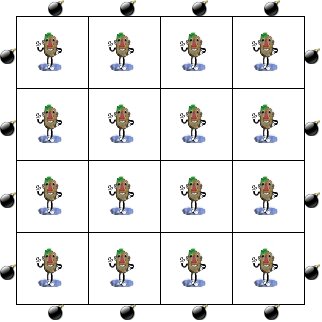
As an example, consider the very friendly and hypothetical Tuber Tribe (so named because the only somewhat anthropomorphic image I could find laying around on my computer is the potato person in the figure below).

Each tuber Tom requires one square of area of land to support himself. A Tuber Tribe of four requires four squares.

But the Tuber Tribe also needs to defend itself. In order to keep their area and the associated resources (i.e. food), the eight positions marked by bombs have to be defended from attacks by the surrounding tribes. In this case, only four tuber Toms have to defend eight positions.

A second Tuber Tribe has 16 members with the corresponding increase in area. It has four times as many members, but the perimeter only doubled. The 16 tuber Toms need to defend 16 perimeter positions. This is a one-to-one ratio instead of the inferior one-to-two ratio shown above.

In a nation of 1,000,000 tubers, there would be only 4,000 perimeter positions to defend. In this case 99.6% of the tuber Toms would not be needed for defense and could be employed doing something else.

In small primitive tribes, one of the things that is particularly brutal, is that every adult (male) needs to be involved in every war directly on the front, whereas even in the brutal wars of the 20th century, a far, far smaller percentage of the populations of the world actually fought.

So there is a major advantage for tribes to become as large as possible, in other words, to combine tribes in order to become nations. This is obviously true if a single large nation forms while all the rest of the people remain part of small tribes. The single nation is then clearly invincible and can also attack and conquer the small tribes with impunity.

However, it's also true that even as organizational methods spread such that many nations evolved from tribes, the size advantage was beneficial to all. All groups of humanity could still be at war, but a far lower percentage of each group needed to be involved in the actual fighting.

In summary, my conclusion is that because humankind engages in war by nature, genetic and/or memetic enhancements that enabled larger and longer lasting societies occupying larger areas were hugely advantageous for the warring groups, even if all of the groups were the same size.

In the next several parts of this series I'll look at some of the changes that enabled humans to organize into ever larger groups in order to capture the geometric area to perimeter advantage.

Saturday, March 04, 2006

Limerick War

The most amazing set of limericks that I've ever seen (and perhaps that have ever been written) can be found in the comments to this post over at the Daily Duck. The most impressive ones begin about half way down (Feb 21, 10:08 AM) where the various commentators begin debating about religion and the Danish cartoons in verse.

Amazing!

Friday, March 03, 2006

A Bet, Price Discovery, and the Peak Oil Predicament

Update 3/5/06: Added some verbage to make a couple of points clearer...

There's seems to be an ever increasing number of perplexed pundits pontificating about the purported peak oil predicament. For example, Russ Roberts at Cafe Hayek links to the following New York Times article excerpt:

[T]here will come a day when oil production "peaks," when demand overtakes supply (and never looks back), resulting in large and possibly catastrophic price increases that could make today's $60-a-barrel oil look like chump change.

In this post I will show why I think the peak oil problem isn't a crisis (or anything like a crisis), won't lead (by itself) to large and “catastrophic price increases” and doesn't warrant a lot of government intervention (which is the conclusion of the NY Times article). To do so, I will begin by describing an amusing bet by a couple of the Daily Duckie dudes, and use that scenario to illustrate the concept of price discovery mechanisms. Those mechanisms will lay the foundation for us to examine the concept of a cost-of-carry market, which will in turn be used to argue against any rapid and "catastrophic" changes in the price of oil due to the peak oil concept that has so many people so worried. I'm going to keep this all as non-technical as possible, but being a commodities future trader (though currently inactive), concepts that I consider to be obvious may not be, so ask questions in the comments and I'll be more than happy to answer them.

The bet is between Duck and Oroborous. Duck bets that oil will hit $100 per barrel by the end of this year (2006). For Duck's sake, I hope the bet is small, because he's not only betting against Oroborous, but he's also betting way, way against all of the money in the crude futures markets, and that is generally a very, very bad idea.

First, a few definitions are needed. In the world of commodities, the “spot market” refers to buying or selling (or at least pricing) the specific commodity right now. Entities that use the spot market are actual producers and consumers of the commodity.

A futures market is a market that enables buying and selling (and pricing) a commodity at a specific date in the future. For example, you can enter into a contract to buy or sell 1,000 barrels of Light Sweet Crude in July, 2006 via the New York Mercantile Exchange (NYMEX). Entities that utilize the futures markets include the producers and consumers of the commodity (known as hedgers), speculators, and arbitragers.

The hedger's goal is to lock in a price for the commodity that they want to buy or sell in the future. For example, if you're a corn farmer, it's important that you know you can sell the corn that you're about to plant for a profitable price after you harvest it. So you enter (sell) a contract before planting to deliver your corn after harvest at a profitable price. If the futures price is too low (i.e. doesn't enable you to make a profit), you don't bother planting and you don't sell the contract. If the price is adequately profitable, the futures contract enables you to get a loan from the bank to buy the seeds and other necessary equipment. So for the hedger, the futures market provides an insurance function.

The speculators provide that insurance. They do so by providing the liquidity that drives the market to the point that best balances the expected needs of buyers and sellers for that market on the delivery date (also called the expiration date). If the market were perfect with perfect predictive powers (e.g. godlike), the price of the futures contract would be driven by the speculators (and arbitragers) to what the spot market price of the commodity will be on the day the contract expires. The spot market price is the price that best balances the needs of buyers and sellers for that market at that given instant in time.

For example, let's say that in July, 2006 the spot price for oil ends up being $60.00 a barrel. If the market were perfect with perfect ability to predict the future, then the current price (and yesterday's price and tomorrow's price, etc.) of the July 2006 futures contract for oil would also be $60.00 barrel. But, market's cannot perfectly predict the future. They can only predict the future based on currently available (and historical) information. As new information regarding supply and demand becomes available, the price fluctuates, though it eventually converges on the the spot price as the contract nears the delivery date.

The speculators have a powerful incentive to be right. If a futures contract price is below what the spot market price will be when it's time for that contract's delivery, and the speculator buys that futures contract, he'll make a lot of money. If he sells, he'll lose a lot of money. Speculators that are able to analyze the data and consistently make the right decisions make a lot of money. Speculators who can't consistently make the right decisions lose money and generally drop out of the game pretty quickly. Thus, the speculators, on aggregate, tend to drive the price toward an optimal price point. This is what's known as the futures market price discovery mechanism. The market finds the best possible prediction of the price of that commodity for the specified future date. Note that this price discovery mechanism, via the speculators, takes all information about all current and future events (including an estimation of the probability of those events) into account. This includes information about the likelihood of war in Iran, unrest in Saudi Arabia, depletion of oil fields in Kuwait, etc.

Now back to Duck's bet. The futures prices for all of the remaining contracts for this year show a price between $60 and $70 per barrel. That means that the people who are willing to put big money on the line, in aggregate, expect oil to remain in that range for the rest of the year. Again, it's people putting big money on the line, who in aggregate, have taken all known information into account. And Duck has bet against them - to the tune of $35 dollars per barrel.

Well, not quite. Duck still has one small thing in his favor: volatility. In other words, even though the predicted price of oil for all months is less than $70, there is some probability that short term swings will happen to push the spot price of crude oil over $100 for at least one trade (in the spot market), in which case Duck wins the bet. It turns out we can roughly estimate that probability fairly easily.

First we assume that the distribution of price changes is a normal distribution. It turns out that the distribution of price changes is not quite normal, but it's close enough for a rough estimate. Next, we look at the monthly price changes for crude oil (in the spot market) and see that the standard deviation of those price changes is approximately $10. Next we know that the standard deviation for price movements over a different time frame for a normal distribution is the square root of the ratio of the time frames times the original standard deviation. There's roughly ten months left in the bet, so we can estimate the standard deviation over the time remaining in the bet to be the square root of 10 times $10, or approximately $32. That means that $100 per barrel of oil is a bit more than one standard deviation higher in price than all of the current futures prices for all of the months remaining in the bet. Using standard normal distribution statistical tables, we can conclude that Duck has an approximately 85 percent chance of losing the bet at this point (or a 15 percent chance of winning). This is still not quite accurate, since the above analysis includes only those possibilities that end over $100 per barrel and not those that go over $100 and then end below $100 per barrel at the end of the year, but it's good enough for a rough estimate in this case.

Let's check our calculations by looking at the price of call options on $100 oil for the remaining futures contracts. The price of the calls for each of the remaining months is only pennies, so our estimate of Duck having a 15 percent chance of winning is generous (and my guess is that I've overestimated the monthly standard deviation, which I did by eye, not spreadsheet). If the bet between them is big enough (which I somehow doubt), Oroborous could actually lock in profit by buying a call for each of the contracts between now and January 2007. There's no way for Duck to lock in profit.

But it's not over until the fat lady takes an oil bath (not a pretty sight), so Duck still has a chance.

We now need to explore an important constraint on the difference in the price between any two points in time for a given (non-perishable) commodity.

Let's say that due to expected changes in supply and demand that next month you expect crude oil to be $80 per barrel. Since you can currently by a barrel of oil for less than $70, it would make sense to buy oil and store it and then sell it next month for a profit. Indeed, as long as the spot price is far enough below the price you expect next month, you would keep buying and storing all the oil you could. How much is far enough below? This question introduces the cost-of-carry model of an asset:

F = S + C – R

where F is the price of the commodity in the future, S is the spot price, C is the cost of carrying the asset for the time you're going to hold the asset, and R is any return you might get on the asset while you're holding it (which is zero for crude oil but non-zero for some financial instruments). The cost of carrying the asset includes storage and financing costs.

What's important here is that people will continue to buy in the spot market as long as F > S + C – R, because it's basically free money. This isn't even a speculation, rather it's a type of arbitrage. This drives the spot price up and alleviates current gluts and potential future shortages while reducing overall volatility.

You actually see carry cost markets in real life when there is a glut of the commodity (at least relative to the expected future supply). When this happens, the commodity generally has a much lower than average price and relatively low volatility. Each futures contract is priced over the previous contract by nearly exactly the amount it costs to carry the commodity for the length of time between the two contract expiration dates.

The important point is that the expected future price of a commodity can never be very much above the current spot market price plus the carrying cost for that commodity. If it is, people will buy in the spot market and store the commodity. Because of this, the current spot market price already takes into account expected future shortages, if any.

Because there is the upper bound on the price of oil in the future relative to the current price, it is unlikely that at some arbitrary point in the future huge spikes in the price of oil will occur simply because of long term expected changes in supply and demand. There are many things that can cause large changes in price (e.g. middle east wars, though even this sort of thing is already reflected in the spot and future prices), but the peak oil model of dwindling supplies is not one of them. The peak oil concept will not bring civilization as we know it crashing down. The F = S + C – R relationship guarantees that the sort of supply/demand price dislocation predicted by the peak oil alarmists will be relatively steady and smooth, giving the world economy many years, or even decades, to adapt.

Crude oil futures trade quite far out. The latest available contract is for delivery in December of 2012. That's almost seven years from now. Yesterday's settle price for that contract was $65.10. Yesterday's spot price was about $63. The big money says that in seven years the price of crude is going to be more or less the same as it is now.

Don't believe it? Think that the peak oil model will make the price far higher by then? Then do a type of trade called a spread: buy the December 2012 contract and sell a nearer term contract. Short term price fluctuations cancel each other out since you'd be on both sides of the market and you'll profit handsomely on the spread if you're right about the effects of the peak oil model. Your action would cause the December 2012 contract to rise relative to the near term contracts, and if you're right, you would be adding good information to the market and benefiting everybody. Indeed, the cost-of-carry model limit for December 2012 is probably somewhere around $100 per barrel. If $100 was the price for that contract, I'd take the peak oil alarmists much more seriously (though I'd bet we could easily adapt to $100 per barrel oil over the course of 7 years since it's only about a $5 per year increase in price). But right now, clearly, the peak oil alarmists are hugely outnumbered in the market by money that says they're wrong, making it difficult for me to give their opinion much weight.

Technological innovation is accelerating. Seven years is a long time. And even after that, our favorite equation (F = S + C – R) guarantees slow long term increases in price (short term volatility can still be huge, but has nothing to do with the peak oil model).

Thus I conclude that the peak oil model is not a good reason for governments to get involved in energy technology development at the current time.


Thursday, March 02, 2006

Fly the Over-Lawyered Skies

I was on an airplane yesterday from Manchester, New Hampshire to Chicago and it was quite bumpy the whole way. The captain left the seat belt on the entire time. The plane was packed and most of the patrons drank a can of soda or something similar. Here's a bit of a conversation I overheard after a couple hours in the air:
Passenger: I know the seat belt sign is on, but can I use the lavatory?

Flight Attendant: Federal law prohibits that I answer your question with yes, though the cabin crew will not physically try to stop you. However, I must warn you that if you get up out of your seat you will put yourself and the other passengers in grave danger.
I'm not sure, but I'm thinkin' that the flight attendant's response was not spontaneous and was carefully crafted by United's lawyers and carefully rehearsed by their flight attendants. I'm also wondering just how "grave" the danger could be given that the cabin crew was wandering around collecting trash.

Nonetheless, the passenger chose to remain in his seat.

Sunday, February 26, 2006

Historically Privileged?

I've seen (like everyone else) a lot of arguments for and against affirmative action. I found a very curious comment to a Left2Right post on the subject. Here's the excerpt that startled me:
In my opinion, those that push the "color blind constitution" ideal want to make the competition "fair" now that the historically privileged have been given a head start.
The term "historically privileged" has me somewhat confounded. On the one hand, it should surely seem that I should know what the person who wrote the comment means, but the more I think about it, the more confused I become. The United States is full of descendents of people who came here because history was not particularly kind to them, and when they got here, the current inhabitants of the United States were not particularly nice to them.

Consider my own ancestors' history. While I don't know for sure the history of my ancestors more than four generations ago, being jewish, there's a reasonable chance one could trace at least a tiny fraction of my genetic heritage back to the slaves in Egypt, being conquered by the Romans, and driven to flee to eastern Europe, where living under the various rulers was tenuous at best. At the point where I actually have details to the story, it sounds rather like "Fiddler on the Roof," where the families of the entire village are told to pack up and get out. My family foresaw that sort of thing and so left before actually being forced to, but nonetheless, they arrived in the new world with pretty much nothing but the clothes on their backs, not knowing the language, and coming to a country that had no great love for jews (but at least it wasn't as hostile as from whence they came). Indeed, the only historical privilege that my grandparents had at the time they immigrated as young children was that they were still alive (no doubt there is a lot to be said for that given that the distant cousins who stayed weren't so lucky!).

Some variant of that story is repeated for numerous immigrant groups last century: Irish, Italians, Poles, Asians, Mexicans, you name it. The only historical privilege they had when they arrived was that they were still alive.

Yet clearly I (and many of the rest of the descendents of immigrants) must be classified as "privileged" for the comment to make any sense at all. One of my grandfathers, who arrived under the tenuous circumstances described above when he was three, managed to complete the 6th grade, got a job as a "go fer" at Detroit Steel, and managed to work his way all the way up to become President of Detroit Steel during the heyday of steel in the United States. As a grandchild I didn't see much in the way of an inheritance (the intervening generation is thankfully still alive), but I did have a very comfortable, upper middle class upbringing.

But the privilege was based on being born into a well off circumstance, and had little to do with history. In fact, it seems to me that my ancestors beat the odds given by the cards history had dealt. So if "historically privileged" means born into a well off circumstance, I guess I understand it, but it's still a funny way to put it.

It also seems to defeat the commenter's argument. Because I don't think anyone (serious) is talking about disallowing economic status as a factor in admissions. The poor should be given an advantage. But race? Why should any rich persons of any race have an advantage over poor ones of any other race? If I'm historically privileged, then it seems that someone born into a rich black family is also historically privileged, and, if so, that person really doesn't need preferential treatment based on race.

Friday, February 24, 2006

Trip Report

I've just returned from Osaka, Japan, where I (and another colleague) met with seven different organizations with potential interest in our technology for mobile robots. I won't comment much on the interactions regarding robotics except to say that the Japanese companies we met with weren't nearly as sophisticated regarding machine vision and mobile robotics as I suspected they were prior to this trip.

Osaka is amazingly homogeneous. We stayed at probably the most "western" hotel in Osaka (the Osaka Hilton), and even there, virtually all of the hotel guests were Japanese. Once I left the hotel, I only saw one other Caucasian person in two days, even though I passed tens of thousands of people on the streets and trains and train stations. I suppose that would be little or no different (except exactly opposite) to being in someplace like Boise, Idaho, where it would be rare to encounter a non-white person. Still, being the only white person for miles around is not something I'm used to, so I was somewhat startled by it. At least nobody seemed to notice me or make a big deal about it.

English may be the world language, but it hasn't yet arrived in Japan. Even though these were technical and business meetings with highly educated people, we needed to rely on an interpreter for most of the meetings. It was amusing to get business cards with only Japanese (Kanji) characters on them - I'm saving them, but they didn't and won't do me much good.

Osaka has a pretty high population density. It's nowhere nearly as dense as Manhattan, but much more dense than San Francisco. There are 10 to 40 story buildings (very few shorter, a few taller) as far as the eye can see (which isn't very far, only a few miles, since it's a fairly hazy place). The subways and trains are crowded, but no worse than Boston, and not at all like those famous stations in Tokyo where the guys in the white gloves push people onto the trains in order to cram 'em in like sardines. I've concluded that you really can't tell much about population density and its effect on living conditions from sampling one part of one city in one country. Not much surprise there I guess.

Overall, I enjoyed both the business and non-business aspects of the trip. The people were very polite and even friendly and I really like Japanese food.

Sunday, February 19, 2006

Off to Osaka

I've made many statements to the effect that I think Japan will be better off in the long run if their population shrinks because it's very crowded there. I've never actually been anywhere in Japan before, but tomorrow I leave for Osaka for the week, so I'll get to check it out first hand. I'll report back on what I find next weekend. Any place in particular I should see while in Osaka?

Thursday, February 16, 2006

Pontifications on the Extended Order - Part 1: Primitive War

Civilization is amazing. We take it for granted, never noticing how much we rely on it, yet we're completely dependent on it for life itself. Without the enormous increase in productivity that the global extended order supports, the planet could not support all six billion of us. If civilization we're to disappear overnight, most of us would die in short order.

The extended order encompasses a wide variety of topics: human nature, genetic and memetic evolution, societal organization, belief systems and dogma, and economics, to name a few. I find these topics so fascinating that I'm planning on posting a series of related essays on the subject. Hopefully, my plans won't come to naught or half a page of scribbled lines, but will develop into something coherent over time. I'd like to say that I've already outlined the whole series, but that wouldn't be true, so success, at least on the "coherent" front, is probably not terribly likely. But I've got to start somewhere. The place to start, I think, is before humans existed and the topic to start with is something that I'm convinced was inherently part of primitive human nature. And that's war.

The topic begins by contemplating when, in primate evolution, did war, or at least war like behaviors, start. Did war exist before homo sapiens, or was it "invented" relatively late in the game? Some have contended, like Rousseau with his "nobel savage" concept, that civilization itself caused war. But looking at some moderately recent archaeological research, Rousseau's ideas were flawed.

According to this discussion of Demonic Males: Apes and the Origins of Human Violence by Richard Wrangham and Dale Peterson, there is now a large and growing body of evidence that other primates also frequently engage in violent and warlike behavior:

Demonic Males discusses new evidence that killer instincts are not unique to humans, but rather shared with our nearest the common chimpanzee. The authors argue that it is this inherited propensity for killing that allows hominids and chimps to be such good hunters.

According to Wrangham and Peterson, the split between humans and the common chimpanzee was only 6-8 Mya [Million years ago]. Furthermore, humans may have split from the chimpanzee-bonobo line after gorillas, with bonobos (pygmy chimps) separating from chimps only 2.5 Mya. Because chimpanzees may be the modern ancestor of all these forms, and because the earliest australopithecines were quite chimpanzee-like, Wrangham speculates (in a separate article) that "chimpanzees are a conservative species and an amazingly good model for the ancestor of hominids" (1995, reprinted in Sussman 1997:106). If modern chimpanzees and modern humans share certain behavioral traits, these traits have "long evolutionary roots" and are likely to be fixed, biologically inherited parts of our basic human nature and not culturally determined.

Does this mean chimpanzees are naturally violent? Ten years ago it wasn't clear....In this cultural species, it may turn out that one of the least variable of all chimpanzee behaviors is the intense competition between males, the violent aggression they use against strangers, and their willingness to maim and kill those that frustrate their goals....As the picture of chimpanzee society settles into focus, it now includes infanticide, rape and regular battering of females by males (1997:108).

Since humans and chimpanzees share these violent urges, the implication is that human violence has long evolutionary roots. "We are apes of nature, cursed over six million years or more with a rare inheritance, a Dostoyevskyan demon...The coincidence of demonic aggression in ourselves and our closest kin bespeaks its antiquity" (1997:108-109).

Why does this matter? Because the narrative that forms the basis for hypotheses regarding how the extended order evolved is profoundly affected by whether human nature is non-violent (according to Rousseau) and we've become more violent over time, or if we've always been a nasty, brutish, and violent species (the Hobbesian view). Given the accumulating evidence regarding chimpanzees, I'm pretty convinced that latter view is more representative of the truth.

But what about all those stories of primitive tribes, isolated from civilization, that when discovered, were completely peaceful? The ones that didn't have a word for war? It turns out that they are all just stories. Primitive people were and are virtually universally violent and frequently engage in war. This point is argued extensively with supporting data in War Before Civilization by Lawrence Keeley and Constant Battles: The Myth of the Peaceful, Noble Savage by Steven LeBlanc. First, an excerpt for War Before Civilization:

The high war death rates among most nonstate societies are obviously the result of several features of primitive warfare: the prevalence of wars, the high proportion of tribesmen who face combat, the cumulative effects of frequent but low-casualty battles, the unmitigated deadliness and very high frequency of raids, the catastrophic mortalities inflicted in general massacres, the customary killing of all adult males, and the often atrocious treatment of women and children. For these reasons, a member of a typical tribal society, especially a male, had a far higher probability of dying "by the sword" than a citizen of an average modern state.
Keeley claims that the typical tribal combat casualty rate in a typical tribal society was 0.5 percent per year. While that may not sound like much, that would be the equivalent of nearly 1.5 million Americans dead from combat each year. By contrast, since 9/11, we've only actually lost around 1,000 Americans per year because of war and war-like events.

LeBlanc, who wrote his book after Keeley's came out, "unequivocally argue[s] that, for most of its existence, homo sapiens has waged almost constant war on its own kind and that primeval society was far more warlike than any of its civilized successors."

Convinced about the inherently violent nature of humans yet? No? Well, neither am I. And here I need to discuss belief systems, which is itself an important extended order subtopic, a bit before continuing on. One things humans must do to survive is to make decisions and come to conclusions in the face of great uncertainty. The universe has essentially infinite information and by the time we learn everything there is to know about all but the most trivial topics, it's way too late. The purpose of a belief system is to provide the structure to be able to make decisions in a timely fashion based on extremely limited information.

My belief system, combined with my observations accumulated during my lifetime, resonates well with the views of Keeley and Le Blanc. So I'm going to buy into their view, hook, line and sinker. Or, more accurately, I'm not actually totally convinced, but I've spent all the time researching this particular aspect of humankind that I'm going to spend, and I've made my tentative conclusion for now.

In summary, I'm going to start the narrative regarding the evolution of the extended order based on the belief that the starting point was a bunch of violent primitive tribes frequently at war.

Tuesday, February 14, 2006

Blogs and Comments

I have a general "rule" that I don't bother to read any blog that doesn't have comments. The blogosphere is a big place, with gazillions of excellent blogs, so I figure I might as well frequent those where I can interact with that blog's community, if I so choose (though, due to time constraints, I rarely do). I do make several exceptions to my rule, however, and there's a different reason for each exception, and I think those reasons are somewhat interesting.

I read Instapundit because it allows me to skip reading news. If anything important happens in the world, I feel that I would find out about it at least as fast by scanning Instapundit as I would if I read the various news sites.

Left2Right was an interesting blog for awhile. The bloggers there were attempting to reach out to the Right in order to increase the ratio of dialogue to diatribe, or something like that. Unfortunately, after just a few months of not making much progress convincing anyone on the Right of anything, and being subjected to malicious comment spam, they "temporarily" shut down comments last summer. In order to provide a forum for continued comments during the "temporary" shut down, I created a comments blog called Left2RightComments with supporting scripts that automatically scanned Left2Right for new posts and created a parallel post with comments enabled. Unfortunately, the frequency of posts at Left2Right has become extremely limited and they've never reintroduced support for their own comments. I would stop supporting the Left2RightComments blog as well, since there is very little activity anymore, but it would take more effort to disable the scripts than to just do nothing, so that site is still operational. Since there is technically a forum for comments for each post, I guess reading Left2Right posts doesn't really violate my rule. I was considering creating comments blogs for sites like Instapundit and Powerline, but I'm afraid I would end up having to moderate the comments for those blogs and I don't have time (if anybody is interested in giving it a shot, let me know).

Brothers Judd is my latest disappointment. While there supposedly are comments at Brothers Judd, they are very carefully controlled, so that it's not a real comment forum at all. Orrin Judd allows comments that either support his general viewpoints, or that have a contradictory viewpoint but are silly or stupid (so that they make liberals seems silly and stupid). In my experience, comments that don't fit into one of those two categories are often deleted. For example, the last two comments of mine in the following sequence were intentionally deleted (confirmed by email with Orrin) (oj is Orrin Judd):

Bret:

Name a people who's ever benefitted from population decline?

Posted by: oj at February 13, 2006 04:01 PM

---

Well, for example, I believe the black death which hit Western Europe in the mid 1300s and greatly reduced the population (especially in the cities) accelerated and extended the renaissance which, of course, led to modern times. It did so, I believe, by increasing the productive capital (farm land, infrastructure in the cities, etc.) per person, with that wealth enabling a portion of the populace to pursue science and technology.

Posted by: Bret at February 13, 2006 04:22 PM

---

Bret:
That's not population decline but a natural disaster. Wars too have little long term effect. The conscious decision to decline demographically is never reversed.
Posted by: oj at February 13, 2006 04:52 PM

---

Oh, I see, we're playing the oj definitional game again. If we asked 100 people on the street what "population decline" meant, I'd bet at least 90 of them would say any reduction in population would qualify.

But, ok, I'm curious. Which examples of "population decline" did you have in mind? Any with an actual reduction in population? Or all they all declining in some other sense?

Posted by: Bret at February 13, 2006 05:01 PM

---

Bret:

Yes, not many folks, particularly you, grasp demographics.

Posted by: oj at February 13, 2006 05:22 PM

---

What's hard to understand about "population decline". If the replacement rate is greater than 2.1 and there's a disaster that kills 50% of the people---then the population takes a drop down but continues upward at the same slope, just from a new lower base. Kinda like the stock market.

If the replacement rate is 1.5 or any number significantly less than 2, then the population size is on a downward slope and shrinks exponentially with each generation.

To paraphrase Jim Cramer, "it's where the number is going that counts".

Posted by: ray at February 13, 2006 07:17 PM

---

Bret, Europe may indeed live longer than OJ, but it won't live longer than his great-grandchildren. I don't think you have a good intuitive grasp for what happens when you are on the righthand side of an exponential curve. It drifts slowly, gently, but gradually steeper and steeper----and then suddenly it goes vertical.

Posted by: ray at February 13, 2006 07:22 PM

---

ray:

Secularists measure things by their own life spans.

Posted by: oj at February 13, 2006 07:53 PM

---

Ray,
Nope. First, the 2.1 number you cite is not constant. It's based on life expectancy, which during my renaissance example was much, much shorter. Second, the "disaster that kills 50% of the people" in that case, took decades. In other words, it wasn't like a tsunami. The reduction in population (which most english speaking people would consider a "population decline") was pretty slow - a few percent a year. It was rough, but when it ended, it spawned the modern age.

As far as "where the number is going" for the western european population, the long term trend is up. There will be at most a relatively short (a century or two max) downward blip before it stabilizes or heads back up.

Posted by: Bret at February 14, 2006 12:08 AM

---

Ray,

Regarding your 2nd post at 7:22 PM. You've (sort of) described what an exponential curve with a POSITIVE exponent looks like. A growing population has a positive exponent, a shrinking population (I would usually say a "population decline", but I don't want to be misunderstood by oj), has a NEGATIVE exponent, and such curves DO NOT go "vertical" on the right hand side. They are "vertical" on the left side and then flatten out asymptotically on the right.

As an example, consider a birthrate of 1.5 children per woman with the replacement rate of 2.1 that you seem to like and a generational timespan of 30 years (since they don't have children until they're fairly old in Europe). Then, every 30 years, after reaching steady state, the population will shrink to 1.5/2.1 times as large as it was. 1.5/2.1 = 0.71.

The population of France is currently about 60 million. The following would be the future population of France predicted by the above numbers:

2005 60 million
2035 43 million
2065 31 million
2095 16 million
2125 11 million
2155 8 million
2185 5.7 million
2215 4.1 million
2245 2.9 million
2275 2.1 million
2305 1.5 million

So after 300 years, they'll still have more than 1.5 million people. That's probably more people than there were in France in biblical times. Keep in mind that the 8 million in the 2155 is roughly the same population France had in the year 1500, when the renaissance swept Europe, and at that point, they'll have a population density more similar to that of what the United States has now.

So this exponential trend won't get really worrisome for hundreds of years. By which time the trend will reverse.

Posted by: Bret at February 14, 2006 01:12 AM
The deleted comments are pretty tame, I think, and well supported with actual numbers. And they took me some time to put together. Since I don't have time to waste, no more commenting for me at Brothers Judd.

However, Orrin does a great job at excerpting the money grafs from a few dozen headline articles from numerous papers around the world - so I'll still be reading Brothers Judd and heartily recommend that portion of it, at least for now.

Sunday, February 12, 2006

Good Day for the Democrats

I figure any day where rich and powerful Republicans accidentally shoot each other must make those who frequent the Daily Kos and the Democratic Underground ecstatic.

Saturday, February 11, 2006

Blind Improvisation

I've been playing piano for over 40 years, never professionally, but I'm a pretty decent player. During that time I've always been amazed by artists such as Ray Charles and Stevie Wonder. I had every right to be amazed, of course, since they are excellent artists. But I was amazed for the wrong reason. I was amazed because they could play piano without the use of their eyes. Instead of being amazed at that, I should've considered that it might actually be an advantage.

Over the past couple of years, I've learned to play with my eyes closed. Obviously, it's a little tough to read music with closed eyes, so I stick to improvisation. It turns out that the keys don't move. They stay exactly where you last played them. You can count on it. And speaking of counting, when I close my eyes, I've got rhythm, and keeping the beat used to beat me up, and still does when my eyes are open.

Playing the piano and improvising with my eyes closed has become a transcendental experience. Sometimes, I get so lost in the notes and textures that I forget where I am, even who I am. I know it sounds hokey, but I become one with the piano and the sound waves. If some external event occurs, for example the phone ringing, it often takes me many seconds for me to realize what that sound is and take action. It's like a drug experience. Er, well, I wouldn't, of course, know what a drug experience is like, so let's just say that I imagine it's what a drug experience would be like. But, of course, much better, especially since I don't seem to be developing an addiction to the piano.

While my playing sounds good to me, I have no idea whether or not it sounds good to anyone else. While my family (they have no choice but listen) is very kind, I've learned from recording two CDs that what you think you sound like when playing has only a very vague relationship to how you actually sound. The recording device is the most cruel critic of all. Eventually, I'll turn on the recorder just to get an idea of what I sound like. But not yet - I don't want to deal with that disappointed quite yet. I'll just keep rollin' along and improvising with my eyes closed.