Search This Blog

Friday, September 20, 2013

An Immodest Proposal

It should be clear by now that unilateral disarmament doesn't work, and pacifism is fatally flawed. Unfortunately, whenever a mass shooting happens, the Left immediately jumps to its default position: calls for more gun regulation, with hopes for confiscation.

That the former is useless, and the latter impossible seems not to register; in reality, that place where nothing is free and unicorns only appear in kids books, the Left would find greater odds of success in making the crazy sane, and the evil good.

By far the most delusional concept has to be "gun free zones", which serve only to clearly identify where utterly defenseless people are gathered in confined spaces so the murderously insane can go on their killing binges with impunity.

It is long past time to break that delusional cycle, and the Federal Flight Deck Officer (FFDO) program provides the way out. FFDOs have to undergo training and regular qualification in order to carry a gun on the airplane. Their authority extends only as far as the flight deck door.

We need to extend that model by creating a Federal Violence Prevention Officer (FVPO) program. It would look something like this:
  • FVPOs are authorized only to stop actions with murderous intent.
  • Local police departments screen applicants. Approval for the program requires a completely clean background check, except for minor traffic violations.
  • Minimum age: 25 years old
  • Approved applicants must, at their expense, purchase an HK USP40 pistol, then successfully complete NRA approved gun safety and tactical shooting programs.
  • Semi-annual qualification shooting.
  • FVPOs may carry anywhere at any time.
  • FVPOs may not carry when drinking alcoholic beverages.
The point should be obvious, and no, it isn't to give Leftists the vapours.

Rather, the FVPO program will stop the fundamental insanity of telling the murderously insane exactly where they can go to kill at will for the 5-15 minutes it will take before the police can arrive. Additionally, it greatly increases the odds that someone will be in the vicinity of a suicide killer when he starts his spree.

In the realm of quotidian murders, the kind that go practically unnoticed by their hundreds in urban neighborhoods, incentives matter. Criminals and gang members are going to put a great deal more thought into popping off caps if they know there are hawks among the pigeons, and there's no telling which is which.

To be perfectly fair, this proposal requires addressing its downsides. Which are ... ummm ... There aren't any. No cost to the government, except for program administration costs. There are already law abiding and trained people carrying guns everywhere they go. They are called police officers. What possible objection could there be to adding to their numbers people who are just as law abiding, and at least as well trained?

Okay, there is one. Self defense is anathema to the Left. Insanity is repeatedly doing the same thing, hoping for a different approach each time. It is long past time to think different.

Thursday, September 19, 2013

With Government and Stagnation for All

Finally! We're heading for equality!

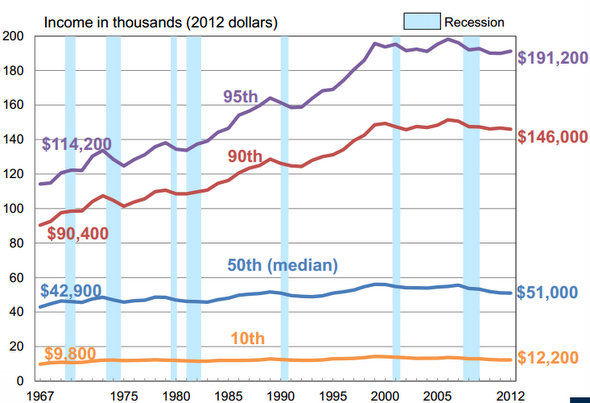
For the last 10 to 15 years, the rich are getting poorer and the poor are getting poorer.  Everybody's in the same boat and the falling tide is lowering everybody.


Better yet, all races are getting poorer at the same time!  We're all in this together!

I wonder where all the money has gone?

Ahhhh.  Found it!  The chart below is United States Government Spending (all levels) per capita in constant 2005 dollars.  We pay approximately 3 times as much per person as we did 40 years ago.


Yes, yes, I know.  I've painted the most dismal and pessimistic picture possible with these three charts. However, the above charts happen to match my observations and daily experiences so perhaps that explains my pessimism.

For better or worse, I think the United States requires forward momentum in terms of wealth generation to exist for the long term in its current form.  Another decade or two of stagnation coupled with continued growth of government spending per capita and the continuing onslaught on an increasing regulatory burden will cripple this country.

I'm strongly encouraging my daughters to look for opportunities beyond our borders.

Tuesday, September 17, 2013

One for the Physicists Among Us...

... who also like music: Bohemian Gravity

A Few Infographics

Income Inequality


Poverty Rates


Income Mobility


The Mystery Graphic


I'll update this post in a day or two identifying "The Mystery Graphic" along with some more commentary.  In the meantime, any guesses?

All four infographics clearly correlate with each other.  The correlation between "The Mystery Graphic" and Income Mobility looks to be quite high by eye.  Any causation between the four?  If so, which way does the causation run?

Update...

Someone had sent me the Income Mobility infographic a couple of months ago. When I saw it, it reminded me of one I saw many years ago when then Senator Daniel Patrick Moynihan (D, N.Y.) quipped: "If you would improve your state's math scores, move your state closer to the Canadian border!" That infographic showed math scores by state and looked nearly identical to the Income Mobility one.

Hey Skipper identified the source for The Mystery Graphic it in his comment on 18-Sep-2013 at 8:26 AM which he then subsequently deleted. The Mystery Graphic is the percentage of the population that's black by county.  The darkest blue is used for counties that are greater than 50% black.

Personally, I think that the correlation between The Mystery Graphic and Income Mobility is the most interesting.  It seems that blacks never have had, and perhaps never will have, any Income Mobility.

The first guess is racism, but as an explanation it has several holes.  Whites are also prejudiced against Asians, yet Asians have higher median incomes than whites.  Also, many of the ancestors of today's Chinese-Americans immigrated to work on the railroad, and were treated only a little, if any, better than the black slaves in the south.  Men are accused of being prejudiced against women, but women now graduate from college at far higher rates than men.  There's plenty of prejudice against Jews even today, yet no affirmative action is required there.  In the middle east, Arabs sometimes seem ignorant and backwards, but Arab-Americans do quite well on average.  In the last several decades, every group except blacks have had significant income mobility.

Also, if the answer is overwhelming racism, then why on earth are blacks moving back to the South?  In fact, why are they staying there at all?  I believe that anti-black racism is more prevalent in the South, but ultimately, money trumps racism for businesses making hiring decisions and catering to customers.  You may loathe the black customer, but his money's just as green as everyone else's, and if you want it, you'll be nice enough to him.  If you need to hire someone to get a job done, and the black guy can do it for a bit less than the white guy, you're going to hire the black guy.

For whatever reason, blacks have no significant income mobility, and are hugely over represented in the lower quintiles of education, earnings and opportunity.  This has been the case for generations.  Affirmative Action has made only the tiniest difference (and some would argue that it's not a positive difference), massive increases in spending on public education has made no difference at all (for anybody of any race), and welfare has fattened them up, but hasn't provided any additional opportunity.

They are stuck, nobody knows why, and there doesn't seem to be a solution.  Bummer.

Wednesday, September 11, 2013

Stuck Between the Devil and the Deep Blue Sea

In a line, that pretty much describes our Syrian national security dilemma.  

While it is a truism, it isn't necessarily trite to note that the choice of solution depends upon framing the problem.  The opening sentence itself contains a frame: what happens in Syria is important to US national security.  Obviously, context matters.  It isn't necessarily true that Syria's civil war should amount to anything but a particularly murderous current event.  Think Rwanda.  

Except that the Assad regime used sarin gas.  To which the enquiring mind might ask, "So?"  There has been plenty of slaughter to go around, and there seems to be no obvious reason to prefer death by shrapnel evisceration over succumbing to sarin.

That the reason isn't obvious should be put down to improperly framing the problem.  Sarin gas is one leg of the triumvirate that comprises Weapons of Mass Destruction.  Aside from pointless wordiness (why not Mass Destruction Weapons?), nerve agents are distinctly different from nuclear and bacteriological weapons.  All three are the antithesis of precise application of force, but nerve agents are unique.  Like bacteriological weapons, and unlike nuclear weapons, they do not cause any infrastructure damage.  Unlike bacteriological and nuclear weapons, nerve agents like sarin have no persistent effects.

Which means we always needed a different term for nerve agents.  Something along the lines of PMW: Profitable Murder Weapon.  It requires no intellectual exertion to demonstrate that some people, given sufficient power, will start from the basest convictions and create hecatombs. What makes PMWs different is that it not only makes hecatombs easy, it makes them profitable.  For the price of a few crop dusters, entire districts can be had intact with only the bother of clearing corpses.  Ethnic cleansing without having to queue up the cattle cars.

That should frame the problem exquisitely.

The Assad regime's undeniable use of sarin presents a meta-problem.  By that I mean a problem that exists above other problems in the same realm.  In national security terms, resorting to a PMW requires a response independent of normal Hobbesian international relations.  And, unfortunately, the only country able to transcend Hobbes is the United States.

Which is one of the reasons why President Obama is stuck between the devil and the deep blue Sea.  Taking the appropriate action against the meta-problem could run directly counter to our Hobbesian interests; since it is impossible to say which victory is worse for us, Assad's, the Sunni's or the Shia's, our national security policy should be aimed at all of them losing for as long as possible.  Indeed, the Obama administrations seeming fecklessness in this regard might well be a cover for a far more cynical foreign policy than his worshipers would ever be willing to acknowledge.

Therefore, if I was the National Security Advisor, my advice would be:  1.  Doing nothing is, counterintuitively, doing something.  2.  This is a meta-problem; doing nothing isn't an option.  3.  The goal of doing something is not to dissuade the Assad regime from using PMWs again, but to make it (or others similarly inclined) sorry they ever thought about it in the first place.

Mr. President, I grant doing so could shift the balance of power to a party that is contrary to our national interests, but since they all are, that is, practically speaking, an imponderable distinction without difference.  

Presuming the President took my advice, the speech I would have written would have made the punitive point clear, and left the suggestion that the Snowden affair might well be a false flag operation:  "Everyone significant in the Assad government and military -- our PGMs have you on speed dial."  The clear goal to make those loyal to Assad, and their families, start to fear us more than him.

Clearly, this isn't what has happened.  Yet just as clearly even President Obama's most fervent critics must admit that what to do about Syria is a dilemma for which either horn could be argued effectively, solely based upon how the problem is framed.

So, no matter the decision, I won't criticize the President for making it.

However, there is criticism aplenty for his administration.  That the Assad regime had significant quantities of a PMW was no secret, nor should the possibility of its use in a regime-threatening civil war have come as any surprise.  That the Obama administration reacted like a headlight-pinned deer when the first small PMW uses occurred is bad enough, but that it should maintain that glassy-eyed posture when Assad stopped fooling around and got busy is almost unfathomable.  

Unfortunately, Obama himself, and the Left in general, are responsible for their own paralysis.  Having excoriated President Bush for having made a far more thorough case for eliminating Saddam, then gotten Congress's approval for doing so, Obama faces charges of gross hypocrisy on one hand, or dereliction in the face of eminently foreseeable provocation on the other.

Just because I framed the problem as I did doesn't make it right.  It would be easy to frame this horrible situation purely in terms of amoral state interests.  I think that would be risking the long term consequences of short term thinking, but there is no denying that the only way to the long term is through all manner of short terms.  

Leaving aside the administration's curious incompetence -- which I think we should, because even competent foreign policy would likely be in the same position -- I have a great deal of sympathy for him.  There is simply no good way out.


Oh, one other thing.  I have learned to absolutely loathe the term "boots on the ground".  If there was ever a dehumanizing term with which to refer to those who swear to risk their lives on our behalf, that must be it.  They are soldiers, people, not boots.  It is bad enough that all manner of people thoughtlessly use that wordy slander, but for the Commander in Chief to include it in a state speech is appalling. 

Monday, September 02, 2013

Andertoons

I've added Andertoons, one of my favorite cartoonists, to this blog's sidebar, so now you can stop by for your daily chuckle.

Monday, August 26, 2013

Who? And When?

At any given moment in time, I have no doubt that some number of poor individuals are better off with the big government welfare state. I don't mean better off in just a gaming-the-system somewhat materially enhanced sort of way, but truly better off.  Some number of other individuals are no doubt worse off.  The welfare state saves some lives.  Others die because of the welfare state.

As with any set of policies, there are winners and losers.  With the welfare state, lobbyists win, politicians win, bureaucrats win, some of the poor win, some of those win who have a strong subjective preference that some of the poor win via help from the government, and most others lose.  Given that there are winners and losers, it's always possible to construct utility functions that justify the welfare state or show that it's a net negative.

Let's for a moment examine one of the more well thought out analyses that's often used to justify the welfare state. A Theory of Justice by John Rawls does just that.  He does this by stepping through a set of clever thought experiments.

Everything flows from the first innovative thought experiment called the original position:
The original position is a hypothetical situation developed by American philosopher John Rawls as a thought experiment to replace the imagery of a savage state of nature of prior political philosophers like Thomas Hobbes. In the original position, the parties select principles that will determine the basic structure of the society they will live in. This choice is made from behind a veil of ignorance, which would deprive participants of information about their particular characteristics: his or her ethnicity, social status, gender and, crucially, Conception of the Good (an individual's idea of how to lead a good life). This forces participants to select principles impartially and rationally. [...]
Rawls argues that the representative parties in the original position would select two principles of justice:
  1. Each citizen is guaranteed a fully adequate scheme of basic liberties, which is compatible with the same scheme of liberties for all others;
  2. Social and economic inequalities must satisfy two conditions:
    1. to the greatest benefit of the least advantaged (the difference principle);
    2. attached to positions and offices open to all.
The reason that the least well off member gets benefited is that it is assumed that under the veil of ignorance, under original position, people will be risk averse. This implies that everyone is afraid of being part of the poor members of society, so the social contract is constructed to help the least well off members.
In other words, Rawls claims that those in the original position would all adopt a maximin strategy which would maximize the prospects of the least well-off.  Inequality is allowed to happen, but only to the extent that it creates incentives for the well-off to produce more such that it benefits the least well-off:
The Difference Principle regulates inequalities: it only permits inequalities that work to the advantage of the worst-off. 
The vast majority of academic criticism of A Theory of Justice came from the Left (i.e. it's not socialist enough).  However, "in Anarchy, State, and Utopia, Robert Nozick argues that ... Rawls's application of the maximin rule to the original position is risk aversion taken to its extreme."

But depending on when the maximin rule is applied, I'm not sure it is extreme in its risk avoidance.  A thousand years ago, it was pretty important to avoid being among the worst-off pretty much everywhere in the world.  Even now, an awful lot of the world is pretty awful and if Rawlsian justice were achievable in those awful places, it would be pretty tempting to adopt it.  Unfortunately, it's precisely because no sort of justice is achievable in most of the awful places that they are awful in the first place.

To me, the primary problem with the original position, the veil of ignorance, the maximin rule, and the difference principle, is that they don't even attempt to take into account the effect of the structure of society on the future.  For example, assume that human civilization will ultimately span 100,000 years (it's spanned somewhat less than 10,000 years so far).  If a society constructed around completely free markets grew at a mere one-hundredth of one-percent per year faster than a society constructed around Rawls' difference principle, the median GDP per capita over the 100,000 year period for the free market society would be 148 times greater than for the difference principle society.  Even if we assume that the worst off get only one-hundredth as large a piece of the pie, the better bet from the original position, if you didn't know which time frame you were going to be part of, is the free market approach for all but the most extremely risk adverse people in the original position.

One of the biggest problems I have with the welfare state is that I believe that it's stealing from me now, but even worse, it's stealing even more from my children's future, and a tremendous amount from their descendants.

To summarize, the welfare state has winners and losers, but more and more losers over time.

Monday, August 19, 2013

Hey, What's Libertarianism, Anyway?

In the posts and comments on this blog, the term "libertarianism" is used quite a bit.  Unfortunately, like most "isms", it means significantly different things to different people.  I can't say what others mean when they use the word, but I'll at least try to be a bit more concrete by what I mean by it.

We'll start with the extremely useless dictionary definition:

lib·er·tar·i·an

noun
1. a person who advocates liberty, especially with regard to thought or conduct.
Anyone who's read a sampling of the posts here knows that liberty is extremely important to me, and is part of the reason libertarianism has appeal to me.  However, there's a bit more to it than that.

Moving onward to Wikipedia, we have:
Libertarianism (Latin: liber, "free")[1] is a set of related political philosophies that uphold liberty as the highest political end.[2][3] This includes emphasis on the primacy of individual liberty,[4][5] political freedom, and voluntary association. It is the antonym to authoritarianism.[6]
 
That definition is more complete, but still not adequate, because the Wikipedia article points out:
Different libertarian schools of thought disagree over whether or not the state should exist at all and, if it should, to what extent.[7] While minarchists propose a state limited in scope to preventing aggression, theft, breach of contract and fraud, anarchists advocate its complete elimination as a political system.[8][9][10][11][7][12][13] While certain libertarian currents are supportive of private property, such as in land and natural resources, others reject private ownership and instead advocate collective or cooperative ownership and management.[14][15][16][17]

Whoa! Some libertarians "reject private ownership" and "advocate collective or cooperative ownership" instead?  I'll admit that's news to me and I definitely don't mean that when I use the term.

When I think of a libertarian state, I think of the United States just after the constitutional convention.  At the Federal level, it was mostly a Minarchy:

In the strictest sense, it holds that states ought to exist (as opposed to anarchy), that their only legitimate function is the protection of individuals from aggression, theft, breach of contract, and fraud, and that the only legitimate governmental institutions are the military, police, and courts. In the broadest sense, it also includes fire departments, prisons, the executive, and legislatures as legitimate government functions.[1][2][3] Such states are generally called night-watchman states. 
Minarchists argue that the state has no authority to use its monopoly of force to interfere with free transactions between people, and see the state's sole responsibility as ensuring that contracts between private individuals and property are protected, through a system of law courts and enforcement. Minarchists generally believe a laissez-faire approach to the economy is most likely to lead to economic prosperity.
That's a pretty good definition of the direction I'd head and what I mean by libertarianism.

There are a few caveats.
  1. I only advocate for libertarianism at the federal level.  As far as I'm concerned, the 50 States can do whatever they like (within constitutional constraints) since I can always move.
  2. I'm libertarian leaning as opposed to libertarian.  That is, I believe that all incremental change at the federal level should be towards a smaller government and that the change should be done in small increments as opposed to a revolution or rapid restructuring.  I suspect that well before we got to a true minarchy at the federal level, I'd want to put on the brakes, but we're so very, very far from that point today, that I simply needn't worry about it now (or in my lifetime).  I'm also very, very sure that the federal government does not need to get any bigger and yet more cumbersome.
So that's what I mean when I use the term libertarianism.

Monday, August 12, 2013

Ranch Liability

I went on vacation (with my wife and daughters) to a ranch (Rankin Ranch) last week.  The main activity is riding horses.  All guests have to sign a liability waiver which says something to the effect that we indemnify, hold harmless, and promise not to sue regardless of what happens during any and all activities (including horseback riding) while on the ranch.  Even though I'm well aware of the substantial danger of riding a horse, I was perfectly happy to sign that form and accept the risk.

I was talking with the ranchers, and they still have a large and very expensive liability insurance policy which imposes a number of restrictions on the types of horseback riding that's acceptable (for example, it's okay to gallop, but the guests have to be in a straight line while doing so) and the ranchers are still extremely worried about losing the ranch to lawyers because some guest gets hurt.

I don't know that much about liability law.  Why does the ranch need to be concerned with liability if everyone has signed a liability waiver?

Saturday, August 03, 2013

Quote of the Day

From Don Boudreaux at Cafe Hayek:
Deirdre McCloskey is right and correct to point out that one of the biggest steps we humans ever took toward being truly civilized was when a sufficient number of us began to regard bourgeois pursuits as virtuous.
Perhaps our next big step forward toward being even more civilized – a step that has yet to be taken by a minimally sufficient number of people – will be when we come to regard those who lust to hold political power as being ethically indistinguishable from pickpockets, shoplifters, and card sharks.
That's been one of the themes here at this blog.  Governments, warlords, and marauding bandits have a lot in common and the difference between shepherds and wolves is fairly minor as far as the sheep are concerned.

Monday, July 29, 2013

The Keynesian Track Record

Keynesian Economics is all the rage these days, especially since the global financial crisis that began in 2008. The basic gist of Keynesian Economics is:
"...that private sector decisions sometimes lead to inefficient macroeconomic outcomes which require active policy responses by the public sector, in particular, monetary policy actions by the central bank and fiscal policy actions by the government, in order to stabilize output over the business cycle."
In practice, on the fiscal policy side, this amounts to calls for increased government borrowing and spending, and sometimes reduced taxation.

One important part of the Narrative for those who believe (or believe in) Keynesian Economics is that what brought the world in general, and the United States in particular, out of the Great Depression, was the stimulative effect of the greatly increased federal government spending due to WWII.

Maybe so (or maybe not), but let's consider the other side of the equation.  In 1943, during the midst of WWII, Paul Samuelson (Nobel Prize in Economics, 1970) wrote[1]:
"When this war comes to an end, more than one out of every two workers will depend directly or indirectly upon military orders. We shall have some 10 million service men to throw on the labor market. ... The final conclusion to be drawn from our experience at the end of the last war is inescapable ... were we again planning  ... to shift from astronomical deficits to even the large deficits of the thirties–then there would be ushered in the greatest period of unemployment and industrial dislocation which any economy has ever faced."
That is what Keynesians believed - that we faced the "greatest period of unemployment and industrial dislocation which any economy has ever faced."

Yet, we did "shift from astronomical deficits to even the large deficits of the thirties" (spending dropped from 43% to 14% of GDP) and what happened?  I'll let President Truman answer [2]:
"During 1946, civilian employment approached 58 million. This was the highest civilian employment this Nation has ever known— 10 million more than in 1940 and several million higher than the wartime peak. If we include the military services, total employment exceeded 60 million. ... 
"Thus, at the end of 1946, less than a year and a half after VJ-day, more than 10 million demobilized veterans and other millions of war- time workers have found employment in the swiftest and most gigantic change-over that any nation has ever made from war to peace."
Samuelson's prediction based on the Keynesian narrative simply couldn't have been more wrong.  Instead of the "greatest period of unemployment and economic dislocation" we had "the swiftest and most gigantic change-over that any nation has ever made from war to peace."

The Keynesian narrative was extended to handle this and other rather significant exceptions.  Nonetheless, for those of us who haven't swallowed it hook, line, and sinker, it looks like the Keynesian narrative explains the relationship between government spending and economic health - except when it doesn't.

References
[1] Paul Samuelson, “Full Employment after the War,” in S.E. Harris, ed., Postwar Economic Problems, 1943.
[2] Harry Truman, "The Economic Report of the President", page 1, issued January 8, 1947

Tuesday, July 23, 2013

High-Fructose Corn Syrup

I received the following email from a student at a local high school.  Explorer is a lower school that my daughters went to at the same time as this student.  My reply is below.
Hello, 
My name is xxxxxxxxx, I am a former Explorer student who is now a rising junior at High Tech High. I decided to send this email to the families of Explorer and former Explorer students because it deals with an issue that is very relevant to parents and children. 
The issue in question is high-fructose corn syrup. For those of you who do not know, high-fructose corn syrup is a processed corn sweetener that is common in a wide array of foods. Many respected and unbiased institutions- such as Princeton University, the American Journal of Clinical Nutrition, etc. have conducted studies on this food additive and have concluded that it is likely a major contributor to the American obesity epidemic. HFCS may also be linked to diabetes, heart disease, cancer, and other illnesses.
Because of this, I have started a petition on the White House website asking the Obama administration to reduce the availability of high-fructose corn syrup. I urge all who care about health and nutrition to sign my petition: 
http://wh.gov/lCiH9
Thank you very much! And please forward this link to your colleagues, friends, etc. 
xxxxxxxxxx 
PS Making an account and signing is very easy and takes only seconds.


The following is my reply.

Dear xxxxxxxxx, 
I too share your concerns regarding the adverse nutritional impact of high-fructose corn syrup (HFCS) and commend you for your investigations in the area of human nutrition.  I also share your concern regarding the "American obesity epidemic" and associated disease states such as diabetes. 
However, I am unable to support your petition for many reasons. 
In addition to HFCS, there are a huge number of foods, drinks, and other consumables that have adverse effects on human health when consumed in large quantities: sugar, candy, cookies, cakes, pasta, bread, trans-fats, sodas, beer, wine, liquor, and tobacco to name just a few.  HFCS doesn't even lead the list in terms of adverse impact on human health and life expectancy (that dishonor is held by tobacco).  If it's helpful to restrict HFCS in order to enhance the health of Americans, clearly it would be helpful to restrict or eliminate many of these other items as well. 
However, with the exception of tobacco, none of the things on this list, including HFCS, have adverse impacts on health when used in moderation by healthy people.  In addition, eating is a fundamental activity of humans (all animals), and the joy of consuming the "treats" on the list is substantial and should not be discounted.  In my opinion, nobody should make the tradeoff of the enjoyment of eating versus potential health effects for someone else, including you and the Obama administration. 
As you note in your petition, the government provides agricultural subsidies to corn farmers.  While I would support eliminating corn subsidies, the idea of adding restrictions on corn based products while subsidizing corn production makes no sense at all to me. 
It seems to me that Obama's administration is having enough trouble dealing with its current set of chores.  Some of the many examples include delays in implementing the ACA (sometimes known as "Obamacare"), NSA spying overreach, IRS targeting of political opponents, troubles with embassy security (e.g. Benghazi), and on and on.  It seems like the last thing our President needs is to have to figure out how to regulate, restrict, and perhaps eliminate a food item while balancing the desires of consumers and the needs of people working in agriculture. 
In addition, I think that the federal level is the wrong level of government to consider restrictions on HFCS.  For example, have you researched the health and dietary needs of everyone across the entire country? Do all of the people from Maine to the southwest deserts, from the everglades to islands in Puget Sound, from the  Mexican border towns to Canadian border towns all have the same needs and consumption patterns?  If not, perhaps nationwide action is inadvisable. Perhaps this sort of advocacy should occur at the State and/or local levels.  How about starting with having San Diego restaurants voluntarily pledge to avoid using HFCS and see how it goes? 
Information and education are good.  There are many ways to get your opinion heard and to educate people about the adverse effects of HFCS.  For example, are you aware of the Nutrition Science Initiative (NuSI, nusi.org)?  Perhaps volunteering with them would be a good approach to advocate for scientific based dissemination of nutritional information. 
If people are armed with the right information, at least there's a chance that they'll make decisions and take actions that optimizes the tradeoffs that are continually part of each of our lives. 
Sincerely,
Bret 
P.S. Your email and this response are being posted on my blog (with your name removed).  My readers can decide for themselves and perhaps some of them will sign on to your petition.

Monday, July 22, 2013

1,000

This is this blogs 1,000th published post.  It's also more or less the ten-year-anniversary of this blog (the first post was in September, 2003).

The name "Great Guys" was a joke among eight friends from college. The blog was started to help coordinate annual get-togethers and to provide a forum for continuing discussions from those get-togethers.  The get-togethers still happen every year.

At least one of the Great Guys never posted anything at all.  Three of us posted regularly for about a year.  Those were some interesting posts since the third regular poster was quite liberal, while Howard and I are, ummm, well, decidely less liberal/progressive/left-wing/statist/collectivist/etc. and too much less so for blogger #3 to continue so he dropped out.  That's unfortunate, because he provided balance to Howard's and my perspectives.

Averaging 2 posts per week for 10 years feels like decent output and decent staying power.  I'm likely to continue for several reasons:
  • I enjoy the debates that many of my posts seem to stimulate
  • It's a great way to keep in practice with writing and I find when I write proposals they go a lot faster and easier when I've been blogging
  • It provides a way for me to organize my thoughts and think about things and I hope it does the same for at least some of my readers
I think Howard, who has become the infrequent co-blogger will probably continue at his current rate as well.

Well, at 1,000 posts per decade, I'm hoping to hit a 5,000 post (I'll be 94 then), but surely we'll see number 2,000 one day?

Many thanks to our loyal readers for all their support and feedback!

Sunday, July 21, 2013

Teaching Moments: Beyond Reasonable Doubt

My younger daughter (age 13) came home from dance lessons and said, "everybody was talking about some white man who shot a black child and got away with it."  I wasn't thinking about the Zimmerman trial just then, so I was quite surprised.  Here is the conversation (more or less) that followed:

Me: Wow! That sounds terrible.  When did that happen?

Younger Daughter (YD): I think the trial just ended.

Me: Ahhhh.  Did they mention the name 'Zimmerman' by any chance?

YD: Yeah.

Me: Well, it's a little more complicated than that.

YD: But he killed a child and got away with it!

Me: How old was this child?

YD: I think they said he was 12 years old.

Me: No, Trayvon was 17 years old.

YD: But he did kill him?

Me: Yes. Do you think it is always a crime to kill someone?

YD: It should be.

Me: How about when a policeman shoots a criminal to protect the public?

YD: Well, that's different.

Me: How about when a soldier shoots a terrorist?

YD: That's different too.

Me: Yes, both the policeman and the soldier were defending people.

YD: What's that have to do with this?

Me: Zimmerman claimed he was acting in self-defense.

YD: But he was older and bigger.

Me: He was older, but Trayvon was 4 inches taller than Zimmerman and more athletic.

YD: But they said that Zimmerman was following Trayvon.  How could that be self-defense?

Me: Zimmerman noticed Trayvon walking around in the dark in the rain looking like someone might look if they were casing a house prior to breaking in.  Zimmerman called the police and wanted to keep track of Trayvon until the police arrived.

YD: He called the police before he killed Trayvon? 

Me: Yes.

YD: Then what happened?

Me: According to Zimmerman, Trayvon confronted him, punched him in the nose, knocked him to the ground, got on top of him, and started punching him and slamming his head against the concrete.  Zimmerman did have a fair amount of blood on the front and back of his head when the police arrived.

YD: And then he shot him?

Me: Yes.

YD: Why didn't he just shoot him in the thigh or something?

Me: Good question, but I have a hunch if you're being pummeled by someone on top of you, it may be hard to aim.

YD: How can we be sure that's what happened?

Me: There were no witnesses who saw it clearly so we can't.

YD: So he might be making the story up?

Me: Yes.

YD: But how can we let someone who killed someone who might be lying get away with it?

Me: Well, our legal system is based on the concept of innocent until proven guilty beyond a reasonable doubt.  In other words, before we punish someone we want to be very sure he's guilty and we'd rather let some guilty people go free if we can avoid punishing innocent people.

YD: So the jury gave him the benefit of the doubt.
Me: Exactly.  The jury didn't find him innocent, but rather found him not guilty beyond reasonable doubt.  He may very well be guilty, but there wasn't enough evidence to prove that guilt beyond reasonable doubt.

YD: It still doesn't seem right.
Me:  Yeah, I don't think there are too many parents who feel good about it.  The idea of having a child killed is horrifying regardless of the child's age.

YD: Yeah.
Me: Anyway, at least you now understand some of the more important details: that self-defense was claimed and that non-self-defense couldn't be proved beyond reasonable doubt based on the evidence, at least according to the jury.

YD: It's definitely not as bad as my friends at dance made it out to be.  I guess sometimes bad things just happen.

Monday, July 15, 2013

Vision Robotics on the News

My company, Vision Robotics Corp., was on the San Diego Channel 10 6PM news this evening. If you're curious, to see the segment, visit http://www.10news.com/video and find the link for "Robots created by San Diego company" (I haven't been able to figure out how to link directly to the video).

10news did a pretty good job - especially considering that they did everything (contacted us, shot the video, did the editing, and produced it) in a span of just over 6 hours.  The first three steps were all done by one guy.

The only noticeable mistake is that they call it a "Lettuce Trimmer" when it's actually a "Lettuce Thinner."

Pam Uphoff's Outcasts and Gods is Free Until the End of the Week

I've mentioned in a previous post that one of my favorite series of novels, fairly recently discovered by me, is the Wine of the Gods series by Pam Uphoff.  She's made the first book in the series, Outcasts and Gods, free for Kindle devices and readers until the end of the week.  This is one of those risk-free opportunities.  It's of the Science Fiction and Fantasy genre.

Wednesday, July 10, 2013

Grumpy Uncles

A friend of mine recently accused me in particular, and libertarians (and probably conservatives) in general, of being "grumpy uncles":
"I'm still looking for the avowed libertarian who doesn't come across as a grumpy uncle."
I don't think I qualify as an "avowed" libertarian, but some background is in order.  I would describe my friend as being enamored with Statism and I take the definition of Statism right out of the dictionary: "the principle or policy of concentrating extensive economic, political, and related controls in the state at the cost of individual liberty."  He believes that the reduction of individual liberty is more than made up for by the solutions made possible using the resources available to a large and powerful government.

Each of us occasionally sends the other a book to read.  The last book I sent him was A Conflict of Visions by Thomas Sowell which makes the argument (compellingly, in my opinion) that a vast number of ideological disagreements can be traced back to assumptions about human nature and the extent of the malleability of human nature.

My friend continued with:
"Although I've experienced plenty of times with you when joy was the operative factor, your written language almost always comes across as negative when it comes to evaluating the human condition (starting with yourself)."
I'm no angel and I know it and I rather doubt that the world is populated with all that many angels or even saints.  Perhaps I'm projecting, but I think it's likely that most people are like me, and with the right incentives have a capacity to live good lives that are beneficial to themselves and those around them.  However, without those incentives or with the wrong incentives, they have the capacity for evil, perhaps great evil.

An example I've given both to my friend and detailed in comment sections of various blogs (including this one) is that I'd be a disaster if I was working within a government framework and had much power.  While I probably wouldn't hurt any fellow citizens if it didn't benefit me (and my family, friends, and communities), if I was presented with a situation where I could extract a penny from every citizen and line my pockets with it, I wouldn't hesitate.  A mere penny.  Even the poorest of poor would hardly miss a penny.  And given a population of 300 million, that would be $3,000,000 in my pocket.  Definitely a worthwhile tradeoff to me.  I wouldn't even feel guilty - a mere penny!

When a million politicians, bureaucrats, lobbyists, government contractors, and constituents all do the same thing, it turns into many thousands of dollars out of the pockets of every citizen every year.  And that's pretty much how the whole lobbyist-bureaucrat game works.

So yes, starting with myself, I have a pretty skeptical view of the human condition when it comes to running governments.

The other reason I'm a grumpy uncle according to my friend, is my disdain for the concept of utilizing experts to tell me and the rest of us how we should live:
"The no-so-subtle loathing by people like Sowell for those of us who dare to imagine that we can actually make the world a better place by taking action at a level above that of the individual used to surprise me given how much empirical evidence there is for the progress wrought on behalf of collective ends.  Sowell and others deride "experts" as if experts have never accomplished something useful."
Yes, I am continually unenthusiastic about assigning yet more resources for yet more "experts" to come up with yet more regulations and programs administered by yet more government costing me yet more money while reducing my liberty every step of the way.  I can see how Statists would find my attitude as decidedly grumpy.

My friend can't understand why I might be grumpy just because I'm forced to fund and be subject to his beloved government and I wanted to try and enlighten him.  Conveniently, he's an avowed Atheist - the type that's certain that deities don't exist, that anyone who's not certain of their non-existence is seriously deluded, and that all religion is evil.  Given that, I wrote the following (unedited) to try to enlighten him as to the cause of my grumpiness:
But let me give an analogy that I think sheds light on why libertarians are "grumpy uncles"... 
So let's say that suddenly, the super majority of Christians in the country managed to get a constitutional amendment passed repealing freedom of religion and declaring the United States to be a Christian nation with forced daily church attendance and whatever the Christian version of sharia law is called including enforced donations to the church.  In addition, the Christians are absolutely certain that this move is required in order to halt and then reverse the rapidly degrading morality that, in their minds, is clearly leading to barbarism and the collapse of the nation.  Because of their certainty of the goodness of their cause, they're also convinced they have the moral high ground in addition to the constitutional and legal high ground. 
And let's take it one step further such that every country on earth also became a Christian country except a dozen poverty stricken hell holes.
So I rather imagine that if you found yourself in this Christian world with mandatory daily church attendance, you might be a rather grumpy uncle.  Or would you go to church with joy in your heart? 
That's what the world looks like to libertarians, except substitute centralized government for church.  That's why we're grumpy uncles.
I'm not religious and for me Big Church and Big Government look remarkably similar.  They have leaders, followers, power, corruption, certainty of rightness (moral superiority, better world or afterlife, etc.), evangelical leanings, ostracizing or dealing harshly with heretics, etc.

From the outside, all dogmas look the same and are annoying to everyone else.

Hence the grumpiness.

Saturday, June 29, 2013

That Which Distinguishes Humans

"That's not real life," complained my wife when I gave our 16-year-old daughter $20 to go to the movies.  My wife is less than pleased that our daughter didn't manage (yet) to get a summer job, wants to keep the pressure on our daughter so that she continues to pound the pavement looking for a job, and thinks that just giving people money when they ask for it is close to ludicrous (or at least not "real life").

The "real life" comment got me thinking and that's always dangerous.  Other than the fact that I believe I'm both real and a life form and so is my daughter and I did give her $20 so it is therefore by definition "real life" in at least this one instance, it seems to me that what really distinguishes humans from all of the other life forms on the planet is the fact that we shape our own reality.  Chimps, crows, etc. use simple tools when convenient and ants, bees, birds, etc. build structures, but humans create their own subjective reality on a grand scale and this subjective reality is only tenuously related to an objective reality of which we know little and generally don't think much about.

Our subjective realities are only related to objective reality by the minor detail that we have to survive.  But survival really only requires some food, some minimal amount of clothing, some shelter to protect us from the elements when the clothing is not going to cut it, and perhaps a few other minor things.  After we cover the bare necessities of life, all other resources can be used to create our subjective realities which need not have anything to do with objective reality.

As we grow richer and richer, we need fewer and fewer people and resources to cover the basics.  In the United States for example, we need less than 3% of the population to produce all of our food (and if we weren't picky we could probably do it with substantially fewer resources still) and we could probably cover the bare minimum of clothing and shelter with an even smaller percentage of GDP than that.  The other 90+% of GDP can be dedicated to ignoring objective reality.

The problem is that we don't agree on how to structure our subjective reality.  I greatly prefer the autonomy of the individual and freedom from government interference.  Others want to pool the sum total of resources for collective deployment.  Still others want a highly religious subjective reality of some form or another.  And so forth.  All of these subjective realities, given the fuel of 90+% of GDP, can work for a long time.

However, as long as there are ever increasing conflicts between people because of conflicting desires for different types of subjective realities, the stability of society is going to be a bit of a fragile thing.  The fact of the matter is that the Left would be far better off if the Right was to disappear from the earth and vice-versa.  It's debatable whether or not they'd be materially better off, but to be free to live unopposed within their subjective reality would no doubt be a great boon.

And given this, I wonder if one day there will be a great extermination war between the ideologies.  If each side thinks they'd be better off with the other side gone, what's to stop that from happening?

Sunday, June 23, 2013

But The Grocery Store Knows Everything!

I haven't written much of anything about the NSA data collection brouhaha - neither blog posts or comments.  My main reaction has been, "What did you expect?"  If you build a massive government that deploys nearly half the resources of the country representing many trillions of dollars and consists of a huge bureaucracy where the bureaucrats have their own self-interest guiding their actions, encourage the government to solve all sorts of problems with nearly unlimited amounts of regulation and enormous programs, and then set up elections between dogmatic political parties where the one currently in power can derive overwhelming benefit by abusing its power, then it seems inherent that there will be enough bad actors that are more than willing to spy on the citizenry.

Oh sure, I suppose we have to feign surprise and even outrage, demand investigations and new oversight (yet another layer of watchers - but who will watch those watchers?), and wring our hands and wail about how it should never have happened.  As least some of us have to perform this charade to maybe slow it down a little. But realistically, it won't slow down and will get ever worse because such activities are inherently part of the system and amplified by the huge size.

I do have to laugh at some of the justifications put forth by some of the citizenry to defend the government.  There's of course the somewhat boring and silly "I have nothing to hide, why should I care?" (if you have nothing to hide, can I put a webcam in your bedroom and broadcast to the web?  No? Well maybe privacy does have some subjective value to most people then).

But my favorite so far is a friend who points out that grocery stores have a great deal of private information about you.  They know when your period is (for fertile females), they know when you're sick, they know when there's a new baby in the family, etc.  They know all this from your buying patterns coupled with that discount card that you swipe at the cash register.  So, my friend asks, "where's the outrage there?"

Ummm.  Oh, I don't know.  I guess I'm just not terribly worried about the grocery store sending in a SWAT team to haul me off to jail for not conforming to their cherished notions about correct buying patterns.

But the government can do exactly that.  Some call me paranoid (actually, I'm not terribly worried, but rather see a distinction between the grocery store and the government), but the possibility of being personally harassed by the government isn't all that far fetched.  Economist Alex Tabbarok writes:
I broke the law yesterday and again today and I will probably break the law tomorrow. Don’t mistake me, I have done nothing wrong. I don’t even know what laws I have broken. Nevertheless, I am reasonably confident that I have broken some laws, rules, or regulations recently because its hard for anyone to live today without breaking the law. Doubt me? Have you ever thrown out some junk mail that came to your house but was addressed to someone else? That’s a violation of federal law punishable by up to 5 years in prison.
Harvey Silverglate argues that a typical American commits three felonies a day.
So we're all felons.

Glenn Reynolds adds:
Though extensive due process protections apply to the investigation of crimes, and to criminal trials, perhaps the most important part of the criminal process -- the decision whether to charge a defendant, and with what -- is almost entirely discretionary. Given the plethora of criminal laws and regulations in today's society, this due process gap allows prosecutors to charge almost anyone they take a deep interest in.
So we're all potential targets of government and the recent IRS scandal shows that discretionary targeting of individuals and entities is a very real possibility.  One thing that gave us some protection from such discretionary, arbitrary, and capricious prosecution was the huge cost of collecting evidence on a significant percentage of us.  Now however, as Tabarrok concludes:
...the NSA spying machine has reduced the cost of evidence so that today our freedom - or our independence - is to a large extent at the discretion of those in control of the panopticon.
 reduced the cost of evidence so that today our freedom–or our independence–is to a large extent at the discretion of those in control of the panopticon. - See more at: http://marginalrevolution.com/marginalrevolution/2013/06/no-one-is-innocent.html#sthash.WUrCJMcQ.dpuf
And that's the difference between the grocery store and the government.

Friday, May 24, 2013

Where the Well Regulated Economy Begins

In this series on the "well regulated" economy, let me be clear that there is no small degree of sarcasm involved in what I mean by "well regulated".  What I mean by "well regulated" is an economy that's pretty much completely controlled, where the government "protects" employees from employers, "protects" consumers from producers, "protects" the poor from the rich, "protects" the rich from the poor, and, most importantly, "protects" all of us from ourselves.  For the "well regulated" economy, the government is essentially one giant protection racket.

The fundamental force that enables both protection rackets and governments to impose their will is violence. The German philosopher Max Weber "defined the state as an entity which successfully claims a 'monopoly on the legitimate use of violence.'" The main difference between government and organized crime in that definition is the word "legitimate," and the degree of legitimacy depends on the degree to which the citizens "voluntarily" comply with government legislation, where "voluntarily" means they would comply even if there were no penalties for not doing so.

In order for a government to be violent, it has to have the will to be violent, which in turn means that its capacity for violence needs to be fulfilled by people willing to order and commit violent acts.  The more "well regulated" an economy and the less "voluntary" the compliance of the citizens, subjects, or serfs, the greater the capacity for government violence is required.

One of the most "well regulated" economies the world has ever seen was the Soviet Union.  Not surprisingly, one of the most totalitarian, ruthless, and violent governments the world has ever seen was also the Soviet Union during the same time period.

Stalin pulls all of the concepts above into one nasty package.  Before he was chief thug of the Soviet Union and responsible for the deaths of at least 20 million people, he was the chief thug of an organized crime group. Via Stephen Hicks, we have the fascinating story of a major bank robbery orchestrated by Stalin:
[O]ne of its most swashbuckling leaders, Josef Djugashvili - better known as Stalin - was about to pull off a dazzling heist. [...] 
The carriages were transporting an enormous sum of money - as much as one million roubles (£7 million) - to the new State Bank. [...] 
Stalin knew it would require great daring to pull of such a coup. He also knew he’d need a dependable gang of fellow criminals to help. These were easy to find in Tiflis: Stalin had already been involved in previous robberies and had a trusty band of individuals who could be relied upon. 
The robbery was meticulously planned. [...] 
The carriages swung into the square exactly as expected. One of the gangsters slowly lowered his rolled newspaper, the signal for the attack to begin. Seconds later, there was a blinding flash and deafening roar as Stalin’s band hurled their hand grenades towards the horses. 
The unfortunate animals were torn to pieces. So, too, were the policeman and soldiers. In a matter of seconds, the peaceful square was turned into a scene of carnage. The cobbles were splattered with blood, entrails and human limbs. 
As the gangsters ran towards the carriages, one of the horses  - maimed but not killed - reared up and began dragging the money-bearing cavalcade across the square. He picked up speed and there was a real danger he would get away. 
One of Stalin's men chased after the horse and frantically hurled another grenade under its belly. It exploded beneath the animal, with devastating effect. The horse was blown apart and the carriages were brought to a definitive halt. 
Before anyone in the square could make sense of what was happening, Stalin’s most faithful accomplice - a bandit named Captain Kamo - rode into the square. The gangsters hurled the banknotes into his carriage and then Kamo rode off at high speed. 
The carnage caused by the attack was spectacular. Some 40 people were killed by the grenades and gunfire and a further 50 wounded. Amazingly, none of the gangsters was killed.


Lives and pain clearly meant nothing to Stalin.  With the bank robbery he proved beyond a shadow of doubt that he had both the ruthlessness and capacity for violence for both organized crime and government.

And with that capacity for violence we can see where the "well regulated" economy begins.