Search This Blog

Showing posts with label Extended Order. Show all posts

Friday, October 25, 2019

Will Trump Make it to the End of His First Term?

In 2017, in a comment to one of Clovis' posts, I wrote:
And, by the way, I think Trump's chance of finishing his first term is less than 70%. He's old and someone his age has about a 7% chance of dying in the next 3+ years. Nobody's been more hated as a president, and while he's a pretty hard target, I think he has a 10+% chances of being assassinated - all you need is one traitorous secret service agent and Trump's a goner. I think there's a 5% chance he just gets sick of it all and quits (resigns). And I think there's around a 10% chance he is removed from office because they do find something bad enough about him and Russia or whatever.
I think the odds are still roughly the same. He probably won't die of natural causes and he almost certainly won't resign because "he just gets sick of it all." On the other hand, the chance of his being impeached and removed from office is probably more than 10% at this point.

I still think there's a significant chance he'll be assassinated, possibly along with Barr and other investigators in Trump's administration. If those investigators really begin indicting people and if there really is a "deep state," then they'll start killing people to stop the investigations, and I think Trump would be the primary target. And the likelihood of assassination will go up substantially if it looks like Trump is likely to win in 2020.

Whether or not there is a "deep state" is either a matter of definition or degree. There are around 2 million federal employees (far more if you include military) and most of them keep their jobs even when the parties of the president and/or congress change. These bureaucrats are in some sense a "deep state" in that they're entrenched very deeply and nearly impossible to get rid of. However, they're not necessarily a "deep state" by the more commonly used definition of people conspiring to rule over the people while ignoring elected officials and perhaps to use any method, including assassination, to guarantee their continued power.

But do they need to conspire to unseat of assassinate Trump? Or at least conspire on a grand scale? I don't think so. I believe that it is true that the vast majority of federal employees would love to get rid of Trump and I believe that each of those is willing to do at least a little bit in order to achieve that goal. Some percentage is probably willing to do quite a lot more than a little bit. Multiply that percentage, even if pretty small, by 2 million people, and suddenly you have an awful lot effort directed at bring down Trump, perhaps tens if not hundreds of thousands of people.

As a result, no conspiracy is necessary to have Trump assassinated and I think there's about a 10% chance of that happening. From large yet largely unconnected groups of people, unpredictable behaviors will emerge.

Thursday, October 17, 2019

Epic Construction Projects

There are train tracks directly behind my office. It used to be a single track, but a 2nd one was built and is about a mile long.

It took more than 2 years from the start of construction to finish that mile of track. At that rate, it would've taken 4,000 years to complete the US Transcontinental Railroad. So I was amused when an article by the historian Victor David Hanson (VDH) asked the question:
Does anyone believe that contemporary Americans could build another transcontinental railroad in six years?
Oh I'm sure someone, somewhere believes that it could be done again, but it seems beyond implausible to me. You'd think that with all of the technology we've developed, we could just snap our fingers and voila!, new railroads and regular roads and bridges and ... would appear in no time. But no, not even close.

VDH notes other typical nearly absurdly slow projects:
Californians tried to build a high-speed rail line. But after more than a decade of government incompetence, lawsuits, cost overruns and constant bureaucratic squabbling, they have all but given up. The result is a half-built overpass over the skyline of Fresno — and not yet a foot of track laid.

California’s roads now are mostly the same as we inherited them, although the state population has tripled. We have added little to our freeway network, either because we forgot how to build good roads or would prefer to spend the money on redistributive entitlements.

When California had to replace a quarter section of the earthquake-damaged San Francisco Bay Bridge, it turned into a near-disaster, with 11 years of acrimony, fighting, cost overruns — and a commentary on our decline into Dark Ages primitivism. Yet 82 years ago, our ancestors built four times the length of our singe replacement span in less than four years. It took them just two years to design the entire Bay Bridge and award the contracts.

Our generation required five years just to plan to replace a single section. In inflation-adjusted dollars, we spent six times the money on one-quarter of the length of the bridge and required 13 agencies to grant approval. In 1936, just one agency oversaw the entire bridge project.

California has not built a major dam in 40 years. Instead, officials squabble over the water stored and distributed by our ancestors, who designed the California State Water Project and Central Valley Project.
Contemporary Californians would have little food or water without these massive transfers, and yet they often ignore or damn the generation that built the very system that saves us.

America went to the moon in 1969 with supposedly primitive computers and backward engineering. Does anyone believe we could launch a similar moonshot today? No American has set foot on the moon in the last 47 years, and it may not happen in the next 50 years.
VDH wonders if a new mythology will be born based on our forebearers being able to construct wonders far beyond our modern day capabilities:
Many of the stories about the gods and heroes of Greek mythology were compiled during Greek Dark Ages. Impoverished tribes passed down oral traditions that originated after the fall of the lost palatial civilizations of the Mycenaean Greeks.
Dark Age Greeks tried to make sense of the massive ruins of their forgotten forbearers’ monumental palaces that were still standing around. As illiterates, they were curious about occasional clay tablets they plowed up in their fields with incomprehensible ancient Linear B inscriptions.
We of the 21st century are beginning to look back at our own lost epic times and wonder about these now-nameless giants who left behind monuments [such as the transcontinental railroad] that we cannot replicate, but instead merely use or even mock.
I do see his point. Who isn't frustrated with traffic being badly slowed for years while crews patch a few holes at a snail's pace?

However, VDH did leave out a few details that I think are important. First, the working conditions were really, really bad for most of those epic projects. Around 1,200 people died building the Transcontinental Railroad. The construction of the Golden Gate Bridge was noted for how "safe" it was - only 11 people died. Things are much, much more comfortable now. Almost nobody would be willing to work in those conditions and take those risks (especially for what they were paid) and even fewer in power are willing to let them take those risks.

Yet before we blame those running the projects for the death toll, we need to keep in mind that those horrible working conditions were often a step up from what the workers were previously experiencing. For example,
Many more workers were imported from the Guangdong Province of China, which at the time, beside great poverty, suffered from the violence of the Taiping Rebellion. Most Chinese workers were planning on returning with their new found "wealth" when the work was completed. Most of the men received between one and three dollars per day, the same as unskilled white workers ... A diligent worker could save over $20 per month after paying for food and lodging—a "fortune" by Chinese standards.
Second, though he does grudgingly admit it, VDH glosses over the fact that working with modern technology very often creates more value than building yet another road. Instead of concrete, we build most of our roads with glass fiber and electrons and both the market and the taxpayer think that's more valuable.

So to me, it's not so much that we were once competent at building immense material things and now we're not. Instead, it's that once upon a time we were very poor and the best we could do was work high-risk construction jobs for the "fortune" of net $20 per month whereas now we can do oh-so-much better doing other things. And those that still work construction jobs (reasonably) demand orders-of-magnitude higher pay, far better working conditions, and far better safety.

VDH ends his article with:
Our ancestors were builders and pioneers and mostly fearless. We are regulators, auditors, bureaucrats, adjudicators, censors, critics, plaintiffs, defendants, social media junkies and thin-skinned scolds. A distant generation created; we mostly delay, idle and gripe.

As we walk amid the refuse, needles and excrement of the sidewalks of our fetid cities; as we sit motionless on our jammed ancient freeways; and as we pout on Twitter and electronically whine in the porticos of our Ivy League campuses, will we ask: “Who were these people who left these strange monuments that we use but can neither emulate nor understand?”

In comparison to us, they now seem like gods.
Perhaps we do "mostly delay, idle and gripe." But we can afford to, our ancestors could not. To me, our ancestors seem far less like gods and far more like people desperately impoverished compared to us trying to do the best they could. I thank them for taking the risks and building our comfort, I really do, but gods? Not so much.

Wednesday, September 11, 2019

Interesting Abstract


Here is an abstract I found interesting:

Technological innovation can create or mitigate risks of catastrophes—such as nuclear war, extreme climate change, or powerful artificial intelligence run amok—that could imperil human civilization. What is the relationship between economic growth and these existential risks? In a model of endogenous and directed technical change, with moderate parameters, existential risk follows a Kuznets-style inverted Ushape. This suggests we could be living in a unique “time of perils,” having developed technologies advanced enough to threaten our permanent destruction, but not having grown wealthy enough yet to be willing to spend much on safety. Accelerating growth during this “time of perils” initially increases risk, but improves the chances of humanity’s survival in the long run. Conversely, even short-term stagnation could substantially curtail the future of humanity. Nevertheless, if the scale effect of existential risk is large and the returns to research diminish rapidly, it may be impossible to avert an eventual existential catastrophe.

This has been my intuition for a long time. My metaphor is this. Humanity/civilization is on a runway in a scramjet accelerating towards a brick wall. If we go full pedal to the metal we might, just might, be fast enough to lift off the runway in time to clear the brick wall. If we don't, we won't reach a high enough speed to to clear the wall but unfortunately our forward momentum is too great to stop and we're sure to hit the wall and that will be the end.

Tuesday, February 05, 2019

Deep Learning and Emergent Deception

With all of the processing power available, all kinds of Deep Neural Network learning topologies are possible with tens of millions of connections or "parameters" (which are similar in purpose to synapses in a biological brain).

One of the more interesting nets to me are Generative Adversarial Networks (GANs) which are two (or more) connected networks that fight to win in a game to "outsmart" the other network. I've written about synthetic face generation before, and those applications use GANs. One network in the GAN learns to distinguish between real faces and synthetic faces and is called the discriminative network. The other network learns to generate synthetic faces and, not surprisingly, is called the generative network. The generative network is "rewarded" when a synthetic face is so realistic that it fools the discriminative network and "punished" when the discriminative network correctly identifies that the face is synthetic and not real. And when the generative network is rewarded, the discriminative network is punished and vice-versa. The two networks are locked in this zero sum win at all costs struggle, each trying to be rewarded and avoid punishment. If the GAN is set up correctly (being correct is mostly guesswork and trial and error), it can provide really impressive results as with the case of the synthetic faces.

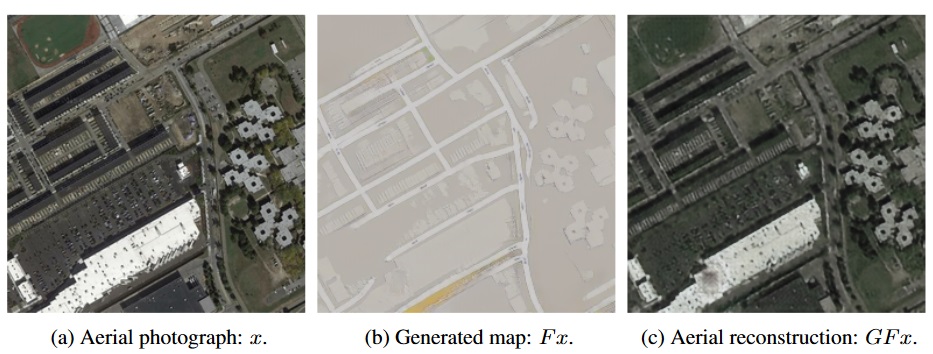
But deception is an inherent part of the generative network. After all, it's designed to try an fool the discriminative network and ultimately us humans. Recently, a generative network went well past the bounds of deception expected by its creators. The application is this: transform aerial images into street maps and back to automate much of the image processing for things like google maps.


The above images show the process. There's the original aerial photograph (a), the street view (b), and the synthetic aerial view (c) that's reconstructed ONLY from the street view (b).

But wait! Looking at image (c), which is constructed from ONLY image (b), how on earth did it guess where to put the air conditioning units on the long white build? Or the trees? None of those details are in the street view image (b), right?

It turns out that the network "decided" to cheat:
It learned how to subtly encode the features of one into the noise patterns of the other. The details of the aerial map are secretly written into the actual visual data of the street map: thousands of tiny changes in color that the human eye wouldn’t notice, but that the computer can easily detect.

In fact, the computer is so good at slipping these details into the street maps that it had learned to encode any aerial map into any street map! It doesn’t even have to pay attention to the “real” street map — all the data needed for reconstructing the aerial photo can be superimposed harmlessly on a completely different street map...
In other words, the street view map has gazillions of minute variations that aren't visible to the human eye that encode the data required for the remarkable aerial reconstructions.
This practice of encoding data into images isn’t new; it’s an established science called steganography, and it’s used all the time to, say, watermark images or add metadata like camera settings. But a computer creating its own steganographic method to evade having to actually learn to perform the task at hand is rather new.
Note the last sentence. The generative network wasn't very good at generating the reconstructed aerial view the way it was supposed to. So instead, it figured out how to encode the data it needed so it didn't have to learn how to do it the right way.

The thing I find most interesting is the emergent deception. Nobody predicted this would happen (since it wasn't a desired result) and I don't think anybody could've predicted it.

We're currently able to use multiple networks with hundreds of millions of connections and we're already seeing emergent behavior that can't be predicted. Every ten years gives about a factor of 100 increase in processing power and network complexity.

It will be interesting to see what emerges when thousands of networks with billions of connections interact.

Tuesday, April 03, 2018

Social Media May Be Really Unhealthy For Civilization

In an article I found fascinating, Jordan Greenhall describes a number of things about social media apps like Facebook that are detrimental to civilization. He groups them into four categories:

  1. Supernormal stimuli;
  2. Replacing strong link community relationships with weak link affinity relationships;
  3. Training people on complicated rather than complex environments; and
  4. The asymmetry of Human / AI relationships

Each category is too involved to describe here with any detail so I urge you to read the whole article. However, here is an excerpt from category (4):
Imagine if your spouse, your therapist and your priest all entered into a conspiracy with a team of world class con men to control and shape your behaviour. Sound a bit unsettling? Well consider what the Facebook algorithms alone know about you. Every conversation you have — even those that you type out but don’t send — are perceived by the Facebook AI, and then analyzed by technology designed by thousands of researchers schooled in the very cutting edge of psychology and cognitive neuroscience. 
Every conversation you have — and every conversation the other 1.4 billion people on the platform have. In one second, the Facebook AI learns more about how people communicate and how they make choices as a result of their communication than an average person will learn in fifty years.
This is somewhat of an exaggeration at this point, but won't be in a decade or two. AI is becoming more capable than humans in many areas and, to the extent that AI is "intelligent" at all, it's a completely alien intelligence. While it sometimes seems almost human, there's nothing human about it. For example, when you're having an oh-so-pleasant conversation with Siri or Google's Assistant or one of the many automated phone systems you regularly encounter, the entity with which you're conversing has nothing in common with a human. Nothing at all. It's not even programmed by a human in any sort of conventional sense. It's just an alien entity trained to do various tasks like set your alarm clock when you ask it to do so.

When the trainers train it to do benign and helpful things it will be (mostly) benign and helpful. However, if the trainers, such as those working for social media companies, train it to manipulate social media users via emotional and other human weaknesses in order to increase profits and power, it will do that too - without having any understanding whatsoever of what it's doing. It's not immoral, just amoral. In fact, the trainers themselves may not really know what they're doing. They may just be trying to sell more advertising or whatever.

The problem is that we are changing our behaviors in ways that are simply bad for social cohesion and civilization itself. We'll see how that works out. Even those of us who are a little older we'll get to see how this one works out because I believe much of the impact will be experienced within the next 20 years.

Related: Nvidia DGX-2 is 2 petaflop AI supercomputer for $399,000

Monday, February 26, 2018

God and the Collective

I've often stated the following analogy:
A neuron is to a brain (network of neurons) as a person is to the collective (network of people).
Here I'm defining "collective" as a "network of people," nothing more (yet), nothing less.

A neuron is a pretty complex and amazing cell, but it's nothing compared to the network of tens of billions of them with many hundreds of trillions of connections between them. A single neuron has some very low level intelligence all on its own (depending on how you define "intelligence") but has absolutely no capacity to understand the large network that it's part of or the capabilities of that network. In fact, it's only in modern times that we can even believe that our intelligence and consciousness are based in that network of neurons. Before that, it was assumed that something external, the "soul" or something similar, was the center of all that.

A human is a pretty complex and amazing animal, but it's nothing compared to the network of almost ten billion humans with tens of trillions of connections between them (yes, I've written this before, but it's worth repeating in my opinion). A single human animal does have intelligence on its own.

But can a single human animal understand the intelligence or agency of the collective?

To me, the answer is no, absolutely not.

Just like the neuron, individuals cannot even begin to comprehend the entity that is the collective. Many don't believe that there is an entity that is the collective that is anything more than simply an aggregation of individuals. Indeed, this is a central tenet of quite a few influential economists such as Mises and Rothbard. For example, here is a quote from Rothbard explaining his view:
Only individuals have ends and can act to attain them. There are no such things as ends of or actions by 'groups,' 'collectives,' or 'States,' which do not take place as actions by various specific individuals.
To me, this is analogous to saying "there are no thoughts within a brain that are not the result of various activity by specific neurons." To me, both this and Rothbard's statement are both true and not at the same time. Yes, a thought can't happen without specific neurons doing specific things, yet it is to ignore the elephant in the room to not recognize that a thought is so much more than just a bunch of neurons firing.

Yet if collective agency and action are so far beyond what we can comprehend, what's the use of even identifying the possibility of it? There may not be any, but I personally wonder if the focus on the individual, especially in libertarian and some conservative circles and even some liberal groups, has been taken too far to the detriment of both the collective and therefore everybody in it. After all, we can't survive individually without the collective.

One of the things I've noticed is that when I try to think about this collective entity is that it has a lot in coming with how people describe God (I'm not personally religious, but neither am I anti-religious). The collective entity may not be all knowing, but relative to an individual, it might as well be. The collective entity may not be all powerful, but again, relative to you or me, it's unfathomably powerful. And just like "God's Will," the collective's will is also unknowable and yet is extremely important because it's critically important to our individual destinies as well as the destiny of the future of human kind and perhaps even all of life. And while on the surface it would seem to make no sense whatsoever to pray to the collective, what if individual prayers led to prayers by larger groups which aligned needs and desires by significant fractions of the collective which did then influence the very powerful collective?

And what if, as social animals and then primates evolved, the ancestors of our species and then our own ancestors had this sense of something beyond merely the aggregation of individuals? Could that be the basis of the evolution of most people over the ages believing in God? Could it be that we both understood there was something more than the individual yet that entity was beyond understanding? Wouldn't many of the common conceptions of God fit pretty well with that?

Monday, December 18, 2017

The Age of Outrage

This article by Jonathan Haidt, to me, is the most insightful of the year and perhaps the millennium. It's tough to excerpt so I'll just provide the link.

Saturday, August 12, 2017

Individual Versus Collective

When I was 16, I was a communist, or at least very impressed by communism (I never signed on to a communist party or organization). I still consider "from each according to his ability, to each according to his needs" to be the single most powerful non-religious idea of all time and it's very simple and easy to understand as well. Over time, as I observed the world, read more about economics and politics, and interacted with others who had communist leanings, I started to become disillusioned with it. In 1983, I visited Czechoslovakia and Hungary (while still communist), and my disillusionment became complete (the folks in those countries were clearly very, very miserable). Talking to socialists and seeing communism in action were great cures for any affinity I might have maintained for that ideology. It was both the utter lack of opportunity and the completely lack of freedom that I found overwhelmingly problematic. Marxist communism is a very powerful idea, but it turned out to be a powerfully bad idea.

Since then, I've been "libertarian leaning" as libertarianism directly addresses both the opportunity and freedom issues of communism. Over time, interacting with libertarians, for example at Cafe Hayek, my enthusiasm for the libertarian ideology has lessened. I've concluded that I'd probably like all of these ideologies a lot better if they didn't involve people - people just always ruin everything! :-)

Communism is a form of collectivism, where collectivism identifies the collective as the entity of primary importance and the individual having less importance and perhaps way, way, waaaaay less importance.

On the other hand, the libertarian holds the individual sacrosanct and the collective as non-existent other than a simple, but utterly unimportant, grouping of the individuals. Because of this, the State/government are considered to be necessary evils at best and more often as unnecessary evils foist upon the unsuspecting masses by corrupt and power hungry politicians and bureaucrats. From this perspective, most actions of the collective and State are held to be morally wrong. Since the individual is sacrosanct, anything he produces is his so taxation is theft or taxation is slavery. Almost all restrictions on individual behavior, for example trade, are considered abhorrent, leading to slogans like protectionism is robbery.

My flippant response to the libertarian slogans above is that if taxation is theft or slavery and protectionism is robbery, then theft, slavery and robbery must not be inherently immoral so I ought to start engaging in such practices more often. Slightly less flippant is that there's a reason we have separate words like "taxation"; trying to equate them with words whose definitions they possibly have something in common is, to me, an attempt at a sort of Orwellian double-plus-good libertarian Newspeak. I mean, okay, but just trying to redefine words isn't particularly convincing to me.

But it is partly a matter of perspective. If the individual is sacrosanct, then it does seem to lead to slogans like taxation is slavery.  Since such slogans seem absurd to me, I've concluded that the principle of the sacrosanct individual is also absurd.

My 17-year-old daughter is extremely tenderhearted - scarily so some days. For example, if she sees an ant walking across the counter, she'll catch it, bring it outside, and release it. I haven't had the heart to break it to her that an individual ant cannot survive (and certainly has no purpose) without access to its colony and by removing the ant from the ant trail it's on, it has been effectively removed from its colony and is a dead ant walking. I'm afraid if I tell her that, she'll stress out every time she sees an ant inside the house; she doesn't like bugs so she won't want to just let it be and she won't want to cause its death by removing it from its ant trail. Yup, life has many tough dilemmas.

An individual ant can't survive without its colony. Can an individual human survive without a collective? If you were dropped off in a random wilderness area with nothing (perhaps not even clothes) and you weren't allowed to interact with any other people or utilize anything made by anybody else, how long would you survive? Even if you had extensive survival training? How long until you cut yourself and the infection killed you? How long until something you drank or ate made you so sick that you died? How long until a series of storms caused hypothermia? Etc.?

Personally, I'd be dead in short order. I've done enough wilderness camping to know that even with modern gear, it's not trivial surviving for moderate to long periods of time. My guess is that maybe 1% of people could survive a year with training, maybe 1 in 1,000 could survive 10 years. Eventually, one of the many things that could go wrong would catch up to almost everybody. There's safety in numbers and there's support in numbers.

But now let's add the last wrinkle. Not only do you have to survive, but you have to have a mate and have at least two children and have the children survive until adulthood. Without any help from anybody else. Ever. All I can say is "good luck with that!"

In other words, just like an individual ant isn't really something independent, neither is an individual human. Humans evolved while being part of collectives (tribes in primitive times). Humans' ancestors evolved while being part of collectives (tribes and packs). A few humans might be able to survive as completely independent entities but it is, at best, not optimal.

Humans are more complicated than ants, and, as a result, our collectives can be much more flexible and varied than an ant colony. We can have tribes and nations and states and empires and commonwealths and subcultures and all kinds of political and economic structures and structures within structures and each individual can be part of numerous collectives and those collective can be overlapping. The possibilities are endless and dizzying. And fortunately, unlike the ant that can only belong to one specific collective, humans can, to some degree, pick and choose which collectives they wish to belong to.

We're all part of collectives. Within each of our collectives we are bound by loyalty, contract, agreement or something like that to others in the collective to some degree. By definition, we are "bound" by "bonds" and "bondage" is composed of a set of "bonds." Furthermore, "bondage" and "slavery" are very closely associated.

It's not taxation that's slavery, but rather the circumstances of human existence that requires us to be bound to others in what might actually be slavery (slavery/serfdom has been one of the most common forms of human existence for all of history and prehistory) or what in a free(ish) society might be termed co-slavery where we're bound to each other, where I own you (you have obligations to me) and you own me (I have obligations to you) though indirectly through the collective.

To me, this makes the collective primary and the individual secondary. My starting point is that the largest and most powerful collective of which we are part actually does completely own us and has the right to all of our output and the right to control each and every aspect of our behavior and lives. I'll get to why this isn't nearly as abhorrent as it sounds in a bit so please don't freak out quite yet. Well, you can freak out a little, but please keep reading. :-)

With the collective owning us, taxation is neither slavery (we're already owned by the collective) nor is it theft. In fact, what isn't taxed is basically given to us by the beneficence of the collective. Protectionism isn't robbery at all but rather some non-protected trade is allowed due to the kindness and lenience of the collective.

While I'm serious about taxation not being slavery using the logic above, I am kidding about the collective having "kindness" or other positive human attributes. A 300,000,000+ person collective cannot have human attributes such as kindness - at least not in any way that an individual human can understand.

But a collective does have one attribute that is understandable by humans - Will to Power.
Each form of life has a particular constitution, with its instincts having different strengths, such that certain conditions will favour its form of life. This brings different types of life into conflict with each other, as each wants different conditions to prevail: ‘life itself in its essence means appropriating, injuring, overpowering those who are foreign and weaker’ ... though this language suggests that such activity is immoral, when it is simply a function of being alive.
A collective is a life form, though not one comprehensible to the individuals who make up the collective (similar to a brain being incomprehensible to a neuron). Its "instincts" will push it to evolve in order to adapt so that "certain conditions will favour its form" enabling it to succeed at "overpowering those [collectives] who are ... weaker." There are some subtleties, but this is very similar to survival of the fittest applied to collectives instead of lifeforms as described by Nietzsche. In other words, collectives compete and evolve. This has certainly happened throughout history and isn't much of a surprise.

How does a collective succeed in surviving and exerting its Will to Power? How does it manage to fend off and even "overpower" competing collectives? Well, that's the rub. It depends on the collective and the environment within which the collective exists. Evolution doesn't have a direction but is really always co-evolution, with each entity evolving relative to the current state of all other entities. Even worse, except for some very small and very well defined collectives (for example, a company that operates a restaurant), the collective and the environment within which it operates has complexity far, far, far beyond the capability of human understanding.

The collective that we call the United States of America is one result of billions of years of biological evolution and tens of thousands of years of cultural and political evolution of homo sapiens in the context of uncountable events around the world and the context of its North American location. It could not have been designed by people and people could not have and can not, from a blank start, design anything better.

Given that I believe that the collective that is the United States owns us and has absolute power over us, why do we have any freedom at all? One answer is that while the collective owns us, we also own the collective and can therefore influence it. However, I don't think that's the main answer.

The main answer is simply that collectives with free(ish) individuals in today's global environment end up being the most powerful collectives. Across the globe, freedom and power per capita are closely related. Within limits, freeing individuals to do what they think best seems to allow for innovation and productivity and those two things are an important part of the basis of increasing power.

Our prosperity and our rights have evolved to this point primarily for that reason, in my opinion. Not because of some intangible moral arguments about peace and love and non-aggression and what's right and what's good. Not because the individual is sacrosanct or because of god given human rights. While there is feedback (the ideas had to come from interacting individuals) and it is a bit of a virtuous cycle, ultimately we have our rights and freedoms because they brought us power and those opposing collectives who didn't give those rights and freedoms to their members lost in the battle of Will to Power. Are there other factors? Of course, but I think this is a very important one.

For additional power and sustainability, should the collective allow more freedom or less freedom? More regulation or less regulation? More rights or fewer rights? I have my guesses but I don't really know and I think I'll leave those guesses for other posts.

Saturday, May 06, 2017

Is Technology Hiding Political Decay?

Perhaps most or all of you had seen this, but I had not. From Arnold Kling almost a decade ago:
Mencius Moldbug proposes a thought experiment.
Imagine that there had been no scientific or technical progress at all during the 20th century. That the government of 2008 had to function with the technical base of 1908..

[Conversely, imagine] what would become of 1908 America, if said continent magically popped up in the mid-Atlantic in 2008, and had to modernize and compete in the global economy - tell a different story. I am very confident that Old America would be the world's leading industrial power within the decade, and I suspect it would attract a lot of immigration from New America. 
...if we imagine the 20th century without technical progress, we see an almost pure century of disaster... 
a decaying system of government has been camouflaged and ameliorated by the advance of technology.
That is, today our elderly are affluent, our poor are more likely to be obese than hungry, and so on, in spite of rather than because of changes in the role of government. Obviously, that point of view is debatable. Still, if you had to choose between 21st-century technology alongside 19th-century government institutions vs. 21st-century government institutions alongside 19th-century technology, you would choose the former, no? If nothing else, the delta in technology is more strongly positive than the delta in government institutions, even if you disagree with Moldbug that the delta for the latter is negative.
Moldbug considers himself a reactionary (way farther right than a conservative) so he would certainly consider the non-technological aspects of last century a disaster.

There's no doubt in my mind that if technology hadn't advanced in the last century or so that white males in the United States would have become far, far worse off, so I'm sure than I'm unable to have a unbiased opinion on this. But from my horribly biased perspective, it does look to me like technological advancements have covered up for a net negative for nearly every group in every region of every country. Without those technological advancements, the world would be a really grim place right now for just about everybody.

It also seems that the wealth created by the technological advancement has enabled us to damage the cultural fabrics of the world without suffering the full effects and, as a result, has left the world in an unfortunately fragile state.

Friday, April 14, 2017

The Importance of Nationalism

Once upon a time, long ago in approximately 1162 AD and faraway in desolate and nearly inhospitable mountains a barbarian boy was born and named Temüjin. The first few decades of Temüjin's life were really miserable, even by the barbarian standards of his environment (which included tribal warfare, thievery, raids, corruption, revenge, and interference from neighboring powers). When he was 9-years-old, his father was poisoned and then his family was completely destitute, living off wild fruit, carrion, and whatever small game he and his brothers could kill. He was caught and enslaved when he was around 15 years old. Bummer!

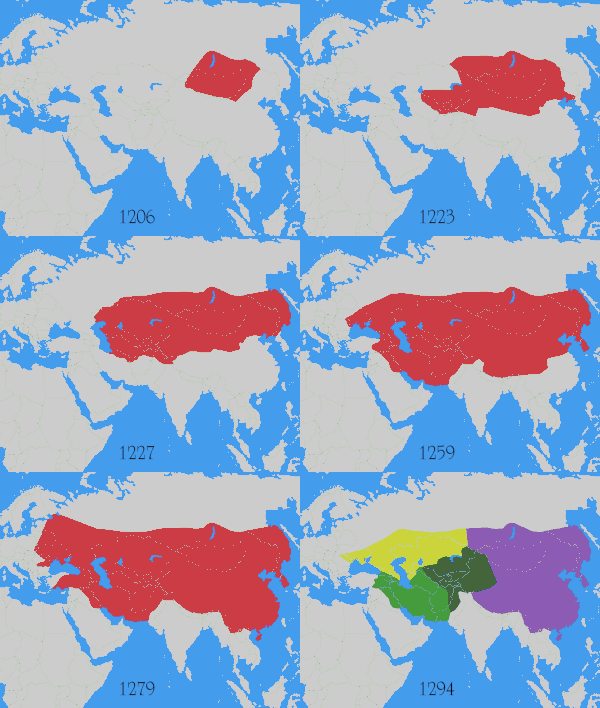
That was probably the low point of his life. He eventually escaped slavery and things generally got better for him (with some ups and downs) from there. For example, during the the period starting when he was 35-years-old to 80 years later, he and his descendants conquered the world; well, not all of the world, merely the portions shown below.


Not all of the world, but in 1279 it was the largest contiguous empire ever (even to this day), totally dwarfing the Roman Empire, for example. Not all of the world, but he was an uneducated barbarian with the rather shaky start described above. Not all of the world, but he did it with the barely beyond stone-age technology of bows and arrows and horses. Think about conquering the area in the map above with just horses (my bottom hurts just thinking about it)!

Somewhere during his conquests, Temüjin became known as Genghis Khan which is how he is remembered today. Scientists estimate that 1 in 200 people are descendants of Genghis Khan, making him one of the 11 most prolific fathers of all time (9 of the 11 are unknown in history).

The horrors of nationalism and religion have been drilled into me my whole life. I've been told about all those people killed by this or that religious atrocity and this or that nationalistic war. Genghis Khan was neither nationalistic nor religious (there's no Genghisstan, for example). But he was possibly the bloodiest, most murderous person in all of history. For example, after conquering Urgench in central Asia, he slaughtered more than a million people in a mere few days. A million people represented 1 in 400 people on earth at the time. All told, the Mongol conquests killed about 10% of the people on earth. Genghis Khan might be considered directly responsible for the deaths of a larger percentage of the human population than anyone else, ever.

So why was this random barbarian able to conquer such a vast area? The pat answer is that he was a brilliant strategist and politically innovative. And that may well be true.

But I don't think that's the most important part. Genghis Khan didn't conquer any nations, not really. There simply were no nations in his path. At least not nations in the sense that if you attack even a tiny corner of the nation, millions upon millions of people will rush to their defense and drive off the attackers. Instead he just rolled through one city-state after another, none of which had an even remote chance of defending themselves. Even the most populous ones were sitting ducks.

One meme shared by progressives and libertarians is that political borders are at least somewhat immoral; that nationalism is quite immoral and responsible for many of the horrors of the last century; that eliminating nations and national sentiment would be very positive for humankind; that one shouldn't care more about someone from Mississippi than someone from Mozambique; etc. They both make similar critiques about religions.

I don't agree with those assessments. One can argue that Hitler was an insane genocidal maniac who hijacked a whole nation and caused misery nearly beyond comprehension and that if nations didn't exist, Hitler wouldn't've been able to do that. Maybe, but I don't think so.

Because, what about Genghis Khan? He was as simple as simple could be. He was simply a predatory mammal looking to extend his legacy like all (non-domesticated) predatory mammals. And he certainly succeeded. He wasn't insane. He wasn't religious. He was very tolerant of ethnic and cultural diversity:
The Mongol Empire did not emphasize the importance of ethnicity and race in the administrative realm, instead adopting an approach grounded in meritocracy. The exception was the role of Genghis Khan and his family. The Mongol Empire was one of the most ethnically and culturally diverse empires in history, as befitted its size. Many of the empire's nomadic inhabitants considered themselves Mongols in military and civilian life, including Mongols, Turks and others and included many diverse Khans of various ethnicities as part of the Mongol Empire such as Muhammad Khan.
If you crossed him, he would raze your city and murder everyone in it (except for the skilled artisans and the women, of course - how do you think 1/2% of the current day population are his descendants? Hmmm?). Very simple, really. But as long as you surrendered to him and didn't cross him, he was much more interested in your abilities than your religion or ethnicity.

There will always be people like Genghis Khan and Hitler. After all, we are predatory mammals, and some of us will simply be better predators than the rest of us.

The way I see it, nations and nationalism stopped Hitler from taking over the world. England, Russia, the United States, and others had the nationalistic fervor that drove them to stop him. It was awful, but it was stopped.

What Genghis Khan did was awful too.

And there were no nations to stop him. Only the technological limitations of the horse and bow kept him and his descendants from extending their empire even further.

If there were no nations and no nationalism, then we're essentially a bunch of city-states and the next Genghis Khan will take over the world, just like the Mongols created their empire.

Monday, February 27, 2017

The Darkness of Light - A Story of Economic Scale

Once upon a time, long ago and far away, it was a dark and stormy night in a small village. Like most small villages of the era, its existence was due to the goods and services its craftsmen provided to the surrounding farmers and to each other. There was a butcher, a baker, and a candlestick maker and a number of other crafts represented (blacksmith, cobbler, etc.). This trading network of a few hundred people (including farmers) was nearly completely self-sufficient, except for the occasional traveling merchant who brought in some critically important goods as well as some more frivolous and luxury goods. This pre-industrial village, while mostly self-sufficient was also quite poor by modern standards as the small size of this economy couldn't enable sufficient specialization to support modern goods and services, even if all the knowledge of the modern world was readily available and understandable.

Glim, the village candlestick maker was happy with his life. His family had always been the candlestick makers in this village and it was comforting to know his place in life. As he gazed out into the storm, he could see flickers of light emanating from the other homes in the village and he had satisfaction knowing that some of that light was his candlesticks pushing back the darkness and providing comfort to the other villagers.

He had to work hard and was hardly rich, but was prosperous enough to support himself, his wife, and his three daughters. When the traveling merchants came to town, he was able to afford some necessities and even an occasional luxury item like the exotically patterned and very warm rug that sat on the floor of his bedroom. In fact, merchants had just arrived that particular evening and would open their booths to trade their wares the following morning. This was good, because Glim's wife was running short on spices, and they could likely remedy that by trading with the merchants in the morn.

When morning came, Glim and his wife went to trade with the merchants. The merchants had their typical wares available, but to Glim's shock and dismay, the merchants had table after table with numerous varieties of candlesticks, and, after inquiring about the price of the candlesticks, Glim discovered that they were selling for less than half the price of Glim's candlesticks. The merchant explained that a village about 50 leagues away (that had recently been renamed Candleton) had discovered a technique that enabled a few dozen people, working together, to churn out an enormous quantity of candles at very low cost and very high quality. Glim was devastated, because he could not make enough money selling his candles at a competitive price to feed his family and survive. Glim, the candlestick maker, was now out-of-business and had no other skills or ways to earn a livelihood.

So now, dear reader, I'll let you choose the fate of Glim and his family. Perhaps the kind villagers, through a mix of charity and giving Glim odd jobs, kept Glim and his family from becoming destitute. Perhaps Glim tried to farm and maybe he succeeded or maybe his family starved. Perhaps Glim moved his family to Candleton where maybe they needed him but maybe they didn't. Perhaps Glim and his wife fell into the depths of despair and drank themselves to death leaving his daughters to become prostitutes in order to survive. Whatever you choose, dear reader, Glim is probably out-of-luck, and your story for him has been repeated countless times over the ages. Chances are, his level of prosperity is probably going to be lower for the rest of his days than it would've been had the folks at Candleton not invented the new candlestick making process.

But Glim's tough luck is everybody else's good luck. Everybody else gets more candlelight for less. And the villagers in Candleton? They're hugely prosperous, especially at first. After a few years, they split into competing companies which drives their prosperity down a bit but makes candles even cheaper for the surrounding villages.

The benefit of more candlelight turned out to be extraordinary. More people learned to read and that additional knowledge inspired a wave of discoveries and inventions. While more folks like Glim lost their livelihoods, new jobs were created at a rapid pace during this heady time of economic and technological growth. In fact, Glim's grandchildren (perhaps bastards born to his daughters when they turned to prostitution?), opened a printing press and shop and became quite prosperous. Too bad Glim never lived to see it (or perhaps he did, dear reader, in your version of Glim's fate?).

Over the next few generations, electricity was discovered and then harnessed to power a very important invention: the electric light bulb. Which brings us back to Candleton.

Between the time of Glim's misfortune and the invention of the lightbulb, Candleton prospered hugely. A hundred people now worked in the village's three candlestick making factories. Further innovations had increased the number of candlesticks made and lowered the cost. Because of the economies of scales, no other village could compete and Candleton provided the vast majoritiy of candlesticks to all villages for hundreds of leagues in all directions.

But now the electric light bulb, being vastly superior to candles, and lasting months instead of hours, rendered the candlestick making talents of the inhabitants of Candleton useless nearly overnight. Revenue ceased to flow into the village. Unlike the case with Glim, where it was one guy and his family who were directly impacted, and where, at least conceivably Glim's fellow villagers could help sustain him, the residents of Candleton were immediately in extremely dire straits: no revenue, no food, no nothing.

Some of the residents of Candleton left to seek their fortunes elsewhere. Some tried to live by hunting. Many, however, became bandits, stealing from travelers and raiding nearby villages. The other villages organized defenses and the clashes with the bandits became increasingly bloody and deadly as all sides became increasingly desperate. After a decade or so, the bandit population dwindled and the area became mostly peaceful once more. Candleton, however, was left in ruins and became a ghost town with the wilderness encroaching on and then devouring the once prosperous village.

That was tough luck for Candleton, it's inhabitants, and the neighboring villages who had to endure the onslaught of desperate bandits, but the surrounding regions were made much better off by the new electric light. The difference between the innovation that hurt Glim and the one that destroyed Candleton is scale. One guy (Glim) losing his livelihood has limited impact. A whole village losing its livelihood is much more catastrophic and much harder for the residents to recover from because there simply aren't the resources from which to build.

With the harnessing of electricity numerous inventions came about and many of these inventions enabled more complex products requiring larger networks of people to create them causing villages to consolidate into towns and towns into cities. In one such city, Carton, thriving automobile and tractor manufacturing companies were created. The tractors made farmers much more productive and the displaced farm workers came to Carton to work in the factories. Jobs were created more rapidly than jobs were destroyed and a large number of jobs required only minimal and/or quickly learned skills. It was a time of great prosperity and economic advancement.

There were over one million inhabitants in Carton, with occupations ranging from miners gathering the raw materials for the cars to school teachers and other supporting professions. People did lose jobs as processes were changed and innovations implemented but such was the prosperity that new endeavors requiring yet more low-skilled workers were being formed all the time, so work was available for all.

In fact, the great prosperity and constant need for labor sowed seeds of problems in the future. The workers realized they could band together and collectively bargain for higher pay, better working conditions, and greater benefits. Management, in return, made the benefits accrue to the future in terms of pensions and health benefits after retirement. The prosperity also enabled management to become lazy and corrupt and they lined their own pockets and did things like hiring incompetent children and nephews.

After a few more decades, the perfect storm hit. Saddled with increasing wages and pension costs from collective bargaining and corruption and incompetence due to human nature, new and distant competitors simultaneously began manufacturing not only cars and tractors, but also steel and other raw inputs. The distant competitors were not saddled with the liabilities of Carton, and ended up having a huge comparative advantage relative to Carton's factories and workers with respect to Carton's products. While this happened over years, Carton and surrounding region was devastated. Hundreds of thousands of people were out of work, poverty and crime skyrocketed, alcoholism and drug abuse decimated the productivity of the potential workforce, and because total revenues declined below subsistence for the population as a whole, and because it was an area for which there was no particular reason for outsiders to invest, people became increasingly desperate.

Along came a leader, Trunald Domp, who realized that while Carton and its people no longer had a comparative advantage in anything productive, they did, like many desperate peoples in the pits of despair who feel they have nothing left to lose, have a yuge comparative advantage in violence. So he organized the people of Carton to produce arms and they attacked the surrounding areas. The bloody war killed tens of thousands of people but eventually Domp and Carton were defeated. The remaining people of Carton fled their collapsing city increasingly desperate to find any means of staving off starvation. The were, of course, met with suspicion and outright hostility, and many were killed on sight. The ones that survived became an underclass and there were frequent violent revolts. Eventually distrust and hatred built to such a fevered pitch that the entire civilization collapsed and everybody died except for a small fraction of the population that fled into the wilderness and formed small groups of farms surrounding small villages. These villages were too small to maintain any sort of advanced economy so they reverted to pre-industrial levels of goods and services.

In one of these villages, a man named Flick was the candlestick maker. It turns out he was a distant descendant of Glim. Flick was proud of his occupation because his candlesticks pushed back the darkness and provided comfort to his fellow villagers.

---

The bigger the scale of the economic trading networks, the more destabilizing the destructive part of Schumpeter's Creative/Destruction. Tough luck for Glim, but everything was perfectly stable and everybody else was more prosperous. Tougher luck for Candleton and the surrounding areas with the bandits but most people were not only unaffected but also much more prosperous. But toughest luck for all for Carton and the rest of the world, where nobody came out ahead. Once a region is sufficiently devastated, there's little hope for the investment and resources required for recovery. The region itself simply doesn't have the resources and outsiders are unlikely to invest in such an unstable and risky region.

Moral of the story: don't put people in a position where they feel they have nothing left to lose - it won't end well for anybody.

Wednesday, August 10, 2016

Go Forth and Multiply

A couple of paragraphs in an article titled How Anti-Discrimination Became a Religion, and What It Means for Judaism caught my eye (don't ask me how I happened upon that article - I have absolutely no idea!):
As for those who remain active members of the Jewish community, they will be divided among a large but shrinking cohort of mostly Reform and other religiously liberal Jews; a smaller but vigorous group of modern and centrist Orthodox Jews joined by remnants of the rapidly declining Conservative movement; and a large and rapidly growing group of ḥaredi or “ultra-Orthodox” Jews. 
At some point, indeed, this last-named group, whose current rate of per-year population growth stands at an astonishing 5.5-percent, will form a significant element of the public “face” of American Jewry.
Before I get to my main point, I first have to point out that even though I'm jewish through ancestry (though non-practicing), ultra-orthodox Jews are as strange and exotic to me as the Amish or Tibetan monks or something like that. For example, if, for some reason, I suddenly decided that I needed to go to some sort of religious service, while my first choice would be a Reform Jewish service, I'd much rather go to, oh, I dunno, let's say a Methodist service or something like that, rather than an ultra-Orthodox Jewish service.

As far as I can tell, the ultra-Orthodox could never really be the "face" or in any way representative of all American Jews. Or, at least, I rather hope not.

But there is that population growth thing to consider. 5.5 percent per year really is astonishing (basically more than doubling every generation and amounts to over 6 children per woman on average) and if maintained, would indeed eclipse the rest of the shrinking American Jewish population in just a handful of generations.

What really caught my attention, though, was how well this real-life scenario potentially fits the population simulations I did a while back:
The simulation is fairly simple. Start with a population of 1,000,000,000 people. There are two types of "genes" in this population. The most common and also dominant gene is the "barren gene" and compels its individual to produce one child on average. Given that it takes two parents to produce a child, if this were the only "gene," the population would halve every generation and mankind would indeed go extinct in only a few hundred years.

The second "gene" is the "fruitful gene" and potentially compels its individual to have three children on average. However, since this "gene" is recessive, the individual is only compelled to have three children if he or she has two of these "genes." At the start of the simulation, only five-percent of the genes are of this type. So not only is it recessive, it's also rare. If a double "fruitful" mates with a someone with at least one "barren gene", they split the difference and have two children.
This very pessimistic simulation shows the population dropping fairly precipitously for 15 to 20 generations until the "fruitfuls" finally become common enough to overwhelm the "barrens" and then the population comes roaring back in 20 to 30 generations.

Here, in real life, the non-ultra-Orthodox American Jews pretty much follow the "barren" pattern (somewhat more than one child per couple) and the ultra-Orthodox Jews are more than "fruitful" (more than 6 children per couple), at least at the moment. In addition, unlike the simulation where all mating is random making it unlikely for the rare "fruitfuls" to mate with each other until enough "barrens" have died out, the ultra-Orthodox clearly seek each other out at a far greater rate than would occur in random mating.

That's why when some folks get to hand-wringing about falling birthrates, I'm far from concerned. Some group will always be happy to go forth and multiply and be there to inherit the earth.

Friday, June 24, 2016

Brexit! Texit?

The British voted to leave the EU.

I realize that the political structure of Britain within the EU is different than the political structure of Texas within the United States, but if Texas wanted to leave, from the perspective of human rights and the right of self determination, would a TEXIT be that much different than a BREXIT?

Tuesday, April 12, 2016

Skins weren't always so thin

When humor goes, there goes civilization. Erma Bombeck
Read more at: http://www.brainyquote.com/quotes/quotes/e/ermabombec131317.html
When humor goes, there goes civilization. Erma Bombeck
Read more at: http://www.brainyquote.com/quotes/quotes/e/ermabombec131317.html
When humor goes, there goes civilization. Erma Bombeck
Read more at: http://www.brainyquote.com/quotes/quotes/e/ermabombec131317.html
 
 
When humor goes, there goes civilization.  - Erma Bombeck

Instapundit linked to an interesting post at brothersjuddblog:
Sales of 'Caucasians' shirts, depicting the Cleveland Indians' team mascot as a caricature of a white person, skyrocketed one day after ESPN's Bomani Jones wore one on a show, the shirt's creator said Friday.


The conclusion at  newsbusters:
So, in other words, Bomani Jones’ stunt backfired. He wore the shirt to provoke anger on the part of white people by flipping the tables and exposing them as hypocrites for being offended by ‘Caucasians,’ while they cheer for the Redskins, Chief Wahoo, the Braves, and so on.
Except very few, if any, white people are offended by the shirt. Proving the opposite of Jones’ point. And that maybe, just maybe, it’s time for race hucksters like Bomani Jones to get a life.
As the Erma Bombeck insight makes clear, humor make life bearable...

The way to make a pluralist multiculturalism workable is demonstrated by  Sultan Knish:
When the Yankees play baseball in the Bronx and the Knicks hit the court at Madison Square Garden, the two teams may belong to different sports, but they're both part of an exchange of taunts and slurs that no one remembers or cares about anymore.


The Knicks are short for the Knickerbockers, one of the derogatory names that English New Yorkers called the Dutch New Yorkers whom they had seized the city from. And the Dutch returned the favor by calling the Anglo newcomers, John Cheese or Jan Kees, which eventually became Yankee.

The English mocked the Dutch and the Dutch mocked English and then both terms became part of the city's cultural heritage and even a point of pride. Yankee may still have a derogatory meaning in the South and in Europe, but in New York, it's on every other baseball cap and the Knicks are on every other jersey; including some of the shorts that resemble the Knickerbockers of the Dutch.

This sort of thing happens a lot in a multicultural society. What used to be a point of insult, blends into the common cultural heritage. The minority teenagers wearing Knicks shorts and Yankees caps care as little about the Dutch and English slurs that got the whole thing started as they do about the Redskins, a term that is as equally out of date and nearly as obscure. 

...
The firemen of tolerance are also the arsonists of intolerance. They start the fires and then put them out. The debate over the Redskins is a classic example of setting a fire and then declaring that they should be able to do whatever it takes to put it out.
...
Liberals nurtured on Orientalism and worries about cultural appropriation are uncomfortable with that; but that's their problem. It's perfectly normal for the old wounds to become the bonds of a new society. It's part of the healing process. It's post-racial and post-everything in a good way.
...
The common American identity was based on the integration of the good and the bad, the loves and the hates, the resentments and the joys, it combines the high and low points of culture, it mixed together aspirations and slurs, baked it together into something strange and wonderful.
...
Liberal political correctness is obsessively consumed with the destruction of any common culture not mediated by their commissars. Their divisive efforts seem calculated to break down any areas where co-existence occurs because the great threat to their political power would come from the revelation that they are not the firemen of tolerance, they are the arsonists of intolerance, setting groups at each other and then stepping in to referee the results.

Promoting the taking of offense at nearly any possible slight is very unhealthy.  Yes, we can get along if our elites stop trying to divide us for their convenience.

Sunday, December 13, 2015

Smackdown

Phony moral posturing is such a mainstay of SJWs.  Dinesh D'Souza schools a student at Amherst College.  Worth the time.

Sunday, November 29, 2015

Despotism of the collectivists

George Will shares his thoughts on the distortions created by the administrative state:
As the administrative state distorts the United States’ constitutional architecture, Clarence Thomas becomes America’s indispensable constitutionalist. Now in his 25th year on the Supreme Court, he is urging the judicial branch to limit the legislative branch’s practice of delegating its power to the executive branch. 
Particularly, it should prevent Congress from delegating to executive agencies the essentially legislative power of formulating “generally applicable rules of private conduct.” Such delegation, Thomas says, erases the distinction between “the making of law, and putting it into effect.” This occurs when Congress — hyperactive, overextended and too busy for specificity — delegates “policy determinations” that “effectively permit the President to define some or all of the content” of a rule of conduct.

This delegation of power to administrative agencies transfers power to unelected officials.  The linkage to accountability of the elected executive is much weaker than ever intended in our constitutional order. Experience with and knowledge of the problems emanating from such an approach exists.

This ties in nicely to the problem of soft despotism and more specifically the relevant thoughts of Walter Lippmann as expressed in Soft Despotism, Democracy's Drift by Paul Rahe:


The progressives expressed great admiration for Abraham Lincoln, and they tended to justify their endeavor with an appeal to the American Founding Fathers and to speak of their aim as the achievement of Jeffersonian ends by Hamiltonian means.  But the truth is that Herbert Croly, Walter Lippmann  ... John Dewey, and their associates aimed at the foundation of a new political regime, distinct from and, in certain critical respects, opposed to the one that had gradually taken shape in the period stretching from 1776 to 1789, which Lincoln later strove so mightily to defend.  To this end, they abandoned not only Jefferson but Hamilton and Lincoln as well, dismissing as outdated the concern with individual, natural rights that the three men shared; rejecting as wrongheaded and outmoded Jefferson’s argument for the virtues of political jealousy and his insistence that vigorous local self-government is essential to the maintenance of liberty; and substituting for Hamilton’s notion of statesmanship and for that of Lincoln an account—grounded in Hegel’s confidence in the inevitability of human progress, owing a great deal to his discussion of the civil service as a “universal class” in his Philosophy of Right, and informed by a truncated reading of Rousseau’s Social Contract – which was incompatible with the principle of limited government and closely akin in its practical aspects to the vision of rational administration once projected in France by Anne-Robert-Jacques Turgot any by the Physiocrats.  To America from Germany, the progressives brought an especially virulent strain of the French disease.  (pp. 245-6)


… “The old ‘rights of personal competency,’” valued by Jefferson, “the right to read, to think, to speak, to choose, and live a mode of life must be respected at all hazards,” but “property rights” would have to give way, for, he (TR) proudly announced, “the day of enlightened administration has come.” 
No one saw the consequences as clearly as did Walter Lippmann, for no one was as well-positioned as he.  Lippmann had been a leading progressive.  At Harvard College, he had dabbled in socialism.  Some four years after his graduation, he had joined Herbert Croly and Walter Weyl in founding The New Republic, and in 1914, he had published the influential progressive tract Drift and Mastery: An Attempt to Diagnose the Current Unrest.  For a brief time, during the First World War, Lippmann had been an advisor to Woodrow Wilson.  After the war, in which he witnessed the effectiveness of propaganda, Lippmann began to harbor doubts about the progressive conviction that popular sovereignty and governance by experts can easily be reconciled.  In Public Opinion, published in 1922, he called into question the capacity of ordinary citizens to discern what was going on; and in The Phantom Public, published five years later, he expressed doubts as to whether it made any sense at all to speak of the public interest in the manner in which the progressives did: as something radically distinct from and in tension with individual rights and the diverse private interests of the citizens. 
In 1932, thinking that there was no alternative, Lippmann voted for Franklin Delano Roosevelt.  But by 1937 he had come to entertain grave misgivings.  He had noticed that, while, the partisans who are now fighting for the mastery of the modern world wear shirts of different colors, their weapons are drawn from the same armory, their doctrines are variations of the same theme, and they go forth to battle singing the same tune with slightly different words… 
Throughout the world, in the name of progress, men who call themselves communists, socialists, fascists, nationalists, progressives, and even liberals, are unanimous in holding that government with its instruments of coercion must by commanding the people how they shall live, direct the course of civilization and fix the shape of things to come… The premises of authoritarian collectivism have become the working beliefs, the self-evident assumptions, the unquestioned axioms, not only of all the revolutionary regimes, but of nearly every effort which lays claim to being enlightened, humane, and progressive. 
So universal is the dominion of this dogma over the minds of contemporary men that no one is taken seriously as a statesman or a theorist who does not come forward with proposals to magnify the power of public officials and to extend and multiply their intervention in human affairs.  Unless he is authoritarian and collectivist, he is mossback, a reactionary, at best an amiable eccentric swimming hopelessly against the tide.  It is a strong tide.  Though despotism is no novelty in human affairs, it is probably true that at no time in twenty-five hundred years has any western government claimed for itself a jurisdiction over men’s lives comparable with that which is officially attempted in totalitarian states… 
But it is even more significant that in other lands where men shrink from the ruthless policy of these regimes, it is commonly assumed that the movement of events must be in the direction.  Nearly everywhere the mark of a progressive is that he relies at last upon the increased power of officials to improve the condition of men.


What worried Lippmann the most – what had worried Coolidge, and what should worry us still – was the failure of those who considered themselves progressives to “remember how much of what they cherish as progressives has come by emancipation from political dominion, by the limitation of power, by the release of personal energy from authority and collective coercion.”  He cited “the whole long struggle to extricate conscience, intellect, labor, and personality from the bondage of prerogative, privilege, monopoly, authority.”  It was, he said, “the gigantic heresy of an apostate generation” to suppose that “there has come into the world during this generation some new element which makes it necessary for us to undo the work of emancipation, to retrace the steps men have taken to limit the power of rulers, which compels us to believe that the way of enlightenment in affairs is now to be found by intensifying authority and enlarging its scope.”

Americans were used to managing their own affairs by way of local and state governments; they had forged political parties for this purpose, and they were instinctively reluctant to cede control to a centralized administration dominated by a distant and patronizing intellectual elite. 
In fits and starts, however, under the influence of progressive political science, the administrative state began to take shape in the last decades of the nineteenth century and in the first two decades of the twentieth century – at first, locally, and, then, at the national level.   (pp. 253-5)


Our new masters have it in their power to deepen the economic crisis and worsen our distress in the manner of Hoover and the younger Roosevelt.  By instituting a second New Deal, as they very much like to do – by sharply raising taxes on fossil fuels, dividends, and capital gains; by targeting the earnings of the well-to-do; by pursuing protectionism, expanding the regime of programmatic rights, and forcing workers into labor unions – they can discourage investment, curb entrepreneurship, reduce foreign trade, and decisively slow economic growth, or even bring it to a lasting halt, while offering to those consigned to the dole thereby a dependence upon the generosity of an all—encompassing state.  Just how ruthless they will prove to be on this occasion, just how far they intend to hustle us down the path we tread, remains as yet undetermined. 
The only thing that is crystal clear is the direction of our drift and the nature of the threat we face.  Walter Lippmann’s warning is as apt today as it was in 1937 – for “the premises of authoritarian collectivism” are once again, as they were then, “the working beliefs, the self-evident assumptions, the unquestioned axioms” behind “nearly every effort which lays claim to being enlightened, humane, and progressive,” and hardly anyone today “is taken seriously as a statesman or a theorist who does not come forward with proposals to magnify the power of public officials and to extend and multiply their intervention in human affairs.”  Like the younger Roosevelt, our new leader poses as a secular Messiah; his minions believe, as did the progressives of an earlier time, that there has recently come into the world “some new element which makes it necessary for us to undo the work of emancipation” achieved by our forebears and “to retrace the steps men have taken to limit the power of rulers”; and in the ranks of our compatriots they will find many prepared to sacrifice self-reliance and personal independence for a promise of security no government can keep.  The hour is, indeed, late. 
To those caught up in the maelstrom, recent developments may well seem dramatic, but, in truth, they serve merely to highlight the plight that we have been in for more than three quarters of a century.    (pp. 269-270)

Those of us who despise hard tyranny might want to consider the importance of resisting and even rolling back soft tyranny as well, lest it lead us someplace we have no wish to go.