Search This Blog

Showing posts with label weapons. Show all posts

Wednesday, September 06, 2017

Insurance

If you were a tiny secretive country, with a wrecked economy run by semi-slaves, and no influence whatsoever beyond your disputed south borders with your far richer nemesis, how would you keep up with the mighty pressure of the most powerful country (and military) the world has ever seen?

Well, you buy insurance, and a nuclear one at that. Kim Jon-un, though relatively young, witnessed in his lifetime what happened to Iraq, Libya and Syria after they gave up their nuclear ambitions. So, contrary to the assumptions in part of the media (‘crazy fat boy’) covering the North Korea imbroglio, Mr. Kim is acting, up to now, as a very rational player.

China, confronted by Mr. Trump to provide a solution on North Korea (NK) - i.e. going against a State it sees as a buffer and ally - while at the same time being challenged over its South China Sea expansionism by the USA, is also acting as a rational player, and doing not much beyond theatrical concessions. 

The USA, apparently, is the only country ignoring basic game theory and asking for denuclearization of North Korea as a pre-condition to any further talks, which the chance of happening is the same as hell freezing over. 

From the point of view of Mr. Kim, the most pressing objective is to maximize its insurance policy. Not only against the USA and South Korea (SK), but also from any possible betray by China.

In this context, I offer the speculative idea that Kim’s ballistic display of force is not only a theater for foreign and internal observers, but also a ruse. 

Kim knows that, when push comes to shove, his atomic arsenal means the chances of a powerful nuclear attack wiping NK out of the map is, now, much higher. The fact that his conventional force is also a great threat to South Korea, given the proximity of Seoul to the border, only adds to the chance of an overwhelming attack, of Fire and Fury, being mandatory if any escalation ever happens. 

What’s a small dog going to do in such a big league fight? 

Kim knows that every surveillance satellite, stealth wing (drone or airplane) and spy is mapping out the main sites to be nullified in the event of war. I don’t think he hopes to ever deliver any ICBM he may have, as well as a good deal of his conventional arsenal. 

So Mr. Kim, if a rational player, can only expect his insurance to hold if he can assuredly deliver a blow even if he is killed by bombs or a China backed coup, and if his weapons and territory are neutered. And that asks for more cunning strategies. 

I place at a high probability that, by now, Kim may have smuggled, by land or sea, a few of his former weaker bombs (in the range of 5-10 kilotons) to hideouts in South Korea, a task far easier than building reliable ICBMs. That, and a few elite agents with trucks, is all he needs to make the threat of nuclear retaliation credible, even after his complete defeat.

A surface detonation of a couple of 10kt bombs, in the middle of Seoul, may instantly claim 100.000 lives, possibly 2 or 3 times that after a few days, and economic devastation of a very rich metropolis. 

There is nothing new in such strategy, as the nuclear-armed B-52 continual flights the US kept up in the 60’s (in order to assure mutual destruction to the USSR before better ICBMs were in place) tell us. The difference being that, in the Koren case with contiguous borders, it makes all the sense NK should have nukes implanted inside SK.

Maybe a few of those showy missile tests were aimed at covering for a submarine/ship landing in a far away and lonely shore of SK, with a precious load to deliver to a small truck driving out of the shadows.

Friday, April 14, 2017

The Importance of Nationalism

Once upon a time, long ago in approximately 1162 AD and faraway in desolate and nearly inhospitable mountains a barbarian boy was born and named Temüjin. The first few decades of Temüjin's life were really miserable, even by the barbarian standards of his environment (which included tribal warfare, thievery, raids, corruption, revenge, and interference from neighboring powers). When he was 9-years-old, his father was poisoned and then his family was completely destitute, living off wild fruit, carrion, and whatever small game he and his brothers could kill. He was caught and enslaved when he was around 15 years old. Bummer!

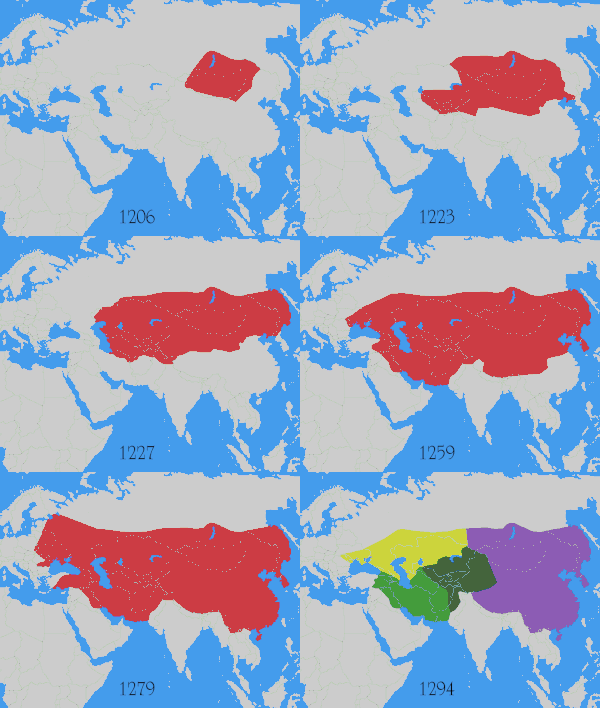
That was probably the low point of his life. He eventually escaped slavery and things generally got better for him (with some ups and downs) from there. For example, during the the period starting when he was 35-years-old to 80 years later, he and his descendants conquered the world; well, not all of the world, merely the portions shown below.


Not all of the world, but in 1279 it was the largest contiguous empire ever (even to this day), totally dwarfing the Roman Empire, for example. Not all of the world, but he was an uneducated barbarian with the rather shaky start described above. Not all of the world, but he did it with the barely beyond stone-age technology of bows and arrows and horses. Think about conquering the area in the map above with just horses (my bottom hurts just thinking about it)!

Somewhere during his conquests, Temüjin became known as Genghis Khan which is how he is remembered today. Scientists estimate that 1 in 200 people are descendants of Genghis Khan, making him one of the 11 most prolific fathers of all time (9 of the 11 are unknown in history).

The horrors of nationalism and religion have been drilled into me my whole life. I've been told about all those people killed by this or that religious atrocity and this or that nationalistic war. Genghis Khan was neither nationalistic nor religious (there's no Genghisstan, for example). But he was possibly the bloodiest, most murderous person in all of history. For example, after conquering Urgench in central Asia, he slaughtered more than a million people in a mere few days. A million people represented 1 in 400 people on earth at the time. All told, the Mongol conquests killed about 10% of the people on earth. Genghis Khan might be considered directly responsible for the deaths of a larger percentage of the human population than anyone else, ever.

So why was this random barbarian able to conquer such a vast area? The pat answer is that he was a brilliant strategist and politically innovative. And that may well be true.

But I don't think that's the most important part. Genghis Khan didn't conquer any nations, not really. There simply were no nations in his path. At least not nations in the sense that if you attack even a tiny corner of the nation, millions upon millions of people will rush to their defense and drive off the attackers. Instead he just rolled through one city-state after another, none of which had an even remote chance of defending themselves. Even the most populous ones were sitting ducks.

One meme shared by progressives and libertarians is that political borders are at least somewhat immoral; that nationalism is quite immoral and responsible for many of the horrors of the last century; that eliminating nations and national sentiment would be very positive for humankind; that one shouldn't care more about someone from Mississippi than someone from Mozambique; etc. They both make similar critiques about religions.

I don't agree with those assessments. One can argue that Hitler was an insane genocidal maniac who hijacked a whole nation and caused misery nearly beyond comprehension and that if nations didn't exist, Hitler wouldn't've been able to do that. Maybe, but I don't think so.

Because, what about Genghis Khan? He was as simple as simple could be. He was simply a predatory mammal looking to extend his legacy like all (non-domesticated) predatory mammals. And he certainly succeeded. He wasn't insane. He wasn't religious. He was very tolerant of ethnic and cultural diversity:
The Mongol Empire did not emphasize the importance of ethnicity and race in the administrative realm, instead adopting an approach grounded in meritocracy. The exception was the role of Genghis Khan and his family. The Mongol Empire was one of the most ethnically and culturally diverse empires in history, as befitted its size. Many of the empire's nomadic inhabitants considered themselves Mongols in military and civilian life, including Mongols, Turks and others and included many diverse Khans of various ethnicities as part of the Mongol Empire such as Muhammad Khan.
If you crossed him, he would raze your city and murder everyone in it (except for the skilled artisans and the women, of course - how do you think 1/2% of the current day population are his descendants? Hmmm?). Very simple, really. But as long as you surrendered to him and didn't cross him, he was much more interested in your abilities than your religion or ethnicity.

There will always be people like Genghis Khan and Hitler. After all, we are predatory mammals, and some of us will simply be better predators than the rest of us.

The way I see it, nations and nationalism stopped Hitler from taking over the world. England, Russia, the United States, and others had the nationalistic fervor that drove them to stop him. It was awful, but it was stopped.

What Genghis Khan did was awful too.

And there were no nations to stop him. Only the technological limitations of the horse and bow kept him and his descendants from extending their empire even further.

If there were no nations and no nationalism, then we're essentially a bunch of city-states and the next Genghis Khan will take over the world, just like the Mongols created their empire.

Sunday, December 16, 2012

Public Shooting Musings

With any change in government policy there are always winners and losers.  Modifying gun control laws would be no exception whether making them stricter of less strict.  Different people will die at different times depending on the changes.

Whenever I put significant effort into yet again contemplating gun control, I start by re-reading "Of Holocausts and Gun Control".  There are many chilling excerpts in it, and the two I found most chilling and focusing are (emphasis added):
"Governments have exterminated or cooperated in the extermination of something like one hundred and seventy million of their own people in the twentieth century"; and

"...it is nevertheless an arresting reality that not one of the principal genocides of the twentieth century, and there have been dozens, has been inflicted on a population that was armed..."
If you think that something like that can't happen here, as explained by the essay mentioned above it almost did at least twice.  Examples include Japanese internment camps during World War II and the violence of the KKK in the south.

I then notice that:
"With a single exception, every multiple-victim public shooting in the U.S. in which more than three people have been killed since at least 1950 has taken place where citizens are not allowed to carry their own firearms."
This follows the genocide paradigm on a smaller scale.  In this case, the killings are too few to be a statistic, not too many to be a terrible tragedy (to paraphrase Joseph Stalin). We feel the pain of public shootings more intimately than a genocide lost in history, because they are more intimate.  We can watch each parent cry on TV and cry along with them.  We can read the notes that the small children wrote to their parents that they would meet them in heaven as tears well up in our eyes.  Anything but this, we say.  Anything but this, I say.

But then I dry my eyes and realize that the similarity is striking.  Unarmed people are sitting ducks, whether for populations of millions or for a building full of school children and unarmed teachers, administrators and other workers.  Predators are attracted to the easiest prey: the sick, the weak, the old, and the unarmed.  School-zone mass shootings didn’t begin until after passing Clinton’s Gun Free Schools Act. The gun-free zone designation is a giant neon sign to the predator: "We're here and helpless. Kill us."  And killed they were.

So the choices are: take weapons away from predators or arm as many people as possible so there's a chance of defense against the predators.  The former seems impossible.  Building guns is not rocket science. Even if every gun magically were confiscated, anyone with minimum determination could build one and each day it gets easier and easier to do so.

That leaves arming as many people as possible.  School teachers should be heavily encouraged to get concealed carry permits.  They should be reimbursed for training to use those weapons.  Same with administrators and even janitors.

But in the end it is a judgment call, a matter of opinion.  I'm not risk adverse, I value individual freedom and responsibility heavily, I don't trust governments, and I'm wildly skeptical that any form of gun control will substantially reduce access to guns by criminals and psychopaths.  If someone else believes the opposite on most or all of these things, they're likely to reach the opposite conclusion.

Since the process is incremental in either direction, there will be more mass killings, more tragedies and more tears.