Search This Blog

Showing posts with label Technology. Show all posts

Tuesday, February 05, 2019

Deep Learning and Emergent Deception

With all of the processing power available, all kinds of Deep Neural Network learning topologies are possible with tens of millions of connections or "parameters" (which are similar in purpose to synapses in a biological brain).

One of the more interesting nets to me are Generative Adversarial Networks (GANs) which are two (or more) connected networks that fight to win in a game to "outsmart" the other network. I've written about synthetic face generation before, and those applications use GANs. One network in the GAN learns to distinguish between real faces and synthetic faces and is called the discriminative network. The other network learns to generate synthetic faces and, not surprisingly, is called the generative network. The generative network is "rewarded" when a synthetic face is so realistic that it fools the discriminative network and "punished" when the discriminative network correctly identifies that the face is synthetic and not real. And when the generative network is rewarded, the discriminative network is punished and vice-versa. The two networks are locked in this zero sum win at all costs struggle, each trying to be rewarded and avoid punishment. If the GAN is set up correctly (being correct is mostly guesswork and trial and error), it can provide really impressive results as with the case of the synthetic faces.

But deception is an inherent part of the generative network. After all, it's designed to try an fool the discriminative network and ultimately us humans. Recently, a generative network went well past the bounds of deception expected by its creators. The application is this: transform aerial images into street maps and back to automate much of the image processing for things like google maps.


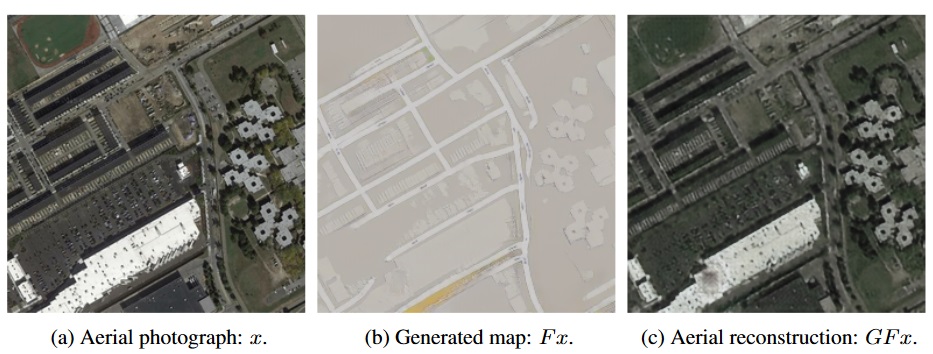
The above images show the process. There's the original aerial photograph (a), the street view (b), and the synthetic aerial view (c) that's reconstructed ONLY from the street view (b).

But wait! Looking at image (c), which is constructed from ONLY image (b), how on earth did it guess where to put the air conditioning units on the long white build? Or the trees? None of those details are in the street view image (b), right?

It turns out that the network "decided" to cheat:
It learned how to subtly encode the features of one into the noise patterns of the other. The details of the aerial map are secretly written into the actual visual data of the street map: thousands of tiny changes in color that the human eye wouldn’t notice, but that the computer can easily detect.

In fact, the computer is so good at slipping these details into the street maps that it had learned to encode any aerial map into any street map! It doesn’t even have to pay attention to the “real” street map — all the data needed for reconstructing the aerial photo can be superimposed harmlessly on a completely different street map...
In other words, the street view map has gazillions of minute variations that aren't visible to the human eye that encode the data required for the remarkable aerial reconstructions.
This practice of encoding data into images isn’t new; it’s an established science called steganography, and it’s used all the time to, say, watermark images or add metadata like camera settings. But a computer creating its own steganographic method to evade having to actually learn to perform the task at hand is rather new.
Note the last sentence. The generative network wasn't very good at generating the reconstructed aerial view the way it was supposed to. So instead, it figured out how to encode the data it needed so it didn't have to learn how to do it the right way.

The thing I find most interesting is the emergent deception. Nobody predicted this would happen (since it wasn't a desired result) and I don't think anybody could've predicted it.

We're currently able to use multiple networks with hundreds of millions of connections and we're already seeing emergent behavior that can't be predicted. Every ten years gives about a factor of 100 increase in processing power and network complexity.

It will be interesting to see what emerges when thousands of networks with billions of connections interact.

Tuesday, January 29, 2019

Happy 60th Birthday to the Transistor!

And what a momentous invention it has been:
The invention of the transistor-based logic engine, the integrated circuit, turned 60 this year. Today, humanity fabricates 1,000 times more transistors annually than the entire world grows grains of wheat and rice combined. Collectively, all those transistors consume more electricity than the state of California. The rise of transistors as “engines of innovation” emerged from Moore’s Law. And we’re still in its early days: paraphrasing Mark Twain, recent reports of the death of that Law are greatly exaggerated.

Monday, January 21, 2019

Artificial Deception

I've written recently about state-of-the-art creation of synthesized faces and I concluded:
I think that the day is coming within my lifetime when there'll be no need for human actors. Any screenwriter will just be able to work with AI based tools to create and produce movies. 
But what if the "screenwriter" isn't creating a work that's meant to be viewed as fiction, but rather a fictional story that's intended to look like news? In other words, what if the screenwriting wants to purposely create fake news? And what if those creations are ever more indistinguishable from real videos of real events?

It's actually beginning to happen:
Lawmakers and experts are sounding the alarm about "deepfakes," forged videos that look remarkably real, warning they will be the next phase in disinformation campaigns.
The manipulated videos make it difficult to distinguish between fact and fiction, as artificial intelligence technology produces fake content that looks increasingly real. [...]
Experts say it is only a matter of time before advances in artificial intelligence technology and the proliferation of those tools allow any online user to create deepfakes.
As a sort of expert in this area, I believe that to be true as well.

Pornography is one the biggest areas where deepfakes are developing at the moment. For example:
Deepfakes are already here, including one prominent incident involving actress Scarlett Johansson. Johansson was victimized by deepfakes that doctored her face onto pornographic videos.
“Nothing can stop someone from cutting and pasting my image or anyone else’s onto a different body and making it look as eerily realistic as desired,” she told The Washington Post in December, calling the issue a “lost cause.”
Ms. Johansson is wise enough to realize that trying to do much about it is a "lost cause." The problem is that the software to "understand" Ms. Johansson's face and to manipulate it realistically to replace the face of someone in a video, porn or otherwise, is actually fairly trivial, widely available, and getting easier and easier to access and use. The genie is out of the bottle and there's no way to recapture it.

Besides, porn is probably fairly far down in the list of things to worry about, even if it will be driver of the technology. Other sorts of fake news will generally be more of a problem:
Other cases have resulted in bloodshed. Last year, Myanmar's military is believed to have pushed fake news fanning anti-Muslim sentiment on Facebook that ignited a wave of killings in the country.
And as the fakes get better and better, inciting mobs will be easier and easier.

Of course governments, which like to regulate everything under the sun, are working to legislate against this sort of technology use:
Farid said First Amendment speech must be balanced with the new, emerging challenges of maintaining online security. [...]
Other countries are already working to ban deepfakes.
Australia, Farid noted, banned such content after a woman was victimized by fakes nudes and the United Kingdom is also working on legislation.
Unfortunately (or maybe fortunately, depending on your point of view), my guess is that there's very little governments can do to stifle this sort of thing. Pretty much anybody with a high-end graphics card and a little too much time on their hands will be able to create these sorts of things.

In the end, I believe that the main reason fake news, including deepfake news, is a problem is that we're too damn gullible. The reason fake news works is because we want to believe it:
“We have to stop being so gullible and stupid of how we consume content online,” Farid said. “Frankly, we are all part of the fake news phenomenon.”
My guess is that after the first couple of outrageous deepfakes that catch us unawares, we'll quickly learn to be more skeptical. Hopefully, the first deepfakes don't drive us to nuclear war or anything completely catastrophic first.

Monday, December 17, 2018

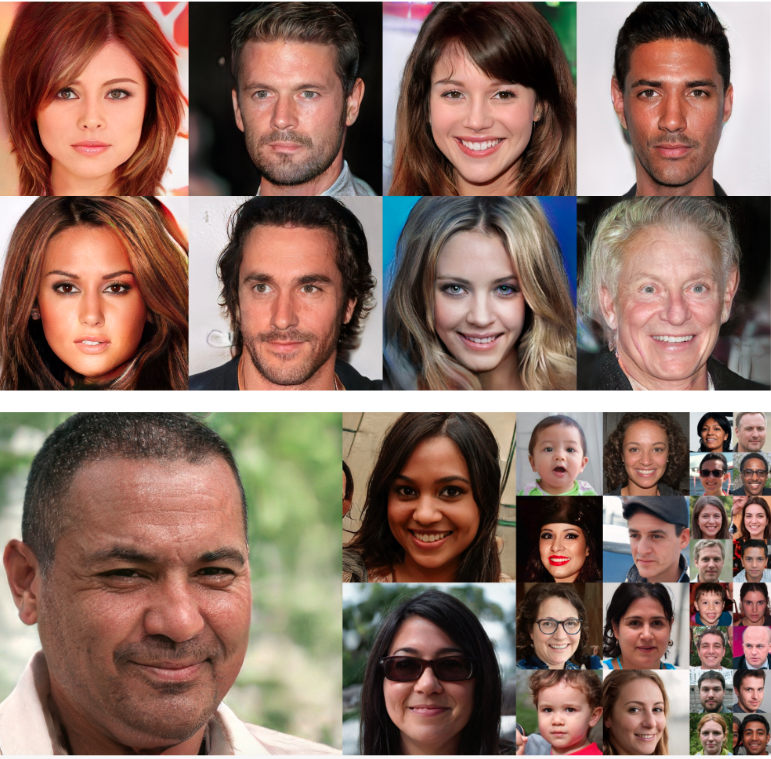
I've written about Artificial Intelligence based face and scene creation before but now the same researchers have taken it one step farther. The top eight pictures were generated with those previous algorithms - pretty realistic but not quite right, especially around the eyes. The bottom pictures were generated by the updated algorithms and it's very hard for me to see the fakeness.


The article is here and the relevant video follows:


I'll admit than I'm not quite following all of the explanation, but it's still fascinating for me to watch.

I think that the day is coming within my lifetime when there'll be no need for human actors. Any screenwriter will just be able to work with AI based tools to create and produce movies.

More Computing Efficiency

Not only have computers gotten exponentially faster per dollar, they've also gotten amazingly more energy efficient:

Over the past 60 years, the energy efficiency of ever-less expensive logic engines has improved by over one billion fold. No other machine of any kind has come remotely close to matching that throughout history.
Consider the implications even from 1980, the Apple II era. A single iPhone at 1980 energy-efficiency would require as much power as a Manhattan office building. Similarly, a single data center at circa 1980 efficiency would require as much power as the entire U.S. grid. But because of efficiency gains, the world today has billions of smartphones and thousands of datacenters.
Of course an iPhone would have been impossible to build at any price in 1980 and even if possible would have required the space of an entire Manhattan office building!

Thursday, August 09, 2018

You Are Here (Update)

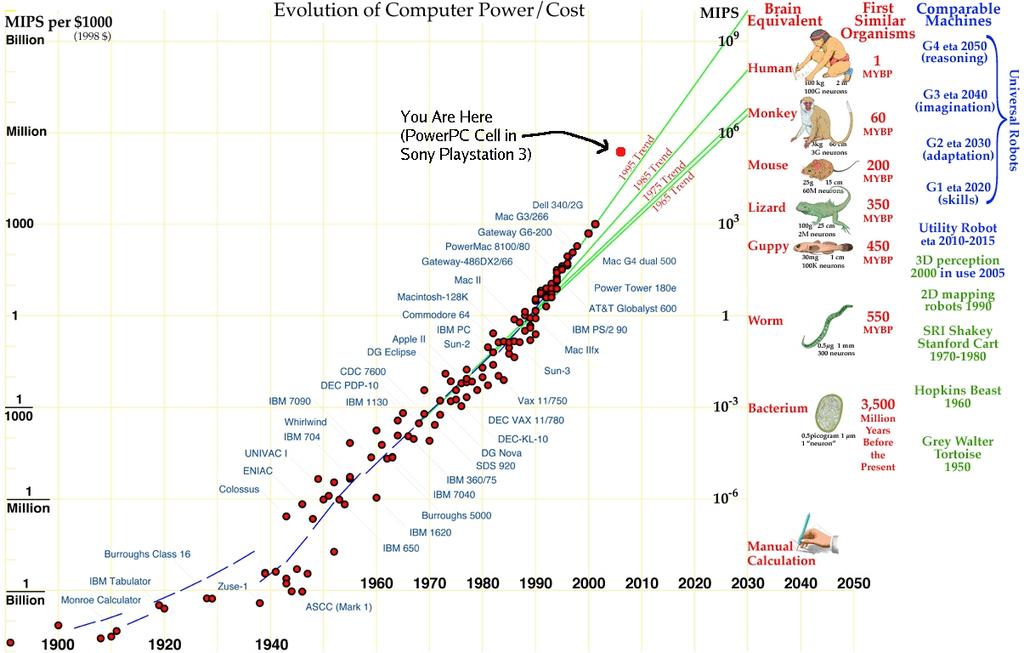
In 2005, I posted about a new PowerPC processor we were starting to use in some of our robots. At processing capability of around 200 billion floating point operations per second (200 GigaFLOPS), it was big news at the time as it put the potential intelligence of our robots into the range of "mouse" instead of lizard as shown by the blue dot in the graph below.


I was thinking about this graph recently with the announcement of NVidia's new Xavier system on a chip computer. With processing capability of 30,000,000,000,000 (30 trillion) operations per second at a price of $1,299, this can be represented by the magenta square labeled "You Are Here" on the above graph. We will have this new processor incorporated into a new product prototype this October, so just like the PowerPC of yesteryear, this is something that's real and used by actual developers as opposed to some theoretical gadget.

It shows the potential intelligence of this device to be somewhere between monkey and human. What does that mean? First, while it's not known how much of the brain works, the functionality of parts of the brain are known really well, for example, the first part of the visual cortex. It's then straightforward to estimate how many computations are required for that functionality. The weight of that portion of the brain is known and it is assumed (this is the leap of faith) that the rest of the brain's processing happens with approximately the same efficiency. Divide the weight of the organism's brain by the weight of that part of the visual cortex, multiply by the number of operations required for that part of the visual cortex, and voila!, the total number of operations per second required for the entire brain of a given organism can be estimated.

A reasonable reaction is, "yeah, sure, whatever, but without the appropriate software, how will this computer be intelligent at all, much less at a monkey or human level?" And that was my first reaction as well, but I've since concluded it was misguided. Just like nobody has to know how a human brain works for it to work just fine, nobody has to know how a neural net within a computer works in order for it to work just fine, and, in fact, that's exactly what's happening, and at a very rapid rate. A number of research groups are trying different structures and computation approaches and are steadily improving the functionality and accuracy of the neural nets without really understanding how they work! It's basically a trial-and-error evolutionary approach.

With this new Xavier processor, using already known neural nets, it will be able to recognize objects in an image with a high degree of accuracy and tell you which pixel belongs to which object 100 times per second. Is that intelligence? Well, when a person does it, we think that's a form of intelligence and since nobody can tell you how the neural net works, I don't think we can say whether or not it's intelligent. If it is intelligent, it's certainly an alien intelligence, but looking at it operate, it looks to me as if it's intelligent.

For me personally, if something seems intelligent, then it is intelligent.

Friday, May 18, 2018

The Intelligent Dodder Weeder

I've been really busy lately at work building BIG machines. My latest creation is the Intelligent Dodder Weeder shown here ambling down the road between fields:


It's 40 feet wide when the wings are down, weighs about 20,000 pounds including the tractor, finds and kills dodder weed in fields of safflower at the rate of about 20 acres an hour, which replaces a crew of roughly 100 people.

With a network of 54 computers with total computational power of 75,000,000,000,000 operations per second (75 teraflops), it processes 720 images per second coming from 36 cameras and identifies the dodder weed using a traditional machine vision algorithm approach coupled with a deep convolutional neural net recognition system. Wherever the weed is found, it's sprayed with an herbicide to kill it.

At this moment in time, it may well be the most advanced mobile agricultural machine in the world in commercial operation. There are probably experimental machines that are at least as advanced, but our Weeder is operating 12 hours per day, 6 days per week in actual working conditions.

It was fun to design and develop this latest machine, but it was a huge amount of work to get it up and running.

Friday, September 15, 2017

What The Heck Is That?

Consider the gizmo in my hand below. It's called a vortex tube and is around 4 inches long and weighs maybe half a pound. I had never heard of these until recently. Had you?

There are no moving parts. You connect the inlet near my thumb to an ambient (room) temperature air supply. Really, really hot air comes out the end near my forefinger. Really, really cold air comes out the other end near the base of my palm. That little orange label says "CAUTION: Hot and cold surfaces" and it's not kidding. If the air supply is 8 cubic feet per minute at 100 psi, the hot end is over 100F hotter than the input air temperature and the cold end is over 100F colder than the input air temperature and can provide over 500 BTUs of cooling.

That's a pretty neat trick for something with no moving parts. Another neat trick is that until recently folks were still debating the physics behind how it works:
...for a long time the empirical studies made the vortex tube effect appear enigmatic and its explanation – a matter of debate.
In fact, the science wasn't totally settled until 2012:
This equation was published in 2012; it explains the fundamental operating principle of vortex tubes. The search for this explanation began in 1933 when the vortex tube was discovered and continued for more than 80 years.
So I don't feel bad that I'd never heard of it and had no idea how it worked. And I'll admit when I read the explanation that I still only have a vague notion of how it works.

Why did I discover it now? We have robotic machines that work in agricultural environments. Those machines have computers. We use computers and systems that can withstand up to about 105 (Fahrenheit). 99.8% of the time, the ambient temperature is below that. Unfortunately, 0.2% of the time, it gets hotter than that but the crops still need to be tended to and the machines fail and even die if they're run at a temperature hotter than 105. Yet for 0.2% of the time, it's expensive, bulky, and makes the system less robust due to complexity to add cooling via air conditioning to every single computer cabinet.

On the other hand, putting a vortex tube in each system isn't expensive, bulky, or complex. On those days when it's really hot, the grower can just attach an air supply from a compressor to the vortex tube and voila!, they can run our systems even when it's ridiculously hot. Most growers have compressors available, but even if they don't, it's straightforward to rent one on short notice. Problem solved!

Tuesday, May 30, 2017

Who wants to live forever?

At my Live at Wembley CD, Freddie Mercury asks the public, right before singing the music of our title above:

Also, I suppose we’re not... We're not bad for four aging queens, are we?

Freddie was to die five years later, by a HIV induced pneumonia.

There are far too many sci-fi books, not to mention more serious literature, reflecting upon what would be a future without death. We look intent on making sci-fi real, as our attempts to cheat death get ever more serious and profitable, as witnessed by those sprawling biotech companies near Bret's home.

De Grey, our bearded main character in this last linked article, looks to believe that the first person who will live to be 1,000 years old has already been born:


"Oh absolutely, yeah,” de Grey assures me. “It’s highly likely.”

Or rather, he does not, as the other people working with him assure us:

"I have to tell you Aubrey has two hats,” she says, smiling. “One he wears for the public when he’s raising funds. The other hat is when he talks to a scientist like me, where he doesn’t really believe that anyone will live to 1,000 years old. No.”

Actually, Aubrey had in past raised the eyebrows of significant researchers in the field, who once wrote an article acusing him of selling pseudoscience:

In 2006, the magazine MIT Technology Review published a paper called “Life Extension Pseudoscience and the SENS Plan.” The nine co-authors, all senior gerontologists, took stern issue with de Grey’s position.

But happily we learn they worked it out, for the greater good of science. Or better yet, for the greater good of funding for science:

More than a decade later, Tissenbaum now sees SENS in a more positive light. “Kudos to Aubrey,” she says diplomatically. “The more people talking about aging research, the better. I give him a lot of credit for bringing attention and money to the field. When we wrote that paper, it was just him and his ideas, no research, nothing. But now they are doing a lot of basic, fundamental research, like any other lab.”

It may be that Aubrey was getting skepticism from an older generation of researchers who saw his popular proeminence with a bit of envy.

Or it may be that, as evidenced by Aubrey's alledged two hats, science these days is a lot more about funding than it is about truth. Has Aubrey's lab turned more "like any other lab", or has any other lab turned more like Aubrey's?

That's a good question for that one-thousand year friend of ours to ponder, in his centuries of boredom.

Wednesday, May 11, 2016

Man, Those Parts Are Small!

We've been working on a PC board for a sensor, and unlike many boards, during this prototype phase we routinely have to change parts on the board. The parts are excruciatingly tiny, especially for aging eyes. The following picture (click to enlarge) is a dime with 5 resistors on it that we had to desolder from one of the boards:


And these are the large size resistors these days! They make discrete resistors that are 1/3 the size in each dimension.

For reference, the dime has about an 18mm diameter.

(Photograph by Rick Wight [http://isleowight.com/])

Saturday, March 12, 2016

The Patent is the Property

Being a roboticist, a song writer, and someone interested in economics and politics means that I almost never go a week without running into the term "Intellectual Property" at least once. The first thing that's interesting about that is that it's a relatively new term that was coined in the 1960s, the decade when the World Intellectual Property Organization (WIPO) was founded, and even then wasn't in widespread use for another couple of decades.


Before that, it seems, it was commonly agreed that one could own a patent, and therefore a patent was a type of property. On the other hand, it wasn't generally thought that the intellectual creation that formed the knowledge on which the patent was based was property. Nowadays, the phrase Intellectual Property has distorted the language sufficiently such that many people believe that intellectual creations are indeed property and are double-plus good.

My belief is that intellectual creations and knowledge are not usually property without completely distorting the meaning of the word 'property.' In order to argue this point, I'm going to focus on just one aspect of intellectual creations as an example: the creation of knowledge that forms the "meat" of method patents. I'm also going to focus on a single attribute of property: that it can be stolen. If something cannot be stolen, as defined by law, then it's not property.

Let's say Joe invents a method. Let's say it's only in his brain and notes and that he hasn't disclosed it to anyone else. Does he, at that moment, own the invention? Not really, I would say. First, Jack, John, Jill and June might have already also invented the method independently or will soon. Indeed, most inventions are not patentable because they fail the non-obviousness criterion. Even the ones that are deemed adequately non-obvious still are, or would be, invented independently by multiple people or entities.

If the invention is ever property, it is at that moment when it is a trade secret, and if and only if nobody else has also come up with the same invention and disclosed it. At the moment, the undisclosed knowledge can be stolen and therefore it can potentially be thought of as property. Someone could torture Joe until he discloses the invention (very unlikely); someone could break into his office and steal his notes and learn of the invention that way (pretty unlikely - have you ever tried to read an inventor's notes?); or someone could bug his office and eavesdrop on him discussing the invention with someone else (rather unlikely). However, trade secrets are typically lost when a rogue employee distributes them without permission and that does happen once in a while. At the moment, if Joe is really the only one to have come up with the invention and if Joe has not disclosed it publicly, then it can potentially be stolen and I'll concede that it is, at that moment, plausibly a type of property. Even so, a trade secret is just a type of secret, and I'm not sure that secrets, while perhaps quite dear to the originator, are really property.

They say Necessity is Mother of Invention. I say Progress is the Father of Necessity in that as new knowledge and products are created so are new needs (part of the process of Creative Destruction). Supporting Technology is the Father of Invention. Engineers and Scientists (and others) are the Siblings of Invention and we all live in the same great big happy and competitive family and are nearly simultaneously exposed to the same Necessity, state of Progress, and Supporting Technology. In other words, many of us are driven to invent more or less the same thing more or less at the same time. I've never seen an invention that nobody else would have ever invented if the particular inventor who first figured it out had not. Of course, I haven't looked through all of the many millions of patents worldwide or considered the far larger body of non-patented inventions, but I've seen quite a few and that's my impression.

Most of the time, it makes no sense to patent an invention. For example, I've invented hundreds of methods in the realm of robotics but have only patented between ten and twenty of them. Perhaps the invention is too obvious so you can't get a patent; perhaps it's so non-obvious that disclosing it in a patent is counterproductive because the disclosure would give the competition a step up that it wouldn't otherwise have; perhaps the value of the invention is less than the cost to file, maintain, and enforce the patent; perhaps the inventor or company just doesn't have enough money or other resources to pursue a patent even if it would be well worth the cost; and so forth.

Are these non-patented inventions property and if so, whose property is it? If Joe's non-patented invention is disclosed, either because he uses it in a commercially available product and the invention is readily deduced from looking at the product or he otherwise causes its disclosure, then everyone learns about it and can use it for any purpose. We don't consider this dissemination and use to be theft or to be illegal, unethical, or immoral in any sense, so I find it hard to consider Joe's invention to be property of any kind. Again, the principle is: if you can't steal it, it isn't property.

Let's say Joe's invention is sufficiently non-obvious and novel to qualify for a patent and he writes the patent and files it and he is the first of the inventors to file (even though the others may have invented it first). Is the invention property now? No. It's the same deal. Until the patent issues (and it might never issue for a variety of reasons), anyone can use the disclosed invention for any purpose. In addition, it's likely that the patent will publish and disclose the invention well before the patent is issued. Again, anybody can use the disclosed invention for any purpose until the patent issues. Again, it's not stealing, therefore it's not property.

Let's say Joe's patent finally issues today. Yesterday, the invention wasn't property. Is it property now that the patent has issued? No. The patent is the property. The patent is a type of Government Originated Legally Enforced Monopoly (GOLEM) (and a GOLEM, in turn, is a type of Government Originated Legally Enforced Restriction on Trade (GOLERT)). The patent is what's sold, licensed, or bartered. The invention is still disclosed and known by many people. They can still build on the knowledge or work to circumvent the knowledge. They can still even use the knowledge for certain non-commercial purposes. The thing of value is the GOLEM and that was created by the government out of thin air. You still can't steal the invention since it's been freely disclosed, therefore the invention is still not property. It's the GOLEM that's property and that property restricts others from using the publicly disclosed invention.

Eventually Joe's patent expires. One day Joe has the right, via the GOLEM, to control most uses of the invention. The next day he doesn't. The invention, which wasn't property one day is definitely not property the day after the patent/GOLEM expired. Now it definitely can't be stolen.

In summary, the only time the invention is plausibly property is prior to when the first inventor discloses it (either intentionally or accidentally). After that, the invention, the intellectual creation, the method, is not property.

The patent is the property.

Friday, September 11, 2015

Give Me a Hand


With two partners, I founded Vision Robotics Corporation over 15 years ago. While very small, we're one of the oldest firms in the world that focuses strictly on machine vision based robotics.

We've seen a great deal of change in those 15+ years.

By far the biggest change is that computers can do more than 10,000 times as much processing per dollar as they could when we founded the company. That means that many of the algorithms and methods for using the information from image sensors that were impossible or extremely hard back then are child's play (for a really smart child!) now. It means that we've gone from vision systems that were vastly inferior to human capabilities to vision systems that often surpass humans' abilities to see and do something with what they see. For example, on our robotics lettuce thinner, the images are streaming by so fast that no human would have any chance of keeping up. Soon, $1,000 worth of parts will build a vision system that surpasses human visual capabilities in nearly every way.

In many other areas, machine intelligence is rapidly catching up to humans. Voice processing such as Apple's Siri may still seem primitive, but consider how far it's come in only a few years and project that forward ten years into the future. Computers will be conversational on most common topics by then.

In fact, in about ten years, $1,000 worth of computer hardware, in real time, will be able to perform as many computations as a human brain. The following graph is taken from an ancient post of mine, and we're still right on track to catch up with human computational capability.


Of course, human computational capability and human intelligence are two very different things. But the latter is probably not possible without the former.

The bottom line is that intelligence is hardly the limiting factor and will most likely not be any factor at all in another decade or two when it comes to automation.

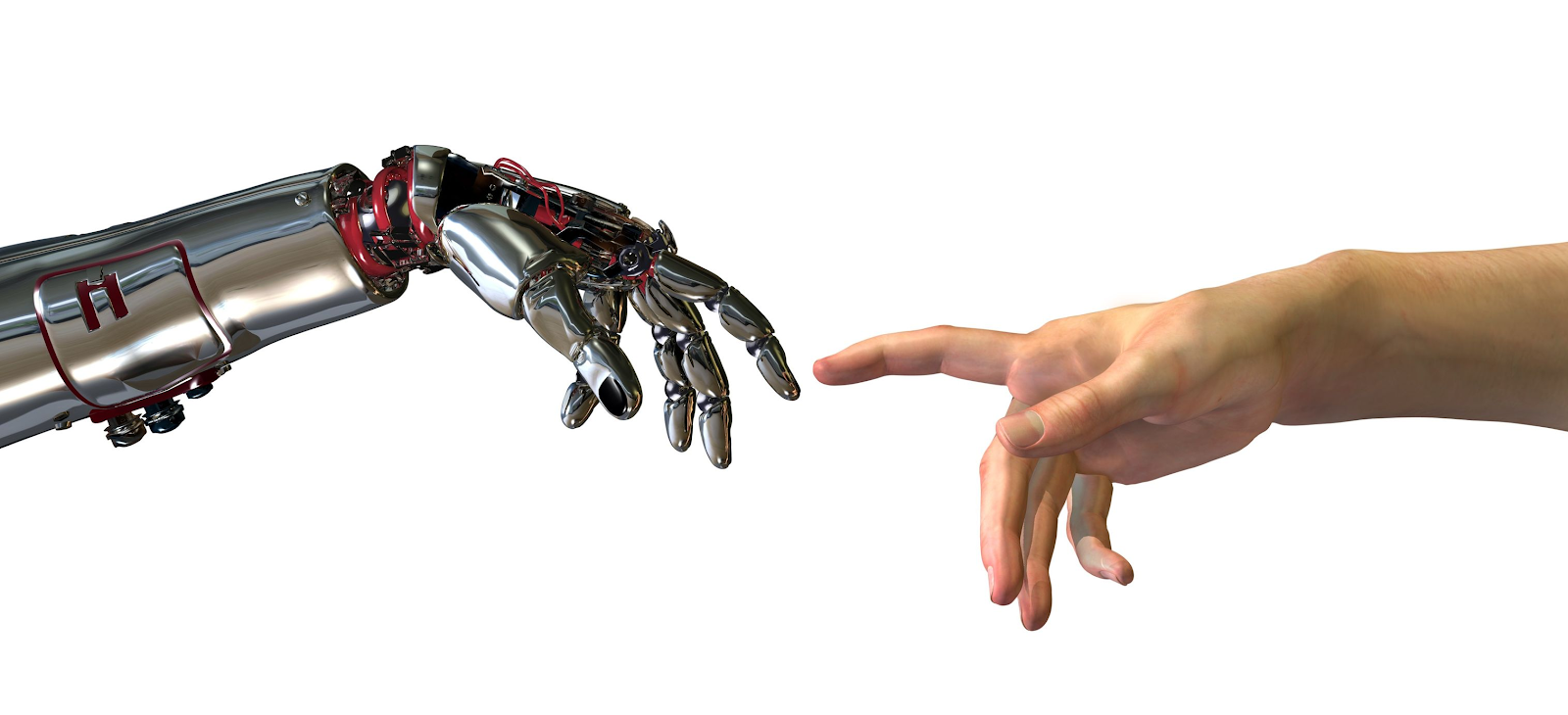
The limiting factor? Hands. Often called "end effectors" in the industry lingo.

The human hand is an amazing tool. Nearly uncountable degrees of freedom. Tremendous flexibility. Incredible strength, especially given its relatively puny size. Amazing endurance. Stunningly large mean-time-between-failures. Essentially maintenance free and self-repairing. Well, maybe not maintenance free since the body it's attached to does need things like food and potty breaks. But still...

We are a few decades away from catching up with the human brain. We are perhaps centuries from competing with the human hand.

If someone could build me an end effector with the characteristics of a human hand for $1,000 or even $10,000, there would be many trillions of dollars worth of robotic and automation applications that would be instantly addressable.

If you want to have unlimited wealth, invent something as effective as the human hand.

Here's a video of a talk I gave not too long ago in which I made this point (towards the end). It's long, so I won't hold it against you if you choose not to watch it. :-)


Monday, February 16, 2015

Fear of Intelligence

I sat on a robotics panel last week that discussed the future of robotics. The audiences' questions exposed the fact that at least some people are really scared of robotics and Artificial Intelligence.  It seems that some of this renewed fear is due to the philosopher Nick Bostrom,who recently authored Superintelligence: Paths, Dangers, Strategies. Bostrom specializes in "existential risk" and I have a hunch that just like everything tends to look like a nail when the only tool you have is a hammer, it's convenient for everything to look catastrophically dangerous when your specialty is existential risk. It certainly increases your likelihood of funding!

The basis for the fear is the advancement of machine intelligence coupled with a technology singularity. The following is a description of levels of machine intelligence:
AI Caliber 1) Artificial Narrow Intelligence (ANI): Sometimes referred to as Weak AI, Artificial Narrow Intelligence is AI that specializes in one area. There’s AI that can beat the world chess champion in chess, but that’s the only thing it does. Ask it to figure out a better way to store data on a hard drive, and it’ll look at you blankly. 
AI Caliber 2) Artificial General Intelligence (AGI): Sometimes referred to as Strong AI, or Human-Level AI, Artificial General Intelligence refers to a computer that is as smart as a human across the board—a machine that can perform any intellectual task that a human being can. Creating AGI is a much harder task than creating ANI, and we’re yet to do it. Professor Linda Gottfredson describes intelligence as “a very general mental capability that, among other things, involves the ability to reason, plan, solve problems, think abstractly, comprehend complex ideas, learn quickly, and learn from experience.” AGI would be able to do all of those things as easily as you can.
AI Caliber 3) Artificial Superintelligence (ASI): Oxford philosopher and leading AI thinker Nick Bostrom defines superintelligence as “an intellect that is much smarter than the best human brains in practically every field, including scientific creativity, general wisdom and social skills.” Artificial Superintelligence ranges from a computer that’s just a little smarter than a human to one that’s trillions of times smarter—across the board. ASI is the reason the topic of AI is such a spicy meatball and why the words immortality and extinction will both appear in these posts multiple times.
The Technological Singularity is described as follows:
The technological singularity is the hypothesis that accelerating progress in technologies will cause a runaway effect wherein artificial intelligence will exceed human intellectual capacity and control, thus radically changing civilization in an event called the singularity.[1] Because the capabilities of such an intelligence may be impossible for a human to comprehend, the technological singularity is an occurrence beyond which events may become unpredictable, unfavorable, or even unfathomable.[2]
The concepts of varying levels of artificial intelligence and the singularity have been around for a long time, starting well before existential risk philosopher Bostrom was even born. I've had the opportunity to contemplate these concepts for decades while I've worked in technology, robotics and artificial intelligence, and I think these concepts are egregiously fundamentally flawed. They make for a good science fiction story and not much else. I was glad to find I'm not alone in this:
If this sounds absurd to you, you’re not alone. Critics such as the robotics pioneer Rodney Brooks say that people who fear a runaway AI misunderstand what computers are doing when we say they’re thinking or getting smart. From this perspective, the putative super intelligence Bostrom describes is far in the future and perhaps impossible.
While it would take volumes of highly detailed technical information for me to present a fully convincing argument, for now, I'd like to leave y'all with a couple of thoughts.

Consider the following words: computation, intelligence, experience, information/knowledge, decision, action.

  • Even infinite computation (which is kind of the basis of the singularity) doesn't inherently translate to infinite intelligence or even any real or general intelligence.
  • In a vacuum, even infinite intelligence is useless.
  • The frontiers of information/knowledge can't be very much expanded with intelligence alone - experience (hypotheses, experiment, scientific method, etc.) is required no matter how intelligent something or someone is, and experience takes time, a long, long, long time as any researcher, developer or thinker (apparently other than an existential risk philospher) knows.
  • No matter how intelligent something is, it can't make decisions to take catastrophic actions based on currently unknown knowledge until it takes the time to gain experience to push the state of knowledge. The actions required to gain that experience will be observable and easily stoppable if necessary.
On the other hand, consider a nuclear tipped cruise missile. It can perform some computation and can maneuver in its very narrowly intelligent way, has none of its own experience (it's a one shot deal after all), has some information/knowledge in terms of maps, someone else made the decision to launch, but it's action is quite devastating. 10,000 of them could destroy most of the advanced life on earth. When I was a child, we had air raid drills in school because we thought some crazy soviet might do exactly that.

The point being that we're already more than intelligent enough to destroy ourselves via nukes, pathogens, etc.  The risk from super intelligent machines pales in comparison. Consider:

  • About 1% of humans are sociopaths and that translates to about 70,000,000 people worldwide. Given standard bell curves, some of those are likely to have IQs in the neighborhood of 200. If intelligence alone is a thing to fear, then it's too late unless we're willing to kill all the smart people, and I strongly suggest we don't do that.
  • Humans, using tools (including computers), have and will continue to have access to all the tools of annihilation that a super intelligence would have and some of us are downright evil already.
Part of the runaway AI fear is based on the concept of a single Artificial Super Intelligence emerging in a winner-takes-all scenario, where it redesigns and rebuilds itself so fast that nothing else will ever be able to out think it and disable it so we'd better hope it's beneficent.

But consider the saying: "Jack-of-all-trades, master of none." My view is that narrow, focused intelligence, sort of the idiot-savants of the AI world, in their narrow area, will outperform a super general intelligence, and enable us to use them as tools to keep super general intelligences, if any are ever created, in check.

There is no commercial reason to ever create a general intelligence. For example, at my company, our vision systems will soon surpass human vision systems, and watching our Robotic Pruner prune, it looks quite purposeful and intelligent, but there's no real intelligence there. Siri's "descendants" will far surpass the Turing Test in a couple of decades (or sooner or later), and will appear extremely intelligent, but will be just a very, very good verbal analysis and response AI and will have no general intelligence of any kind. C-3PO in Star Wars appears intelligent and we will be able to create a C-3PO eventually, but the real world version will have no real, general intelligence.

The illusion that many of us seem to have fallen for is that many behaviors that we associate with our own anthropomorphic intelligence are only possible if we create an entity with intelligence that somehow operates like a human's, or is orthogonal to the way human intelligence operates, but is similarly global and all encompassing. I strongly believe that view is mistaken and that it is just an illusion. Seemingly intelligent looking behaviors will emerge from massive computation and information interacting with a non-trivial environment, but it won't be any sort of conscious or real intelligence. And because of that, it won't be dangerous.

Human intelligence requires a human body with a circulatory system pumping hormones and responding to rhythms and movements and events and sensory input. I always chuckle when someone suggests encoding someone's brain (neurons & connections) into a computer. You know what you get if you do that? The person in a coma, which doesn't seem particularly useful to me.

I think intelligence, especially within this particular topic, is wildly overrated, and there's nothing to fear.

Tuesday, December 16, 2014

More Manufacturing

Literally!

As shown in the graph below, manufacturing (real) output (the red line) has finally recovered from the Obama recession and clearly has a lot of momentum in the growth direction.  Of course, also clearly, that "momentum" isn't really momentum at all, and can change nearly instantaneously.


From the Money Illusion comes this somewhat related commentary:
First some international comparisons.  In the US, IP [Industrial Production] is up more that 73% in the past 25 years. In Japan it fell by 1.5%.  Some of that is population, but not all. After all, Japan’s population is higher than it was 25 years ago, and America’s has risen by roughly 30%, not 73%.  America industrializes as Japan de-industrializes. Germany reunified 25 years ago, which might affect the data, but their IP is up only about 30% since 1991.  France is up only 9% in 25 years. (The 35-hour workweek?).   Britain is similar to Japan, down by about 1%.  (Falling North Sea oil output?) Italy is down 11.2% in 25 years.  (Berlusconi spending too much time at orgies?) It’s the US that stands out as an industrial power, at least if the data is correct.
I wrote "somewhat related" because the numbers don't exactly match between countries (various countries slice and dice Industrial Production versus Manufacturing differently and the above commentary is more related to Industrial Production than Manufacturing, but the longer term trends are pretty similar).  So you can get an idea from this, but I suggest not quoting any of the numbers without doing more extensive research to understand what you are quoting.  Or at least put forth a caveat like I just did.

Nonetheless, of all the advanced economies of any size, the United States is actually doing quite well as far as Manufacturing output and Industrial Production goes (Industrial Production looks even better recently than the above chart because of the shale oil boomlet).  Germany is the closest and may possibly be better, but even if so, not by much.

On the other hand, as the above graph also shows, while real Manufacturing output is up 73% over the time period (20 years), the number of jobs has dropped by 30% and as a percent of the workforce has fared even more poorly. A common explanation for the loss of jobs is that they've been transferred overseas, but given the fairly dramatic increase in output, all of the job loss and then some can be explained by increased productivity.

In other words, technology is more the enemy of jobs than foreign competition.  But technology is what makes us all better off over the long haul.

Tuesday, October 14, 2014

Congrats to India

India now has a satellite orbiting Mars:
India put a satellite into Mars orbit early Wednesday, the only nation to have done so on a maiden voyage and the first in Asia to reach the red planet.
 And unbelievably inexpensively too!
Mangalyaan, Hindi for Mars craft, cost $74 million ... [Prime Minister] Modi boasted in June that India had spent less than Hollywood had on producing the film “Gravity” to reach the red planet.
A second cost comparison is that $74 million could buy you (or them) about 50 cruise missiles.  The per mile cost is stunningly inexpensive; as Tyler Cowen points out, the mission was cheaper per mile than a cab ride in Delhi.

It just goes to show that it's a lot easier to pull off impressive feats of rocket engineering than social engineering.  And yet the saying is "it's not rocket science" when implying something isn't all that difficult. Shouldn't it be, "It's not social science?"

Wednesday, September 24, 2014

Long Winded Manual

I've often criticized the massively long bits of legislation like Obamacare that exceeded 2,000 pages and made it so "[w]e have to pass the bill so that you can find out what is in it."

But it turns out the Obamacare documents are puny relative to a reference manual I've recently had the opportunity (misfortune?) to encounter.  For one of our robot projects, we're using a small inexpensive Single Board Computer (SBC) called the BeagleBone Black, which retails for about $50.  On the BeagleBone Black, the processor is the Texas Instruments AM3358 Sitara System on a Chip (SOC) which retails for a little over $10.


The AM335x Sitara™ Processors Technical Reference Manual for this $10 chip is a whopping 4,966 pages!  I cringe to consider how long the manual for a $500 Intel chip is these days.  I do wonder, if like Obamacare, they had to build the chip to see what was in it!

The reason I was engaged in this light reading was that I was trying to figure out how to set the duty-cycle on the PWM subsystems and right there on page 2,329 was the information I needed:
The value in the active CMPA register is continuously compared to the time-base counter (TBCNT).
When the values are equal, the counter-compare module generates a "time-base counter equal to counter compare A" event.
This event is sent to the action-qualifier where it is qualified and converted it into one or more actions.
Unfortunately, I didn't realize that was what I was looking for as the term "duty-cycle" doesn't appear anywhere.  So I gave up trying to decipher the multi-thousand page manual and instead, I downloaded the source for the linux operating system and in /arm-kernel/linux-dev/KERNEL/drivers/pwm/pwm-tiehrpwm.c there appeared something much easier to understand:

 if (pwm->hwpwm == 1)
  /* Channel 1 configured with compare B register */
  cmp_reg = CMPB;
 else
  /* Channel 0 configured with compare A register */
  cmp_reg = CMPA;

 ehrpwm_write(pc->mmio_base, cmp_reg, duty_cycles);

It's so simple! Just write duty_cycles to cmp_reg, which is either CMPA or CMPB depending on which channel you want to control.  A quick search showed that CMPA has an offset of 12 (hex) and voila, I had all the information I needed!  How exciting! (The sad part is that I really do find that exciting; perhaps you now understand why I so rarely write about technical topics).

I guess that's why I consider English to be my second language, with C being my native tongue, as it's easier for me to search through many tens of thousands of lines of code than to read a handful of pages in a manual to figure something out.  C (and math) are so wonderfully precise while English is mostly gobbledygook as far as I can tell.

Back to the processor. The reason the manual is so long is that the Sitara chip has a lot of random stuff. For example, I imagine that the PWM subsystem I'm using would qualify as random stuff to most people.  The chip has 3 such subsystems to control 3 motors and in this project I'm working on, it coincidentally turns out that I need to control 3 motors.  What are the odds of that?

The chip has all this stuff, but you can only access a fraction of the stuff at any given time.  For example, you can either access the PWM stuff or you can hook up a monitor, but not both.  So most normal people can use this board as an everyday Linux computer (Linux comes pre-installed) with their monitor, keyboard and mouse connected and I can control motors but we can't do both.  No matter what, a large part of any given chip remains unused.

All those logic gates sitting idle.  I find that painful.  A logic gate is a terrible thing to waste!

Yet I can see how it makes sense.  By throwing everything but the kitchen sink onto this chip, they make it so versatile that a lot of people can use it for a lot of different things and that pushes the manufacturing volumes up which pushes the cost down. $50 for a Gigahertz Linux system is pretty good. Right?

Thursday, June 12, 2014

Now I Wish I Had Bought the Tesla

Well, it's still out of my price range, but I sure do like this ("All Our Patent Are Belong To You") from CEO Elon Musk at the Tesla Blog.  Maybe I'll be able to afford one of their future cheaper models.

I seriously dislike the patent system and its effect of stifling innovation and it's nice to see that Elon agrees with me.

Saturday, February 23, 2013

Quadrocopters Juggling Inverted Pendulums

This is incredible - quadrocopters autonomously throwing and catching poles (inverted pendulums):


With all the talk about the use of drones to kill terrorists and the debate whether or not to use them within the boundaries of the United States, it seems odd to me that no one considers that this technology forms the basis for personal drones. In about ten years, for a few hundred dollars, anyone will be able to build an incredibly maneuverable autonomous drone that will be able to find and destroy a target.

Technology is wonderful but dangerous.

HT: Marginal Revolution

Wednesday, November 21, 2012

Resilience and Collapse

In 1992, Francis Fukuyama famously claimed that we're at "The End of History" because the "struggle between ideologies is largely at an end".  While not everyone agrees with Fukuyama's assessment, the end of history implies that western civilization will also have no end and will continue forever.  Forever is a long time, but perhaps the end of history could mean that the span of our current civilization might be measured in tens of millennia instead of the tens of decades that have measured the length of every civilization that began and ended before this one.

On the other hand, many scholars, including Joseph Tainter ("The Collapse of Complex Societies") and Mancur Olson ("The Rise and Decline of Nations") identify powerful forces inherent in the formation of civilizations that sow the seeds for the decline and eventual collapse of the extended order.

Civilization is a society that surpasses a minimum level of complexity where complexity is, according to Tainter, "generally understood to refer to such things as the size of a society, the number and distinctiveness of its parts, the variety of specialized social roles that it incorporates, the number of distinct social personalities present, and the variety of mechanisms for organizing these into a coherent, functioning whole. Augmenting any of these dimensions increases the complexity of a society."

Complexity is created in order to solve problems according to Tainter.  The main problem is to support ever more people with ever more material comfort but also includes problems such as competition and warfare.

Complexity has a cost.  Layers of management, analysis, research, and other functions are required, none of which directly produce anything but each layer requires energy and resources.  At this level, these resource are the same, in theory, whether or not they are part of private or public institutions.

At first the benefits of the added complexity far outweigh the costs.  For example, the minimal complexity needed to go from hunter/gatherer tribes to an agrarian society increase human edible food per acre by a large multiple without adding all that much cost.

But eventually, the incremental level of innovation and specialization to increase prosperity and/or populations or even maintain them at current levels in the face of decreasing natural resources per capita becomes ever more difficult and costly.  According to Tainter, once this diminishing marginal return for additional complexity is surpassed by the impact of declining resources, the civilization begins to decline.

During the decline, the civilization is less able to deal with new adversity and eventually a problem that might have been trivial to overcome a few decades or centuries earlier, becomes catastrophic and the civilization collapses.  In other words, the civilization becomes increasingly less resilient after complexity increases beyond a certain point and becomes unable to respond adequately to a wider range of shocks and events.

Collapse also has a specific definition in this context.  Collapse is the rapid simplification of society.  In other words, the society loses much or all of its complexity in a relatively short period of time, where the time frame is typically less than a couple of generations.  A great simplification is sometimes associated with a greatly reduced population, but not always - if the cost of maintaining the complexity prior to the collapse far outweighed the benefits, the population can be better off and better fed after the collapse.

Tainter's models are based on resource depletion.  All of the numerous civilizations he studied were ultimately unable to maintain even the status quo as the resources available given the technology of the era diminished on a per capita basis.

We're probably not terribly near the diminished resource per capita wall yet, and we probably won't be there for decades or centuries.  At least not according to Julian Simon who has been fairly accurate in his many predictions so far:
“Our supplies of natural resources are not finite in any economic sense. Nor does past experience give reason to expect natural resources to become more scarce. Rather, if history is any guide, natural resources will progressively become less costly, hence less scarce, and will constitute a smaller proportion of our expenses in future years.”
So maybe our current civilization is safe for a while, or at least won't collapse due to lack of resources.  Let's turn to the individual nations that make up our civilization.  Here we need to consider the structure of socio-economic complexity.  This is where Mancur Olson's work (and also the work of Public Choice Theorists) is important:
"The idea is that small distributional coalitions tend to form over time in countries. Groups like cotton-farmers, steel-producers, and labor unions will have the incentives to form lobby groups and influence policies in their favor. These policies will tend to be protectionist and anti-technology, and will therefore hurt economic growth; but since the benefits of these policies are selective incentives concentrated amongst the few coalitions members, while the costs are diffused throughout the whole population, the "Logic" dictates that there will be little public resistance to them. Hence as time goes on, and these distributional coalitions accumulate in greater and greater numbers, the nation burdened by them will fall into economic decline."
The burden imposed by the  lobby groups described by Olson has a similar effect to the burden of reduced resources per capita described by Tainter.  They both increase the cost and decrease the benefit derived from increasing complexity while decreasing the resilience of society.  The difference is that resource limitations may be a civilization-wide constraint (if Julian Simon is wrong) while the sclerosis Olson identified is primarily (but not completely) associated with governments within a nation state.  As a result, nation states can collapse without bringing the surrounding civilization down with them.

Perhaps even the United States could collapse without dragging the rest of western civilization down with it.  However, there's tremendous risk if the United States collapses because of a number of factors:

  • As sclerotic and fragile as the United States government and economy are getting to be, most of the other governments that comprise western civilization are even worse - a US collapse could easily be the first domino to fall taking a slew of other countries with it;
  • All bets are off regarding Simon's prediction of essentially infinite resources if the drivers of innovation in the US and other western countries suddenly find themselves without a functioning society in which they can continue to innovate putting civilization solidly into Tainter's reduced resources per capita state of decline coupled with the chaos of one or several non-functioning nations;
  • Efficiency via specialization and resilience are often opposites and therefore the efficiencies gained by specialization within the global order can become an Achilles Heel when one or more nations collapse - an example was the 2011 Japanese tsunami (not all that huge of a natural disaster) that damaged global automobile production for months.

The last point deserves more elaboration.  In the short term, resilience is increased by redundancy since if a resource becomes unavailable a redundant resource can be used instead.  Redundancy is generally the opposite of efficiency as it implies either resources that are typically not used or at least not optimized for a specific use so they can be used for multiple functions.  Specialization generally increases efficiency since each component is optimized for its task but reduces redundancy and resilience since the component isn't as easily available for alternative uses.

However, in the bigger picture, in the longer time frame, efficiency in a complex society may increase overall resilience because it enables more rapid growth of knowledge, experience, and wealth which may be called upon to mitigate the impact of adverse events.  So efficiency can increase resilience in dealing with slow decline but can decrease resilience relative to short-term shocks or rapid collapse.

Centralization of resource and/or the management and control over those resources generally reduces resilience.  In addition to Olson's insight regarding the burdens of special interests that are both inherent to a central government and more easily extracted from the concentrated target represented by a large, centralized entity, damage to the command and control of the centralized entity is more difficult to recover from than a decentralized, redundant decision making regime.  Examples* include large and centralized mainframe servers versus the Internet (for which the primary design criteria was to be fault tolerant and resilient) and cloud computing; a single large distribution center for a given commodity such as gasoline which could cause grave problems in the case of failure or attack versus multiple production and distribution centers run by different organization and spread out in terms of geography; a single monopoly producing a product where poor and wasteful decisions can lead to both inefficiency and catastrophic failure of that market versus a vibrant competitive market with many companies involved where poor decisions lead to bankruptcy of some with the recycling of the associated resources but the probability of at least some companies making good decisions is increased; and so forth.

Yet in certain cases, centralization of resource can add to resilience.  In addition to obvious cases like defense, the re-insurance market with governments being the insurer of last resort comes to mind.  This alleviates the need for small communities and even entire regions to produce adequate savings to fund their entire redevelopment should catastrophe strike (note that this doesn't imply that the central government should be involved in actually performing disaster relief and redevelopment - only that it be able to make the resources, in this case money, available for disaster relief and redevelopment).

Overall, it's clear to me that the debate about whether or not various functions being performed by a central government make a society more or less resilient is going to be split along ideological lines with Libertarians and Conservatives claiming that virtually everything done by government makes society less resilient and Statists and Collectivists claiming the exact opposite.  But the framework above allows everybody to think through the different possibilities and come up with their own conclusions.

I've been thinking about the rise and fall of civilizations because I've encountered quite a number of libertarian/conservative/republican blogs and websites panicking about Obama's reelection because they are certain that collapse is now imminent for the United States and even Western Civilization:  "The Titanic is sinking" (where the Titanic is the United States) in a post by one of Instapundit's recent co-bloggers, Sarah Hoyt; "piling up our own funeral pyre" in an article by Roger Kimball (who was predicting a Romney landslide - oops!); etc.

Nothing has changed.  Same President, same Republican House (more or less), and the Senate is still run by Democrats and the level of sclerosis due to lobbying probably won't accelerate much due to split government.  We have stable or expanding exploitable resources per capita (with the exception of helium) so we're not a lot closer the style of collapse described by Tainter.  In my analysis, while we may well be getting ever less resilient, the process is very slow and near term collapse isn't much more likely than it was before the election.  Obamacare was and continues to be a large unknown and might easily make our health care system brittle, but as a society, we can probably easily survive that even if it's horrendously bad for individuals.

My advice?  Stop worrying, relax and enjoy life!

*Thank you readers for the examples!
Wednesday, August 31, 2011

Instapundit's Fingers to Lance Armstrong's Tweet

On August 30th, Instapundit asks: IS IT PARENTAL NEGLECT to let your kid bike to school?

Within 24 hours the story is around the globe and Lance Armstrong, the famous Tour de France winner, tweeted his opinion about the story: "That's ridiculous. I'm glad I was so "neglected".

And mainstream media is gonna compete with the reactive ability and rapid, targeted, viral dissemination of these alternative information channels how?