Search This Blog

Showing posts with label Trading. Show all posts

Tuesday, February 11, 2020

Recent Real World Example of Efficiency vs. Resilience

I'm not a very good libertarian because I don't support unlimited free trade. One reason is that unrestricted free trade tends to concentrate manufacturing of given products in a small number of countries. That's very efficient, of course, because of amazing economies of scale. But what if something happens to one of those massive manufacturers? For example, in this post I wrote:
As a roboticist, I have almost a fetish for electric motors and actuators and the production thereof. While I’ve never visited their factory in China (Hong Kong area), some colleagues that have visited it describe Johnson Electric[johnson] as one of the most awesomely efficient motor production facilities in the world; in one end goes copper ore and other raw materials and out the other end comes millions of motors per day. It’s a shining example of economies of scale and efficiency. Their specialty is automotive electric motors (for power windows, for example) and they produce a significant fraction of all motors worldwide in that niche. If trade restrictions and tariffs were further reduced, no doubt they would have even a larger share of the market and be even more efficient and be able to produce and sell the motors at a somewhat lower cost.
I imagine that part of the appeal of free trade is that there would be many extremely efficient companies like Johnson Electric, each thriving in a specific niche with tremendous volumes, yet with enough competition from a handful of other companies to drive relentless innovation, quality improvement, and cost reduction.
However, there’s potentially a downside to such a scenario. What happens if something happens to Johnson Electric? What happens if there’s political unrest (war), a fire, or a natural disaster?
To war, fire and natural disaster we can now add epidemic. China's latest coronavirus problem is causing economic turmoil beyond the epicenters of the epidemic:
The coronavirus outbreak in China has generated economic waves that are rocking global commodities markets and disrupting the supply networks that act as the backbone of the global economy.
Some of this would happen if there is any international trade at all. But the more free trade there is, the more susceptible we all are to the economic disruptions that have been (and will be) caused by the virus. Having multiple sources for those things manufactured predominantly in China would be less efficient in the general case, but more resilient in the face of issues in one part of the world.

My company has been adversely affected (but not badly) by these disruptions. We have most of our electronics boards manufactured in China and we had to scramble to move that production elsewhere because the factories we normally use have been shut down due to quarantines.

Nobody twisted our arms and told us we had to manufacture in China, but in a world with minimal tariffs and minimal trade restrictions, that's simply what naturally happens. If China hadn't taken over manufacturing small quantities of boards, domestic companies would develop and while they wouldn't be as inexpensive and efficient as China was before the coronavirus outbreak, I believe it would be close enough to not matter much. In other words, less efficient, but not terribly less efficient.

Somewhat less efficient but more resilient.

Tuesday, May 30, 2017

Horrifically Dogmatic?

Someone asked Don Boudreaux at Cafe Hayek if he would oppose any sort of free trade by giving the following example:

Don — I wonder about “unconditionally.” Would you make an exception for trade in goods produced by slavery? For example, would you object even to a law barring the import of products manufactured in Soviet- or Nazi-era slave labor camps? 
Best,Jeff

Don's response?
Jeff, 
I would not make that exception. [...] 
Don
Oh sure, I cut the explanation out of why Don wouldn't make an exception, but is there any explanation that could really justify that response?

Not for me (but perhaps I'm the one being dogmatic?).

Perhaps I should seek out some somewhat less dogmatic libertarians to read...

Monday, February 27, 2017

The Darkness of Light - A Story of Economic Scale

Once upon a time, long ago and far away, it was a dark and stormy night in a small village. Like most small villages of the era, its existence was due to the goods and services its craftsmen provided to the surrounding farmers and to each other. There was a butcher, a baker, and a candlestick maker and a number of other crafts represented (blacksmith, cobbler, etc.). This trading network of a few hundred people (including farmers) was nearly completely self-sufficient, except for the occasional traveling merchant who brought in some critically important goods as well as some more frivolous and luxury goods. This pre-industrial village, while mostly self-sufficient was also quite poor by modern standards as the small size of this economy couldn't enable sufficient specialization to support modern goods and services, even if all the knowledge of the modern world was readily available and understandable.

Glim, the village candlestick maker was happy with his life. His family had always been the candlestick makers in this village and it was comforting to know his place in life. As he gazed out into the storm, he could see flickers of light emanating from the other homes in the village and he had satisfaction knowing that some of that light was his candlesticks pushing back the darkness and providing comfort to the other villagers.

He had to work hard and was hardly rich, but was prosperous enough to support himself, his wife, and his three daughters. When the traveling merchants came to town, he was able to afford some necessities and even an occasional luxury item like the exotically patterned and very warm rug that sat on the floor of his bedroom. In fact, merchants had just arrived that particular evening and would open their booths to trade their wares the following morning. This was good, because Glim's wife was running short on spices, and they could likely remedy that by trading with the merchants in the morn.

When morning came, Glim and his wife went to trade with the merchants. The merchants had their typical wares available, but to Glim's shock and dismay, the merchants had table after table with numerous varieties of candlesticks, and, after inquiring about the price of the candlesticks, Glim discovered that they were selling for less than half the price of Glim's candlesticks. The merchant explained that a village about 50 leagues away (that had recently been renamed Candleton) had discovered a technique that enabled a few dozen people, working together, to churn out an enormous quantity of candles at very low cost and very high quality. Glim was devastated, because he could not make enough money selling his candles at a competitive price to feed his family and survive. Glim, the candlestick maker, was now out-of-business and had no other skills or ways to earn a livelihood.

So now, dear reader, I'll let you choose the fate of Glim and his family. Perhaps the kind villagers, through a mix of charity and giving Glim odd jobs, kept Glim and his family from becoming destitute. Perhaps Glim tried to farm and maybe he succeeded or maybe his family starved. Perhaps Glim moved his family to Candleton where maybe they needed him but maybe they didn't. Perhaps Glim and his wife fell into the depths of despair and drank themselves to death leaving his daughters to become prostitutes in order to survive. Whatever you choose, dear reader, Glim is probably out-of-luck, and your story for him has been repeated countless times over the ages. Chances are, his level of prosperity is probably going to be lower for the rest of his days than it would've been had the folks at Candleton not invented the new candlestick making process.

But Glim's tough luck is everybody else's good luck. Everybody else gets more candlelight for less. And the villagers in Candleton? They're hugely prosperous, especially at first. After a few years, they split into competing companies which drives their prosperity down a bit but makes candles even cheaper for the surrounding villages.

The benefit of more candlelight turned out to be extraordinary. More people learned to read and that additional knowledge inspired a wave of discoveries and inventions. While more folks like Glim lost their livelihoods, new jobs were created at a rapid pace during this heady time of economic and technological growth. In fact, Glim's grandchildren (perhaps bastards born to his daughters when they turned to prostitution?), opened a printing press and shop and became quite prosperous. Too bad Glim never lived to see it (or perhaps he did, dear reader, in your version of Glim's fate?).

Over the next few generations, electricity was discovered and then harnessed to power a very important invention: the electric light bulb. Which brings us back to Candleton.

Between the time of Glim's misfortune and the invention of the lightbulb, Candleton prospered hugely. A hundred people now worked in the village's three candlestick making factories. Further innovations had increased the number of candlesticks made and lowered the cost. Because of the economies of scales, no other village could compete and Candleton provided the vast majoritiy of candlesticks to all villages for hundreds of leagues in all directions.

But now the electric light bulb, being vastly superior to candles, and lasting months instead of hours, rendered the candlestick making talents of the inhabitants of Candleton useless nearly overnight. Revenue ceased to flow into the village. Unlike the case with Glim, where it was one guy and his family who were directly impacted, and where, at least conceivably Glim's fellow villagers could help sustain him, the residents of Candleton were immediately in extremely dire straits: no revenue, no food, no nothing.

Some of the residents of Candleton left to seek their fortunes elsewhere. Some tried to live by hunting. Many, however, became bandits, stealing from travelers and raiding nearby villages. The other villages organized defenses and the clashes with the bandits became increasingly bloody and deadly as all sides became increasingly desperate. After a decade or so, the bandit population dwindled and the area became mostly peaceful once more. Candleton, however, was left in ruins and became a ghost town with the wilderness encroaching on and then devouring the once prosperous village.

That was tough luck for Candleton, it's inhabitants, and the neighboring villages who had to endure the onslaught of desperate bandits, but the surrounding regions were made much better off by the new electric light. The difference between the innovation that hurt Glim and the one that destroyed Candleton is scale. One guy (Glim) losing his livelihood has limited impact. A whole village losing its livelihood is much more catastrophic and much harder for the residents to recover from because there simply aren't the resources from which to build.

With the harnessing of electricity numerous inventions came about and many of these inventions enabled more complex products requiring larger networks of people to create them causing villages to consolidate into towns and towns into cities. In one such city, Carton, thriving automobile and tractor manufacturing companies were created. The tractors made farmers much more productive and the displaced farm workers came to Carton to work in the factories. Jobs were created more rapidly than jobs were destroyed and a large number of jobs required only minimal and/or quickly learned skills. It was a time of great prosperity and economic advancement.

There were over one million inhabitants in Carton, with occupations ranging from miners gathering the raw materials for the cars to school teachers and other supporting professions. People did lose jobs as processes were changed and innovations implemented but such was the prosperity that new endeavors requiring yet more low-skilled workers were being formed all the time, so work was available for all.

In fact, the great prosperity and constant need for labor sowed seeds of problems in the future. The workers realized they could band together and collectively bargain for higher pay, better working conditions, and greater benefits. Management, in return, made the benefits accrue to the future in terms of pensions and health benefits after retirement. The prosperity also enabled management to become lazy and corrupt and they lined their own pockets and did things like hiring incompetent children and nephews.

After a few more decades, the perfect storm hit. Saddled with increasing wages and pension costs from collective bargaining and corruption and incompetence due to human nature, new and distant competitors simultaneously began manufacturing not only cars and tractors, but also steel and other raw inputs. The distant competitors were not saddled with the liabilities of Carton, and ended up having a huge comparative advantage relative to Carton's factories and workers with respect to Carton's products. While this happened over years, Carton and surrounding region was devastated. Hundreds of thousands of people were out of work, poverty and crime skyrocketed, alcoholism and drug abuse decimated the productivity of the potential workforce, and because total revenues declined below subsistence for the population as a whole, and because it was an area for which there was no particular reason for outsiders to invest, people became increasingly desperate.

Along came a leader, Trunald Domp, who realized that while Carton and its people no longer had a comparative advantage in anything productive, they did, like many desperate peoples in the pits of despair who feel they have nothing left to lose, have a yuge comparative advantage in violence. So he organized the people of Carton to produce arms and they attacked the surrounding areas. The bloody war killed tens of thousands of people but eventually Domp and Carton were defeated. The remaining people of Carton fled their collapsing city increasingly desperate to find any means of staving off starvation. The were, of course, met with suspicion and outright hostility, and many were killed on sight. The ones that survived became an underclass and there were frequent violent revolts. Eventually distrust and hatred built to such a fevered pitch that the entire civilization collapsed and everybody died except for a small fraction of the population that fled into the wilderness and formed small groups of farms surrounding small villages. These villages were too small to maintain any sort of advanced economy so they reverted to pre-industrial levels of goods and services.

In one of these villages, a man named Flick was the candlestick maker. It turns out he was a distant descendant of Glim. Flick was proud of his occupation because his candlesticks pushed back the darkness and provided comfort to his fellow villagers.

---

The bigger the scale of the economic trading networks, the more destabilizing the destructive part of Schumpeter's Creative/Destruction. Tough luck for Glim, but everything was perfectly stable and everybody else was more prosperous. Tougher luck for Candleton and the surrounding areas with the bandits but most people were not only unaffected but also much more prosperous. But toughest luck for all for Carton and the rest of the world, where nobody came out ahead. Once a region is sufficiently devastated, there's little hope for the investment and resources required for recovery. The region itself simply doesn't have the resources and outsiders are unlikely to invest in such an unstable and risky region.

Moral of the story: don't put people in a position where they feel they have nothing left to lose - it won't end well for anybody.

Thursday, April 10, 2014

A Case Against Free Trade

I'm generally for allowing trade to occur between entities with as little interference from government(s) and others as possible.  I'm pretty vocal about that, so people are often very surprised when they learn that I'm NOT for completely free international trade.

Let's start with a specific definition for Free Trade found by typing "Free Trade Definition" into Google:
free trade noun
noun: free trade; modifier noun: free-trade 
1. international trade left to its natural course without tariffs, quotas, or other restrictions.
I'll focus on tariffs because that's my preferred way of "restricting" trade.  A tariff is just a tax.  Taxes are required for governments to operate.  Even radical libertarians think that at least a minimal government is required for civilization to flourish and therefore, taxes of some sort (or multiple sorts) need to be collected from somewhere.

I've yet to see a good argument why the tariff sort of tax is less legitimate than any other sort of tax such as the sales tax, income tax, real estate tax, estate tax, capital gains tax, health tax, etc.  To the extent that revenues from tariffs can replace those other taxes, I don't think that tariffs are any more onerous for an economy and society than any of those other taxes.  In addition, tariffs are a fairly efficient tax in that there are a limited number of ports where goods can enter the country, as opposed to income tax where 300,000,000 individuals in the United States alone have to file.

Trade enables specialization.  Specialization leads to efficiency and innovation and enhanced wealth creation, leaving the trading entities better off overall, potentially far better off.

But I think that the incremental advantages of trade diminish as the scale increases.  Two people trading with each other are much better off than each doing everything for himself, 100 people better off than 2, a million better off than 100, etc., but it may break down at some point.  500 million may be better off trading with each other compared to restricting trade within groups of 50 million, or maybe not.

How about 5 billion versus a half a billion?

My guess is no.

Consider the approximately half billion people in the North America Free Trade Area (NAFTA).  It contains labor from first and third world countries, at least some of nearly all natural resources required for any economy, and extensive diversity of people and geography. I think that NAFTA and the trade that occurs within it is a good thing and very beneficial for the countries that are members.

But I think that if we expand beyond NAFTA, the adverse effects of the chaotic nature of trade will begin to overwhelm the benefits of specialization and economies of scale provided by trade.  As a result, I think that NAFTA should impose across-the-board, uniform tariffs on all goods coming into it and that the Eurozone and other free-trade areas should do the same.

A description of the chaotic nature of markets is provided by Professor David Ruelle in his book Chance and Chaos:
A standard piece of economics wisdom is that suppressing economic barriers and establishing a free market makes everybody better off.  Suppose that country A and country B both produce toothbrushes and toothpaste for local use.  Suppose also that the climate of country A allows toothbrushes to be grown and harvested more profitably than in country B, but that country B has rich mines of excellent toothpaste.  Then, if a free market is established, country A will produce cheap toothbrushes, and country B cheap toothpaste, which they will sell to each other for everybody's benefit.  More generally, the economists show (under certain assumptions) that a free market economy will provide the producers of various commodities with an equilibrium that will somehow optimize their well-being.  But, as we have seen, the complicated system obtained by coupling together various local economies is not unlikely to have a complicated, chaotic time evolution rather than settling down to a convenient equilibrium.  (Technically, the economists allow an equilibrium to be a time-dependent state, but not to have an unpredictable future.) Coming back to countries A and B, we see that linking their economies together, and with those of countries C, D, etc., may produce wild economic oscillations that will damage the toothbrush and toothpaste industry.  And thus be responsible for countless cavities.  Among many other things, therefore, chaos also contributes to the headache of economists. 
Let me state things somewhat more brutally.  Textbooks of economics are largely concerned with equilibrium situations between economic agents with perfect foresight.  The textbooks may give you the impression that the role of the legislators and government officials is to find and implement an equilibrium that is particularly favorable for the community. The examples of chaos in physics teach us, however, that certain dynamical situations do not produce equilibrium but rather a chaotic, unpredictable time evolution.  Legislators and government officials are thus faced with the possibility that their decisions,  intended to produce a better equilibrium, will in fact lead to wild and unpredictable fluctuations, with possibly quite disastrous effects.  The complexity of today's economics encourages such chaotic behavior, and our theoretical understanding in this domain remains very limited.
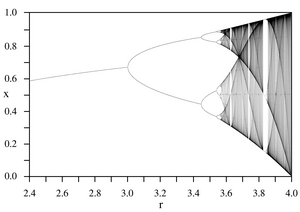
A graphical example of "tipping" points in a chaotic system is shown by the bifurcations in the following graph:
The system is perfect stable for r < 3, enabling a false sense of security and ability to predict the system response for other values.  By r = 3.6, the system has become completely unstable and unpredictable with rapid further increases in instability as r increases from there.

There are many real-world physical examples of this such as turbulent versus laminar flow of a fluid in a pipe where linear increases of pump pressure lead to more-or-less linear increases in flow rate until a certain flow rate is hit, after which the flow becomes turbulent and massive increases in pump pressure give little or no increase in flow rate. Eventually the pipe will burst from the pressure.

In the economy, chaotic effects are manifested in things like shifting comparative advantages between regions leading to the collapse of whole industries and sub-economies.  Examples include: steel shifting to Asia, gutting the U.S. steel industry and leaving the badly damaged rust-belt in its wake; and accelerated devastation of Appalachia from the changing economic viability of coal and farming.  Each of these examples were exacerbated by rent-seeking unions, government and environmental regulations, less than optimal management, technological innovation, and foreign subsidies, but the chaotic nature of markets still played a significant role and these other factors are an inherent part of the chaotic global political economy.

As the chaotic effects increase, investment risk also increases.  It's easier to get investment for a venture that can provide a positive ROI and an exit strategy in a short time frame than for ventures that have a longer time horizon.  This is partly inherent in the risk assessment and its effect on the subjective discount rate used in Net Present Value calculations which penalize longer time horizons.  However, a substantial part of the risk analysis takes the chaotic nature of markets into account.

I have personally experienced this sort of effect.  I may have a high degree of confidence that I'm the only one working on a certain innovation in a given region, but I'm unable to predict the status of this innovation world wide.  Investors, however, want to know if there's a chance they'll be blindsided by some competing group in India, or Israel, or Ireland, or Italy, etc. and if so, will be far less likely to invest.  I think that part of slowing of worldwide investment is partly due to this sort of phenomenon.  There's a lot money sitting, doing nothing, with nobody willing to pull the trigger to invest that money, because that money will be wasted if competing entities are working on the same thing.

Resilience is affected by chaos as well.  In March 2011, an earthquake and tsunami damaged a portion of the northeast coast of Japan and this affected the global supply of motor vehicle parts:
Located in the disaster region and adversely affected by these forces are a number of manufacturing facilities which are integral to the global motor vehicle supply chain. They include plants that assemble automobiles and many suppliers which build parts and components for vehicles. Some of the Japanese factories that were forced to close provide parts and chemicals not easily available elsewhere. This is particularly true of automotive electronics, a major producer of which was located near the center of the destruction.
While efficiency is increased by global trade, the above example shows that resilience is not.  Concentrating manufacturing in one or a handful of facilities to benefit from economies of scale leaves the world economy more vulnerable to natural and man made disasters.

Trade and fluid flows have similarities.  When fluid flows become turbulent, backing off the pressure helps. In a more complex fluid system, adding baffles can help.  Tariffs are essentially baffles in this context.  A 20% across the board tariff would enable redundant manufacturing of various products in different and independent regions, reducing chaos, increasing resilience.  While possibly somewhat less efficient, if the manufacturing is shut down in one region due to an earthquake, tsunami, meteor strike, political unrest, invasion, war, etc., the impact on the rest of the world economy will be mitigated.

In summary, I think there are issues of scale when it comes to free trade. I see no reason why tariffs are any more onerous than other types of taxes, and the chaotic and fragility effects are reasons to use across the board tariffs to restrict international trade.

Monday, June 25, 2012

Chaos and Trade

I'm not a very strong advocate for unfettered free trade.

The main reason is that more is not always better.  While people trading with each other enables efficiencies of specialization, economies of scale, etc., and there's little doubt that 10 people trading with each other are  better off than if each did everything for himself, and 100 is better than 10, and 1,000 is better than 100, it seems that increasing the size of a free trade area beyond a certain point is going to have minimal additional benefits.


There are lots of examples of this: eating more is good up to a point, then you get fat; increasing pressure when pumping fluid in a pipe increases flow until the flow becomes turbulent - then additional pressure has little effect other than possibly rupturing the pipe; entities get too big to fail (see Wall Street, GM, etc.); etc.  In general, complex systems with chaotic interactions can't be scaled without limitation.

An economy is such a system.

Would going from a free trade area of 500,000,000 (roughly the size of NAFTA) to 7,000,000,000 really enable significantly more wealth creation?  I doubt it (though I admit that there is no empirical evidence that supports my doubt).

As a result, I support across the board tariffs on all goods and services coming into NAFTA.  I think that NAFTA is a pretty ideal free trade area with first and third world countries with more than adequate resources.  If having free trade worldwide is in fact better, it won't be all that much better. The tariffs serve as "baffles" to help reduce chaotic interactions that could increase the risk of catastrophic failure.  Lastly, revenues for the government have to come from somewhere and tariffs are no worse of a source than anything else.

Tuesday, May 15, 2012

The Demons of Volatility

Do speculators increase market volatility?  Our president claims to think that:
"President Barack Obama on Tuesday asked Congress for $52 million in new federal funding to boost oversight of oil markets, increase penalties for price manipulators and raise margin requirements to reduce market volatility."
On the other hand, many economists claim the volatility is not increased by speculation.  Here is one example:
"And yet even with no traders to blame, the volatility in onion prices makes the swings in oil and corn look tame, reinforcing academics' belief that futures trading diminishes extreme price swings."
I've been doing the speculating thing for decades now and I'm certain that  both Obama and the economists are confused, misleading and/or just plain wrong.

Speculators absolutely increase price volatility but that volatility is an important feature of the speculator's function in the market that ultimately, over time, benefits the consumer.

Speculators' trades push the price up and down in a given market.  That's inherent in the whole concept of trading.  Activity moves prices.  No activity implies stable/stagnant prices.

So how is the price movement beneficial?  Many price movements either are proxies of actual information or beget real information that can and should cause changes in economic activities and allocations.  There are myriad mechanisms for this, but I'll describe one of them.

Actually, I'll let our president describe the first one:
"The problem is ... speculators and people make various bets, and they say, you know what, we think that maybe there's a 20 percent chance that something might happen in the Middle East that might disrupt oil supply, so we're going to bet that oil is going to go up real high. And that spikes up prices significantly."
Obama is a pretty confident guy and is probably certain that his brilliant and flawless foreign policy will prevent any middle eastern oil supply disruptions.  But let's say, just hypothetically of course, that instead of a perfect and all-powerful United States government under a president who can slow the rise of the oceans and heal the planet and apparently keep the oil flowing, we lived in a world where there really was a chance of a supply disruption.

In that case, the price increases and extra volatility due to speculators and people making "various bets" can be quite beneficial.  First, if the supply disruption occurs, we will already be partially adapted to the higher prices that will result from the disruption.  Second, the oil is still currently being extracted and the higher prices mean that more is being currently stored, so if a disruption happens, there will be more stored oil available.  Third, because demand is already lower and storage is higher, when the disruption of middle eastern oil occurs, the ensuing gap between supply and demand will not be as large and the smaller gap will attenuate the price spike and/or shortages and therefore reduce the negative impact on the rest of the economy.  Fourth, current higher spot and future prices of oil stimulates more drilling and reserves all over the world, which, as they come on line, mitigate the future impact of any disruption of the middle eastern oil supply.


Yet Obama is absolutely correct in that the speculators' activities are spiking "up prices significantly", at least in the short term, and perhaps needlessly should a supply disruption never occur.


If a supply disruption never materializes, what happens?  Most likely, the price will drop substantially over time.  After all, new supply has been stimulated, storage has been increased, and demand has been reduced.  All of these typically lead to lower prices.  Assuming that the price drops substantially, the speculators lose a ton of money.  The speculators, as a group, only make money if the price goes higher.
 
But if the price does go higher because of a disruption, instead of thanking them for blunting the effect of the disruption, we become even angrier at them because they're making tons of money while we're feeling pain at the pump.  It's far less pain than we would've felt without the activity of the speculators, but we won't know and/or understand that as the gasoline purchase drains our wallets.

In my personal experience and observing other speculators, significant money is only made on about one in ten trades.  The rest of the trades either lose money or more or less break even.  Each of those trades adds volatility to the price action.  The losing ones add unnecessary volatility but the benefit from the winning trades makes the entire economy better off in the long run by anticipating and blunting the negative effects of future events.


Speculators are very important for the economy, but they're damned if the prices rise and screwed if the prices fall and demonized in either case.

Wednesday, November 23, 2011

Price to Earnings Ratio

I happened to see the following chart of the Price to Earnings ratio of the S&P 500 and thought it was interesting (click on it to enlarge):

After each of the previous periods with poor economic performance, the P-E ratio had to get down into the neighborhood of 10 for an extended period of time before rapid economic growth resumed. I sure hope that's not the case this time or we have a long, long ways to go before growth resumes.

Tuesday, September 30, 2008

Or Not

On Tuesday the stock market had a big rally after the plunge on Monday.  The headlines everywhere were more or less, "Markets Rally Because of Renewed Optimism That Bailout Plan Will Eventually Pass".

So, how does the Main Stream Media know that for the hundreds of millions of shares that traded, the price was driven up because of buyers' renewed hope that some bailout plan would pass?  Why didn't they have at least some of that optimism on Monday?

If I was left to make up the headline, I would have guessed something more like, "Markets Rally Because Everyone Came to Their Senses and Realized That the Bailout Plan Wasn't Really Particularly Great After All" or, "Markets Rally Because Dollar Surges Against Foreign Currencies".  Or, how about, "Markets Rally Because Fed Continues to Inject Huge Amounts of Liquidity Into System Along with Planning to Reduce Reserve and Capitalization Requirements"?

It could be renewed excitement about the Bailout.  Or not.

Monday, September 17, 2007

Another Bet?

Apparently flush with confidence from his successful bet last year with Duck regarding the price of oil, Oroborous is interested in seeing if he can extend his winnings. Oroborous has made a number of dire predictions for the economy and the markets. For example, in a comment to his post "Morons" he wrote:
"However, buying stocks [on the rally on August 29, 2007] because they're "bargains", with the Dow a mere 6% down from the nominal all-time high, with the economy's warning lights all in the red and flashing, and with the "recession klaxon" sounding, is either speculation of the most egregious kind or simply moronic."
A second example is his comment from "Mountains, Molehills and the Government":
"Rather, the problem is just getting started, and the worst is yet to come."
My response was that the only significant problem facing the economy and/or financial markets was the potentially precipating panic due to the rising subprime mortgage rate of defaults and that the potential for panic seemed to be dissipating. Oroborous replied as follows:
"Would you like to make a small wager on that ?"
I wondered what exactly we might bet on and Oroborous replied:
"You'd have to come up with a description of what you'd be willing to wager won't happen.

"We could use GDP stats, employment figures, foreclosure stats, declines in home prices...

"Whatever you like."
Whatever I like? Excellent! I bet the stock market doesn't go down 100% in the next month!

Actually, being the fair guy that I am, let me propose something more sporting. What I think the fundamental claim that Oroborous is making is that something unusually bad is in store for the markets and the economy. For example, people who are investing right now (or at least on August 29th) are moronic for not seeing a train wreck coming.

I'm claiming that nothing out of the ordinary is likely to occur and that there's no readily available knowledge that makes the current moment a particularly bad (or good) time to invest.

So what's ordinary? One thing that ordinarily occurs is that the Dow Jones Industrial Average chops around an upward trendline of about 6% per year. The standard deviation of the movement about that trendline for any given period can be approximately predicted from lognormal standard deviations of the daily returns. If the lognormal standard deviation of the daily returns is S, the lognormal standard deviation for a period of N trading days is S * (N 0.5). The lognormal standard deviation of the daily returns for the DJIA from August 1st to September 14th is 1.27%. The quarterly, 1/2 yearly, and yearly derived standard deviations to the downside would be approximately 10%, 13%, and 19% respectively.

To have statistical confidence (to the 95% confidence level) that something out of the ordinary has occurred, we would need to see a drop of at least 1.96 standard deviations below the expected trend line. Since my prediction is simply that we don't observe anything out of the ordinary (with statistical confidence), I thus predict (and am willing to bet) that the DJIA doesn't drop more than 17% in the next 90 days, 22% in the next 180 days, or 29% in the next year. (Note that all these calculations are done in the lognormal domain which is why the don't "add" up).

Since the DJIA is more or less as good a measure as any regarding the future health of all aspects of the economy, if Oroborous isn't willing to take one of the above bets, then we have to assume that he and I are in concurrence that nothing unusual and measurable with statistical confidence is likely to occur to the downside during the above periods due to the subprime markets, the housing market, or anything else.

Friday, July 20, 2007

I'm Thinking of Buying Puts

In the last book of the Bartimaeus Trilogy, a major character dies in the last paragraph. After reading that book to her, my 9 year old daughter was devastated for weeks. She kept reading the last chapter over and over again, hoping it would turn out different.

The first printing of the 7th and last book in the Harry Potter series is slated to be "an astounding 12 million copies" (at a length of 784 pages, that works out to just shy of a cool 10 billion pages - that's a lot of trees!). That's a readership of about 100 times as large as the Bartimaeus series. If Harry dies and there ends up being 12 million children, teenagers, and young adults moping about for a few weeks, that could have a significant negative impact on the economy and on the stock market.

As a result, if the stock market begins to lose steam over the next few weeks, I may hedge my position by buying puts on stock index futures. I don't mind if the stock market goes down a bit so I can buy ones that are far out of the money and that should be pretty inexpensive insurance.

By the way, this post should definitely not be construed as financial advice. I'm just jotting down some thoughts, that's all.