Once upon a time, long ago in approximately 1162 AD and faraway in desolate and nearly inhospitable mountains a barbarian boy was born and named
Temüjin. The first few decades of Temüjin's life were really miserable, even by the barbarian standards of his environment (which included tribal warfare, thievery, raids, corruption, revenge, and interference from neighboring powers). When he was 9-years-old, his father was poisoned and then his family was completely destitute, living off wild fruit, carrion, and whatever small game he and his brothers could kill. He was caught and enslaved when he was around 15 years old. Bummer!
That was probably the low point of his life. He eventually escaped slavery and things generally got better for him (with some ups and downs) from there. For example, during the the period starting when he was 35-years-old to 80 years later, he and his descendants conquered the world; well, not all of the world, merely the portions shown below.
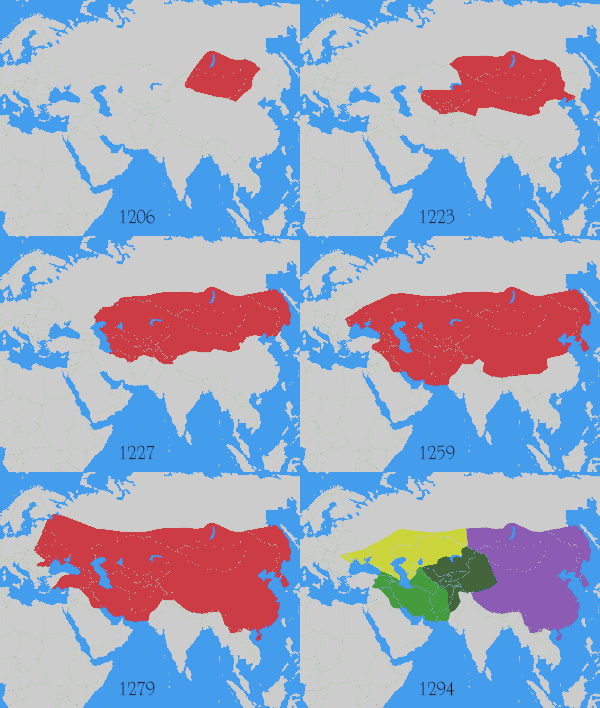
Not all of the world, but in 1279 it was the largest contiguous empire ever (even to this day), totally dwarfing the Roman Empire, for example. Not all of the world, but he was an uneducated barbarian with the rather shaky start described above. Not all of the world, but he did it with the barely beyond stone-age technology of bows and arrows and horses. Think about conquering the area in the map above with just horses (my bottom hurts just thinking about it)!
Somewhere during his conquests, Temüjin became known as Genghis Khan which is how he is remembered today. Scientists estimate that 1 in 200 people are descendants of Genghis Khan, making him one of the 11 most prolific fathers of all time (9 of the 11 are unknown in history).
The horrors of nationalism and religion have been drilled into me my whole life. I've been told about all those people killed by this or that religious atrocity and this or that nationalistic war. Genghis Khan was neither nationalistic nor religious (there's no Genghisstan, for example). But he was possibly the bloodiest, most murderous person in all of history. For example, after conquering
Urgench in central Asia, he slaughtered more than a million people in a mere few days. A million people represented 1 in 400 people on earth at the time. All told, the Mongol conquests killed about 10% of the people on earth. Genghis Khan might be considered directly responsible for the deaths of a larger percentage of the human population than anyone else, ever.
So why was this random barbarian able to conquer such a vast area? The pat answer is that he was a brilliant strategist and politically innovative. And that may well be true.
But I don't think that's the most important part. Genghis Khan didn't conquer any nations, not really. There simply were no nations in his path. At least not nations in the sense that if you attack even a tiny corner of the nation, millions upon millions of people will rush to their defense and drive off the attackers. Instead he just rolled through one city-state after another, none of which had an even remote chance of defending themselves. Even the most populous ones were sitting ducks.
One meme shared by progressives and libertarians is that political borders are at least somewhat immoral; that nationalism is quite immoral and responsible for many of the horrors of the last century; that eliminating nations and national sentiment would be very positive for humankind; that one shouldn't care more about someone from Mississippi than someone from Mozambique; etc. They both make similar critiques about religions.
I don't agree with those assessments. One can argue that Hitler was an insane genocidal maniac who hijacked a whole nation and caused misery nearly beyond comprehension and that if nations didn't exist, Hitler wouldn't've been able to do that. Maybe, but I don't think so.
Because, what about Genghis Khan? He was as simple as simple could be. He was simply a predatory mammal looking to extend his legacy like all (non-domesticated) predatory mammals. And he certainly succeeded. He wasn't insane. He wasn't religious. He was
very tolerant of ethnic and cultural diversity:
The Mongol Empire did not emphasize the importance of ethnicity and race in the administrative realm, instead adopting an approach grounded in meritocracy. The exception was the role of Genghis Khan and his family. The Mongol Empire was one of the most ethnically and culturally diverse empires in history, as befitted its size. Many of the empire's nomadic inhabitants considered themselves Mongols in military and civilian life, including Mongols, Turks and others and included many diverse Khans of various ethnicities as part of the Mongol Empire such as Muhammad Khan.
If you crossed him, he would raze your city and murder everyone in it (except for the skilled artisans and the women, of course - how do you think 1/2% of the current day population are his descendants? Hmmm?). Very simple, really. But as long as you surrendered to him and didn't cross him, he was much more interested in your abilities than your religion or ethnicity.
There will always be people like Genghis Khan and Hitler. After all, we are predatory mammals, and some of us will simply be better predators than the rest of us.
The way I see it, nations and nationalism stopped Hitler from taking over the world. England, Russia, the United States, and others had the nationalistic fervor that drove them to stop him. It was awful, but it was stopped.
What Genghis Khan did was awful too.
And there were no nations to stop him. Only the technological limitations of the horse and bow kept him and his descendants from extending their empire even further.
If there were no nations and no nationalism, then we're essentially a bunch of city-states and the next Genghis Khan will take over the world, just like the Mongols created their empire.

