Search This Blog

Showing posts with label economics. Show all posts

Tuesday, February 11, 2020

Recent Real World Example of Efficiency vs. Resilience

I'm not a very good libertarian because I don't support unlimited free trade. One reason is that unrestricted free trade tends to concentrate manufacturing of given products in a small number of countries. That's very efficient, of course, because of amazing economies of scale. But what if something happens to one of those massive manufacturers? For example, in this post I wrote:
As a roboticist, I have almost a fetish for electric motors and actuators and the production thereof. While I’ve never visited their factory in China (Hong Kong area), some colleagues that have visited it describe Johnson Electric[johnson] as one of the most awesomely efficient motor production facilities in the world; in one end goes copper ore and other raw materials and out the other end comes millions of motors per day. It’s a shining example of economies of scale and efficiency. Their specialty is automotive electric motors (for power windows, for example) and they produce a significant fraction of all motors worldwide in that niche. If trade restrictions and tariffs were further reduced, no doubt they would have even a larger share of the market and be even more efficient and be able to produce and sell the motors at a somewhat lower cost.
I imagine that part of the appeal of free trade is that there would be many extremely efficient companies like Johnson Electric, each thriving in a specific niche with tremendous volumes, yet with enough competition from a handful of other companies to drive relentless innovation, quality improvement, and cost reduction.
However, there’s potentially a downside to such a scenario. What happens if something happens to Johnson Electric? What happens if there’s political unrest (war), a fire, or a natural disaster?
To war, fire and natural disaster we can now add epidemic. China's latest coronavirus problem is causing economic turmoil beyond the epicenters of the epidemic:
The coronavirus outbreak in China has generated economic waves that are rocking global commodities markets and disrupting the supply networks that act as the backbone of the global economy.
Some of this would happen if there is any international trade at all. But the more free trade there is, the more susceptible we all are to the economic disruptions that have been (and will be) caused by the virus. Having multiple sources for those things manufactured predominantly in China would be less efficient in the general case, but more resilient in the face of issues in one part of the world.

My company has been adversely affected (but not badly) by these disruptions. We have most of our electronics boards manufactured in China and we had to scramble to move that production elsewhere because the factories we normally use have been shut down due to quarantines.

Nobody twisted our arms and told us we had to manufacture in China, but in a world with minimal tariffs and minimal trade restrictions, that's simply what naturally happens. If China hadn't taken over manufacturing small quantities of boards, domestic companies would develop and while they wouldn't be as inexpensive and efficient as China was before the coronavirus outbreak, I believe it would be close enough to not matter much. In other words, less efficient, but not terribly less efficient.

Somewhat less efficient but more resilient.

Tuesday, May 30, 2017

Horrifically Dogmatic?

Someone asked Don Boudreaux at Cafe Hayek if he would oppose any sort of free trade by giving the following example:

Don — I wonder about “unconditionally.” Would you make an exception for trade in goods produced by slavery? For example, would you object even to a law barring the import of products manufactured in Soviet- or Nazi-era slave labor camps? 
Best,Jeff

Don's response?
Jeff, 
I would not make that exception. [...] 
Don
Oh sure, I cut the explanation out of why Don wouldn't make an exception, but is there any explanation that could really justify that response?

Not for me (but perhaps I'm the one being dogmatic?).

Perhaps I should seek out some somewhat less dogmatic libertarians to read...

Wednesday, April 19, 2017

No Liberty without Justice

When G.W. Bush gave his second inaugural address, he chose the topic to be the Justice and Freedom conferred by the Constitution, and the lack thereof in other places:

"America's belief in human dignity will guide our policies. Yet rights must be more than the grudging concessions of dictators. They are secured by free dissent and the participation of the governed. In the long run, there is no justice without freedom, and there can be no human rights without human liberty."

The problem with Justice requiring Freedom, is that very often Freedom requires Justice too. How do you get to one without the other? Chicken and eggs.

So the short answer to Bret, who asks me "Is Liberty Erupting in Brazil?", is no, it is not, for we have no Justice.


When we last touched the subject here (see also the comments section), Brazil was rocked by the actions of a single judge (Sergio Moro) who started with a case of money laundering in a gas station a few miles from my home (rendering the name of the scandal: Car Wash operation), and end up with multi-billion corruption charges related to PETROBRAS (the Brazilian petroleum company) and our biggest Construction companies, siphoning off money to many politicians and parties.

Afterward, the President back then, Ms. Roussef, was impeached, and the Workers Party (PT) has been in free fall since the 2016 elections. The Vice-President, Michel Temer, did a U-turn on the leftist platform he was elected on, and a naive free-market-oriented external observer may well believe we are now in the right path: an addendum to the Constitution now forbids the growth of spending to exceed inflation rate for the next 20 years; several public programs have been reduced in size and scope (like public health system and public education); the pension system is being reformed as I type; and labor laws are being completely reviewed, with major protests from trade unions. 

Looks like the dream package for liberal reformers, so how come Liberty is not arriving?

The thing is, Brazil is not for amateurs. We have a long tradition of, as we say down here, doing things "para gringo ver" (to show up for foreigners). After all, our Elites were established by a foreign power (Portugal), and since then their business has been to show what they were asked to show - not necessarily doing it. It follows that we got our Independence blood free in the 1800's, but never our Liberty.


Mr. Temer's party (PMDB) has been in power - by giving their political force and support in Congress - since our redemocratization, in 1985, and many of its members were in power before that, during the Military Dictatorship (1964-1985), and yet even before that. It is an Establishment party. And the Establishment never gave us Liberty - why would it do that now?

I once pointed out to Bret that, though Mr. Moro was brave, the end game of his anti-corruption crusade would be our higher court, the analogue of SCOTUS, where eleven judges are appointed to by Presidents for life. Hey, what could go wrong?

I can't openly comment on the judges of this court - after all, this is not a free country - but let me say that it may have (very few) honest members (to the very limited extent of my knowledge -- legal disclaimer: for all purposes, I hereby declare I do not mean any of our judges could possibly be dishonest). Teori Zavascki, the judge assigned to oversee the Car Wash cases that touched politicians with special immunity from lower courts (which are all under present mandates), is one of those honest judges, in my limited opinion. Or he was.

Odebrecht - the biggest of the Brazilian contractors, a multi-billion company with international operations (did you notice they reformed the Miami airport, Erp?) - had its CEO (Mr. Marcelo Odebrecht) under "provisional" arrest since 2015, implicated in the Car Wash operation. It's been calculated they paid away more than one billion dollars in kickbacks throughout the last decade, for every political party and sub-relevant politician down here. In order to negotiate less prison time and fewer fines, he and dozens of executives at Odebrecht have agreed to a guilty plea, detailing all their corruption scheme and beneficiaries. Their confession was being hailed as the Mother of All Bombs (MOAB) over our political system.

On January 19, the week right before Judge Zavascki was to validate that mighty bomb, an accident happened. He took a private airplane with a rich friend, to visit the friend's beach mansion at Rio de Janeiro's coast, with a highly experienced pilot (who used to teach younger ones how to fly under coastal conditions) in a Hawker Beechcraft King Air C90 aircraft (that's for Skipper) - and, for apparently no reason known, the pilot (or the plane) failed 2 miles before the landing field, while on descent under light rain.

Accidents. They happen, sometimes more often than others. Since the Car Wash operation started, 5 high profile people with possible connections to it (as bribers or bribed) died flying private airplanes. A number of other people committed suicides, under not very clear conditions, to say the least. 

But I digress. Our Supreme Court could not stay with only 10 judges, even more so when they have such a high profile case to judge. So our President, Mr. Temer, got to place a judge by his finger there now. Mr. de Moraes, his Minister of Justice (since the impeachment a few months back) was the man. I can not comment much about him - after all, this is not a free country - but there is good evidence he, among other iffy stuff, had in his CV a few millions earned from dubious companies, and was the lawyer for one of Brazil's most dangerous mafias (the PCC). You guys get Gorsuch, we got Mr. de Moraes. He is now appointed by the President to be one of the judges who will decide on the future of the same President, and his own pals back in his days of politics.

Though Judge Zavascki's death delayed the Odebrecht MOAB for a few months - buying time for President Temer to pass his reforms, and to appoint other judges to other positions where they will lead cases that hang on Mr. Temer's head - that bomb finally came through.

As per Odebrecht's own account (and of his father, the previous CEO), they have been bribing and buying our political system for 30 years. Our 5 last Presidents - which are all since we got elections back - are implicated. As is our President now, which personally coordinated at least two meetings where he asked for Odebrecht's money (of course, in exchange for overpriced public contracts, so in the end *our* money) totalling many dozens of millions.

To be precise, Odebrecht also points his finger to 415 politicians, among them 8 present ministers, 13 governors, 36 senators (24 present ones), many dozens of congressmen (of which 39 are today in Congress, including its higher chairs). Though the Worker's Party, which had the Presidency for the last 13 years, had all its main heads involved, they are easily outnumbered by PMDB and PSDB - the main parties that granted Roussef's impeachment last year, and make up the present Government by Mr. Temer.

What's more, another legal case - aimed to cancel the election of Ms. Roussef and Mr. Temer in 2014, due to the illegal money by Odebrecht and other constructors - under our higher courts has been further stalled since Mr. Temer got the chair. He also got to indicate other judges for this court in the last few months, and though Odebrecht's bomb clearly spell out the illegal money they gave for that election, there is no sign the case will be judged anytime soon.


Though I could go on for a long while, I hope I already gave a hint of why I believe we have no Justice. And will have no Liberty, anytime soon.

But surely the economic gains by those reforms will be a step up, won't it?

I don't know. I can point out a number of holes in each of those reforms, all giving more power to our corrupt political/judiciary system, while taking away resources - some of which were well employed, notwithstanding our many problems - from the public system serving the poorest.

Will they lead to growth only for the upper class, as happened in the 70's, when our economy had two digits growth but the largest formation of favelas ever seen?

Anyway, I much doubt the very same people who made fortunes of our statism and cronyism, will be the ones to lead us, finally, to Liberty.

Friday, April 14, 2017

Is Liberty Erupting in Brazil?

It sorta seemingly might be according to this article. Here's an excerpt:
Brazil has tried everything else. Now it seems ready to try liberty. Nothing ever goes in a straight line but the chances for real victories – privatization, tax cuts, trade reform, liberalization of health care and education and business enterprise – actually seem possible. And if not immediately, it is also clear that this movement is not going away. It is growing, even exponentially.
If true, this would be an extremely interesting development. Brazil has, after all, the 7th largest economy in the world and it's economy is about the same size as Germany, Japan, and Russia. If Brazil somehow threw off the shackles of corruption, bureaucracy, and centralized control, something big and interesting would happen - hopefully good, possibly not (and there would certainly be losers along with the winners), but big and interesting either way.

Monday, February 27, 2017

The Darkness of Light - A Story of Economic Scale

Once upon a time, long ago and far away, it was a dark and stormy night in a small village. Like most small villages of the era, its existence was due to the goods and services its craftsmen provided to the surrounding farmers and to each other. There was a butcher, a baker, and a candlestick maker and a number of other crafts represented (blacksmith, cobbler, etc.). This trading network of a few hundred people (including farmers) was nearly completely self-sufficient, except for the occasional traveling merchant who brought in some critically important goods as well as some more frivolous and luxury goods. This pre-industrial village, while mostly self-sufficient was also quite poor by modern standards as the small size of this economy couldn't enable sufficient specialization to support modern goods and services, even if all the knowledge of the modern world was readily available and understandable.

Glim, the village candlestick maker was happy with his life. His family had always been the candlestick makers in this village and it was comforting to know his place in life. As he gazed out into the storm, he could see flickers of light emanating from the other homes in the village and he had satisfaction knowing that some of that light was his candlesticks pushing back the darkness and providing comfort to the other villagers.

He had to work hard and was hardly rich, but was prosperous enough to support himself, his wife, and his three daughters. When the traveling merchants came to town, he was able to afford some necessities and even an occasional luxury item like the exotically patterned and very warm rug that sat on the floor of his bedroom. In fact, merchants had just arrived that particular evening and would open their booths to trade their wares the following morning. This was good, because Glim's wife was running short on spices, and they could likely remedy that by trading with the merchants in the morn.

When morning came, Glim and his wife went to trade with the merchants. The merchants had their typical wares available, but to Glim's shock and dismay, the merchants had table after table with numerous varieties of candlesticks, and, after inquiring about the price of the candlesticks, Glim discovered that they were selling for less than half the price of Glim's candlesticks. The merchant explained that a village about 50 leagues away (that had recently been renamed Candleton) had discovered a technique that enabled a few dozen people, working together, to churn out an enormous quantity of candles at very low cost and very high quality. Glim was devastated, because he could not make enough money selling his candles at a competitive price to feed his family and survive. Glim, the candlestick maker, was now out-of-business and had no other skills or ways to earn a livelihood.

So now, dear reader, I'll let you choose the fate of Glim and his family. Perhaps the kind villagers, through a mix of charity and giving Glim odd jobs, kept Glim and his family from becoming destitute. Perhaps Glim tried to farm and maybe he succeeded or maybe his family starved. Perhaps Glim moved his family to Candleton where maybe they needed him but maybe they didn't. Perhaps Glim and his wife fell into the depths of despair and drank themselves to death leaving his daughters to become prostitutes in order to survive. Whatever you choose, dear reader, Glim is probably out-of-luck, and your story for him has been repeated countless times over the ages. Chances are, his level of prosperity is probably going to be lower for the rest of his days than it would've been had the folks at Candleton not invented the new candlestick making process.

But Glim's tough luck is everybody else's good luck. Everybody else gets more candlelight for less. And the villagers in Candleton? They're hugely prosperous, especially at first. After a few years, they split into competing companies which drives their prosperity down a bit but makes candles even cheaper for the surrounding villages.

The benefit of more candlelight turned out to be extraordinary. More people learned to read and that additional knowledge inspired a wave of discoveries and inventions. While more folks like Glim lost their livelihoods, new jobs were created at a rapid pace during this heady time of economic and technological growth. In fact, Glim's grandchildren (perhaps bastards born to his daughters when they turned to prostitution?), opened a printing press and shop and became quite prosperous. Too bad Glim never lived to see it (or perhaps he did, dear reader, in your version of Glim's fate?).

Over the next few generations, electricity was discovered and then harnessed to power a very important invention: the electric light bulb. Which brings us back to Candleton.

Between the time of Glim's misfortune and the invention of the lightbulb, Candleton prospered hugely. A hundred people now worked in the village's three candlestick making factories. Further innovations had increased the number of candlesticks made and lowered the cost. Because of the economies of scales, no other village could compete and Candleton provided the vast majoritiy of candlesticks to all villages for hundreds of leagues in all directions.

But now the electric light bulb, being vastly superior to candles, and lasting months instead of hours, rendered the candlestick making talents of the inhabitants of Candleton useless nearly overnight. Revenue ceased to flow into the village. Unlike the case with Glim, where it was one guy and his family who were directly impacted, and where, at least conceivably Glim's fellow villagers could help sustain him, the residents of Candleton were immediately in extremely dire straits: no revenue, no food, no nothing.

Some of the residents of Candleton left to seek their fortunes elsewhere. Some tried to live by hunting. Many, however, became bandits, stealing from travelers and raiding nearby villages. The other villages organized defenses and the clashes with the bandits became increasingly bloody and deadly as all sides became increasingly desperate. After a decade or so, the bandit population dwindled and the area became mostly peaceful once more. Candleton, however, was left in ruins and became a ghost town with the wilderness encroaching on and then devouring the once prosperous village.

That was tough luck for Candleton, it's inhabitants, and the neighboring villages who had to endure the onslaught of desperate bandits, but the surrounding regions were made much better off by the new electric light. The difference between the innovation that hurt Glim and the one that destroyed Candleton is scale. One guy (Glim) losing his livelihood has limited impact. A whole village losing its livelihood is much more catastrophic and much harder for the residents to recover from because there simply aren't the resources from which to build.

With the harnessing of electricity numerous inventions came about and many of these inventions enabled more complex products requiring larger networks of people to create them causing villages to consolidate into towns and towns into cities. In one such city, Carton, thriving automobile and tractor manufacturing companies were created. The tractors made farmers much more productive and the displaced farm workers came to Carton to work in the factories. Jobs were created more rapidly than jobs were destroyed and a large number of jobs required only minimal and/or quickly learned skills. It was a time of great prosperity and economic advancement.

There were over one million inhabitants in Carton, with occupations ranging from miners gathering the raw materials for the cars to school teachers and other supporting professions. People did lose jobs as processes were changed and innovations implemented but such was the prosperity that new endeavors requiring yet more low-skilled workers were being formed all the time, so work was available for all.

In fact, the great prosperity and constant need for labor sowed seeds of problems in the future. The workers realized they could band together and collectively bargain for higher pay, better working conditions, and greater benefits. Management, in return, made the benefits accrue to the future in terms of pensions and health benefits after retirement. The prosperity also enabled management to become lazy and corrupt and they lined their own pockets and did things like hiring incompetent children and nephews.

After a few more decades, the perfect storm hit. Saddled with increasing wages and pension costs from collective bargaining and corruption and incompetence due to human nature, new and distant competitors simultaneously began manufacturing not only cars and tractors, but also steel and other raw inputs. The distant competitors were not saddled with the liabilities of Carton, and ended up having a huge comparative advantage relative to Carton's factories and workers with respect to Carton's products. While this happened over years, Carton and surrounding region was devastated. Hundreds of thousands of people were out of work, poverty and crime skyrocketed, alcoholism and drug abuse decimated the productivity of the potential workforce, and because total revenues declined below subsistence for the population as a whole, and because it was an area for which there was no particular reason for outsiders to invest, people became increasingly desperate.

Along came a leader, Trunald Domp, who realized that while Carton and its people no longer had a comparative advantage in anything productive, they did, like many desperate peoples in the pits of despair who feel they have nothing left to lose, have a yuge comparative advantage in violence. So he organized the people of Carton to produce arms and they attacked the surrounding areas. The bloody war killed tens of thousands of people but eventually Domp and Carton were defeated. The remaining people of Carton fled their collapsing city increasingly desperate to find any means of staving off starvation. The were, of course, met with suspicion and outright hostility, and many were killed on sight. The ones that survived became an underclass and there were frequent violent revolts. Eventually distrust and hatred built to such a fevered pitch that the entire civilization collapsed and everybody died except for a small fraction of the population that fled into the wilderness and formed small groups of farms surrounding small villages. These villages were too small to maintain any sort of advanced economy so they reverted to pre-industrial levels of goods and services.

In one of these villages, a man named Flick was the candlestick maker. It turns out he was a distant descendant of Glim. Flick was proud of his occupation because his candlesticks pushed back the darkness and provided comfort to his fellow villagers.

---

The bigger the scale of the economic trading networks, the more destabilizing the destructive part of Schumpeter's Creative/Destruction. Tough luck for Glim, but everything was perfectly stable and everybody else was more prosperous. Tougher luck for Candleton and the surrounding areas with the bandits but most people were not only unaffected but also much more prosperous. But toughest luck for all for Carton and the rest of the world, where nobody came out ahead. Once a region is sufficiently devastated, there's little hope for the investment and resources required for recovery. The region itself simply doesn't have the resources and outsiders are unlikely to invest in such an unstable and risky region.

Moral of the story: don't put people in a position where they feel they have nothing left to lose - it won't end well for anybody.

Friday, October 21, 2016

Response to "Open Letter to Commenter Bret Wallach"

Hi Don,

You asked the following in your Open Letter to me:
Do you, in short, believe that you have an ethical right to grow your own tomatoes with your own resources if you choose – a right that trumps other tomato-growers’ insistence that you instead buy your tomatoes from them?
I've never had tomatoes thrown at me before in a debate, even figuratively, so this is a first. I'm sure it beats being hit with actual tomatoes. :-)

But I wonder if you've asked yourself that very question? And I wonder what your answer to yourself would be?

I wonder that because you seem to be a strong supporter of patents. If so, consider the following. I'm happily and honestly growing my tomatoes using only my own and all completely legal resources. As they're growing away, some tomato DNA from an adjacent field of tomatoes grown from Monsanto tomato seeds blows into my field and inadvertently contaminates the tomatoes that I've planted for next year's seed stock. Unfortunately for me, Monsanto's patent protection on the DNA disallows me from planting and selling tomatoes next year using my own seed stock. These Monsanto patent rights that prohibit me from growing my own tomatoes have been upheld by the Supreme Court:
The US Supreme Court upheld biotech giant Monsanto’s claims on genetically-engineered seed patents and the company’s ability to sue farmers whose fields are inadvertently contaminated with Monsanto materials.
Of course, other tomato-growers who use Monsanto's seeds will be quite happy that I'm stuck buying tomatoes grown by them instead of growing my own. I assume that as a supporter of patent rights that you side with the Supreme Court and Monsanto on this one and you, in short, do NOT believe that I have an ethical right to grow my own tomatoes with my own resources if I choose. At least not an inherent right - Monsanto's patent right trumps any rights I might have to grow my own tomatoes.

Or am I mistaken? Perhaps you're going to tell me that the DNA that trespasses onto my property is not my resource? Perhaps, but then neither is the sun that falls on my crops nor the CO2 that the tomatoes need to grow that blows through my fields nor the earthworms that migrated from adjacent fields nor the rain that falls from the sky, etc. If you follow that line of reasoning, I'm therefore not able to grow tomatoes with solely my own resources and so your question becomes meaningless. Or perhaps I could grow them in an airtight greenhouse with only artificial lights and sterilized topsoil purchased elsewhere rejuvenated by microbes I buy elsewhere, etc., but such tomatoes would have no chance to be commercially viable making your question still mostly meaningless.

Or perhaps you're a strong supporter of patents except in this case? And cases like it?

Do you support precluding an inventor from using a method he invented independently (and possibly before anybody else) with the sweat of his brow risking his own capital simply because he filed his patent application a nanosecond after someone else filed a patent application for more-or-less the same invention (also invented independently)? This happens quite frequently (though there's usually a bit more than a nanosecond between the applications) and is quite a severe restriction on the freedom and even life of the very slightly slower-to-file inventor.

But that's all well and good: them's the rules and them's the breaks. We've collectively, via the State, decided that patents benefit the collective in aggregate and if some folks are deprived of the fruits of their labors and possibly severely damaged because of that, tough luck - the freedom to use what you've developed is trumped by what benefits the collective. And you support that, right?

To me, a patent is a GOLEM (Government Originated Legally Enforced Monopoly) and GOLEMs are a subset of GOLERTs (Government Originated Legally Enforced Restrictions on Trade). Your support of patents makes you perfectly okay with GOLEMs and therefore at least that type of GOLERT. To paraphrase an old joke, now that we've identified that you're perfectly happy and supportive of the collective placing some restrictions on trade, all that's left is to haggle over the details. :-)

Oh, I have no doubt you'll find some way to rationalize it. Perhaps you'll say "BUT IT'S PROPERTY!" Okay, but then why isn't it property for the other guy who invented it (perhaps he even invented it first, he was just slower to file)? Why isn't it property after 20 years? Or is it property but then it's okay for the State to take it away after 20 years? In which case why wouldn't it be okay for the State to take away any property if it benefits the collective? And if inventions are property, why were they not generally described as property prior to the 1960s, the decade when the World Intellectual Property Organization (WIPO) was founded (with the purpose of getting everybody to think of inventions as property)? Etc.

Applying this to growing tomatoes, perhaps the invention that I invented first using only my own resources but was slightly slower-to-file than someone else was a new-fangled super-duper tomato transplanting system (since I'm a roboticist who develops agricultural automation products, I actually bid on developing exactly such a system a few weeks ago). Assuming the other inventor got the patent, it would be illegal to use my invention to grow my own tomatoes. However, I could probably prevent anyone from proving that I was doing so (since I simply wouldn't allow them on my property) and could use my invention without fear of punishment. Would that be unethical? Immoral? Would it matter whether or not I sold the tomatoes?

In thinking about one small aspect (patent considerations) of your seemingly simple question of whether or not I should be able to grow stuff (tomatoes) on my own property using my own resources without any interference from the collective (the State) or subsets of the collective (other growers), more than a dozen questions have already come to mind. That's because your question is not simple. Everything that everybody does affects everybody else and nothing that involves large numbers of people is simple.

My answer to your seemingly simple question of whether or not I should be able to grow stuff on my own property without any interference from others is "it depends."

Sincerely,
Bret Wallach
President
Vision Robotics Corporation
San Diego, CA

P.S. If you excerpt any of the above, please also provide a link to this page (http://greatguys.blogspot.com/2016/10/response-to-open-letter-to-commenter.html) so readers can see the full context of what I've written.

Thursday, October 20, 2016

Response to Don Boudreaux - Rough Draft

Hi Don,

You asked the following in your Open Letter to me:
Do you, in short, believe that you have an ethical right to grow your own tomatoes with your own resources if you choose – a right that trumps other tomato-growers’ insistence that you instead buy your tomatoes from them?
I've never had tomatoes thrown at me before in a debate, even figuratively, so this is a first. I'm sure it beats being hit with actual tomatoes. :-)

But I wonder if you've asked yourself that very question? And I wonder what your answer to yourself would be?

I wonder that because you seem to be a strong supporter of patents. If so, consider the following. I'm happily and honestly growing my tomatoes using only my own and all completely legal resources. As they're growing away, some tomato DNA from an adjacent field of tomatoes grown from Monsanto tomato seeds blows into my field and inadvertently contaminates the tomatoes that I've planted for next year's seed stock. Unfortunately for me, Monsanto's patent protection on the DNA disallows me from planting and selling tomatoes next year using my own seed stock. These Monsanto patent rights that prohibit me from growing my own tomatoes have been upheld by the Supreme Court:
The US Supreme Court upheld biotech giant Monsanto’s claims on genetically-engineered seed patents and the company’s ability to sue farmers whose fields are inadvertently contaminated with Monsanto materials.
Of course, other tomato-growers who use Monsanto's seeds will be quite happy that I'm stuck buying tomatoes grown by them instead of growing my own. I assume that as a supporter of patent rights that you side with the Supreme Court and Monsanto on this one and you, in short, do NOT believe that I have an ethical right to grow my own tomatoes with my own resources if I choose. At least not an inherent right - Monsanto's patent right trumps any rights I might have to grow my own tomatoes.

Or am I mistaken? Perhaps you're going to tell me that the DNA that trespasses onto my property is not my resource? Perhaps, but then neither is the sun that falls on my crops nor the CO2 that the tomatoes need to grow that blows onto my fields nor the earthworms that migrated from adjacent fields nor the rain that falls from the sky, etc. If you follow that line of reasoning, I'm therefore not able to grow tomatoes with solely my own resources and so your question becomes meaningless. Or perhaps I could grow them in an airtight greenhouse with only artificial lights and sterilized topsoil purchased elsewhere rejuvenated by microbes I buy elsewhere, etc., but such tomatoes would have no chance to be commercially viable making your question still mostly meaningless.

Or perhaps you're a strong supporter of patents except in this case? And cases like it?

Do you support precluding an inventor from using a method he invented independently (and possibly before anybody else) with the sweat of his brow risking his own capital simply because he filed his patent application a nanosecond after someone else filed a patent application for more-or-less the same invention (also invented independently)? This happens quite frequently (though there's usually a bit more than a nanosecond between the applications) and is quite a severe restriction on the freedom and even life of the very slightly slower-to-file inventor.

But that's all well and good: them's the rules and them's the breaks. We've collectively, via the State, decided that patents benefit the collective in aggregate and if some folks are deprived of the fruits of their labors and possibly severely damaged because of that, tough luck - the freedom to use what you've developed is trumped by what benefits the collective. And you support that, right?

To me, a patent is a GOLEM (Government Originated Legally Enforced Monopoly) and GOLEMs are a subset of GOLERTs (Government Originated Legally Enforced Restrictions on Trade). Your support of patents makes you perfectly okay with GOLEMs and therefore at least that type of GOLERT. To paraphrase an old joke, now that we've identified that you're perfectly happy and supportive of the collective placing some restrictions on trade, all that's left is to haggle over the details. :-)

Oh, I have no doubt you'll find some way to rationalize it. Perhaps you'll say "BUT IT'S PROPERTY!" Okay, but then why isn't it property for the other guy who invented it (perhaps he even invented it first, he was just slower to file)? Why isn't it property after 20 years? Or is it property but then it's okay for the State to take it away after 20 years? In which case why wouldn't it be okay for the State to take away any property if it benefits the collective? And if inventions are property, why were they not generally described as property prior to the 1960s, the decade when the World Intellectual Property Organization (WIPO) was founded (with the purpose of getting everybody to think of inventions as property)? Etc.

Applying this to growing tomatoes, perhaps the invention that I invented first using only my own resources but was slightly slower-to-file than someone else was a new-fangled super-duper tomato transplanting system (since I'm a roboticist who develops agricultural automation products, I actually bid on exactly such a system recently). Assuming the other inventor got the patent, it would be illegal to use my invention to grow my own tomatoes. However, I could probably prevent anyone from proving that I was doing so (since I simply wouldn't allow them on my property) and could use my invention without fear of punishment. Would that be unethical? Immoral? Would it matter whether or not I sold the tomatoes?

In thinking about one small aspect (patent considerations) of your seemingly simple question of whether or not I should be able to grow stuff (tomatoes) on my own property using my own resources without any interference from the collective (the State) or subsets of the collective (other growers), more than a dozen questions have already come to mind. That's because your question is not simple. Everything that everybody does affects everybody else and nothing that involves large numbers of people is simple.

My answer to your seemingly simple question of whether or not I should be able to grow stuff on my own property without any interference from others is "it depends."

Sincerely,
Bret

Wednesday, October 19, 2016

Don Throws Tomatoes at Me

Here's a post from today at Cafe Hayek (I assume that since it's an "Open Letter" to me that I have every right to reprint it verbatim):

=======================================================================

Open Letter to Commenter Bret Wallach
by DON BOUDREAUX on OCTOBER 19, 2016


Bret Wallach

Mr. Wallach:

I close my recent “Elemental Case for Free Trade” with the following ethical argument: “if you work and earn income honestly, that income is yours to use as you choose.  You may use it to buy tomatoes from your neighbor or to buy tomatoes from a farmer in Mexico.  It’s your money.  It belongs neither to the state nor to any domestic producer.  Yet protectionist arguments rest on the premise that your tomato-growing neighbor has some positive claim on your income.  If you are prohibited from buying tomatoes from Mexico, or – more commonly today – penalized with a tariff for doing so, the state is insisting that domestic tomato growers have an ethical claim on part of your income.”

You disagree with my argument.  That is, you apparently believe that the state acts ethically if, in its efforts to increase sales made by existing domestic tomato growers, it penalizes you for using your own income to buy foreign-grown tomatoes.  Do you, then, also believe that the state would be acting ethically if, in its efforts to increase sales made by those same domestic tomato growers, it penalized you for using your own income to buy potting soil, fertilizer, and tomato seeds that you use to grow your own tomatoes?

If you believe that there’s nothing ethically objectionable about Uncle Sam penalizing you for spending your income in ways that cause the sales of some domestic producers to be lower than otherwise, surely you then have no objection to Uncle Sam penalizing you for growing your own tomatoes.  Nor must you object if Uncle Sam were to penalize you and other Americans for buying used rather than new cars (or, indeed, for putting off buying new cars by keeping your existing cars in good repair) – or for buying previously owned rather than newly build homes – or for growing beards rather than shaving daily (think of all the sales that Gillette loses because more men today wear facial hair!) – or for recycling aluminum cans and plastic cartons – or, indeed, for doing anything with your own resources that Uncle Sam judges to wrongfully reduce sales made by its favored domestic producers.

Do you, in short, believe that you have an ethical right to grow your own tomatoes with your own resources if you choose – a right that trumps other tomato-growers’ insistence that you instead buy your tomatoes from them?  If so, how do you square this belief with your insistence that it is ethically acceptable for the state to penalize you and others for spending parts your incomes on the purchase of imports?

Sincerely,
Donald J. Boudreaux
Professor of Economics
and
Martha and Nelson Getchell Chair for the Study of Free Market Capitalism at the Mercatus Center
George Mason University
Fairfax, VA  22030

=======================================================================

I'll (most likely) respond to Don in the next few days.

The gross simplification of Don's philosophy is "BUT FREEDOM!" where freedom to do as you see fit, as long as it's peaceful and voluntary for all parties, trumps (nearly) all other considerations. The gross simplification of my philosophy is "WHEN IN DOUBT, CHOOSE FREEDOM!" and that means that I basically believe that some ends can sometimes justify some means that might restrict peaceful, voluntary freedom, but the case for doing so has to be really strong. I think there's a lot of overlap, but I think that the hairs we split are important to some degree.

Tuesday, August 16, 2016

Karl's Still Going Strong

Here's an interesting tidbit: Karl Marx is the most assigned economist in U.S. college classes:
More than 25 years after the fall of the Berlin Wall, the collapse of the Soviet Union and the onset of market-economy practices in China, “The Communist Manifesto” still ranks among the three most frequently assigned texts at American universities. 
That’s according to data from Open Syllabus Project, which tracks books and other works assigned to students in more than 1 million syllabi.
That's pretty good staying power!

Wednesday, June 29, 2016

More Gloom ... for Apocaholics

The Malthusians of the world are always right until they’re wrong. They’ll warn of impending resource depletion until they’re blue in the face, but time and again human ingenuity (and natural providence) has made fools of them. We’ve seen two welcome new examples of Gaia’s riches this week—what’ll we find next?
So concludes an article at The American Interest. (h/t Instapundit)  It mentions:
 As one of the researchers put it, “[t]here’s a lot more fresh groundwater in California than people know.” The breakthrough here involved searching for water deeper underground than aquifers designated for human consumption typically lie.
...
    
Halfway across the world a different group of scientists employing a novel new detection technique found an enormous new supply of helium gas—an increasingly scarce element that’s critically important for advanced scientific research and medical technologies—in Tanzania. The University of Oxford reports:
[A] research group from Oxford and Durham universities, working with Norway-headquartered helium exploration company Helium One, has developed a brand new exploration approach. The first use of this method has resulted in the discovery of a world-class helium gas field in Tanzania. […]
...
 
Helium prices have quintupled since 2000 as supplies have started to dwindle. You can understand, then, why this discovery is being described as a “game changer,” and not just for the fact of this specific supply alone, either: this was the first place these scientists employed their new surveying technique. They’re batting 1.000, and could now apply this technique in areas with similar geology in different parts of the world.

The Apocaholics, control freaks and statists of varying stripes just never learn...

Monday, May 09, 2016

Question About Free Trade: A Letter to Don Boudreaux

Dear Don,

I've been following your blog posts regarding free (international) trade for a decade (including the one today titled "Crying Crocodile Tears") and I'm wondering what your thoughts are regarding a number of free trade subtopics. If you had time to blog about them, I'd find that interesting and think some of your other readers would too.

Definition of  Free Trade

One thing I've never been quite sure of is your definition of free trade. Here's what I get by typing "Free Trade Definition" into Google[google]:
free trade noun
noun: free trade; modifier noun: free-trade 
1. international trade left to its natural course without tariffs, quotas, or other restrictions.

Is that the definition you have in mind when discussing free trade? The rest of this letter assumes so.

Efficiency of Tariffs

According to the definition above, Free Trade and tariffs (where a tariff is a tax) are mutually exclusive. Yet domestic economic transactions are subjected a huge number and wide variety of taxes such as sales taxes, earned income taxes, real estate taxes, estate taxes, capital gains taxes, corporate taxes, health taxes, transportation taxes, and so forth. It doesn’t appear to me that tariffs are any less legitimate than any of the other myriad types of taxes.

In addition, tariffs are a fairly efficient tax in that there are a limited number of ports where goods worth a great deal can enter the country. Compare this to an income tax where a large percentage of more than 300,000,000 individuals in the United States have to file. I’m under the impression that efficiency is why the tariff was historically used to help keep the kingdom’s coffers complete.

Given that libertarians believe that at least a minarchist government is required and even a minarchist government requires some revenue, to the extent that revenues from tariffs can replace the need for other taxes, I don't see why tariffs are any more onerous for an economy and society than any of those other taxes. To me, tariffs seem at least as legitimate and at least as efficient as of the other forms of taxation.

If a majority of the American people and its resultant bureaucracy prefer tariffs to other forms of tax, is that really so bad from an economic efficiency point of view?

Efficiency Versus Resilience

As a roboticist, I have almost a fetish for electric motors and actuators and the production thereof. While I’ve never visited their factory in China (Hong Kong area), some colleagues that have visited it describe Johnson Electric[johnson] as one of the most awesomely efficient motor production facilities in the world; in one end goes copper ore and other raw materials and out the other end comes millions of motors per day. It’s a shining example of economies of scale and efficiency. Their specialty is automotive electric motors (for power windows, for example) and they produce a significant fraction of all motors worldwide in that niche. If trade restrictions and tariffs were further reduced, no doubt they would have even a larger share of the market and be even more efficient and be able to produce and sell the motors at a somewhat lower cost.

I imagine that part of the appeal of free trade is that there would be many extremely efficient companies like Johnson Electric, each thriving in a specific niche with tremendous volumes, yet with enough competition from a handful of other companies to drive relentless innovation, quality improvement, and cost reduction.
However, there’s potentially a downside to such a scenario. What happens if something happens to Johnson Electric? What happens if there’s political unrest (war), a fire, or a natural disaster?

I find the answer to these questions disconcerting. Examples indicate to me that moderate natural disasters cause significant supply chain disruptions. For example, the 2007 Niigata earthquake [niigata] caused a significant supply chain disruption [farber]:

By now everyone has heard of the M6.8 earthquake up in Niigata last week, a couple of hours north of Tokyo by shinkansen.  [...]

One small company in Niigata, Riken (no relation to the research lab with a similar English name, I'm sure) makes 60% of the piston O rings used by *all* of the car manufacturers in Japan.  Their plant was badly damaged.

Japan's auto makers, of course, are famed for their "just in time" supply chain management. [...]

Toyota was forced to idle at least 27 plants, Daihatsu four, Honda and other manufacturers several each.  Toyota is still shut down, as of this writing (Monday, a week after the quake), and has an output loss of 46,000 cars or more.

A 6.8 magnitude earthquake is not a huge natural disaster, especially not for Japan. In fact, this was merely the warm up for the Tohoku quake four years later which caused the tsunami that in turn caused the well publicized Fukushima Daiichi nuclear disaster [fukushima]. What was less publicized was that “[l]ocated in the disaster region and adversely affected by these forces are a number of manufacturing facilities which are integral to the global motor vehicle supply chain” [canis] and that “it took three months for Toyota to recover to its pre-earthquake production level.” [matsuo]

You’d think that Toyota would learn to second source most or all of their supply chain and they do for the most part. But even those companies that are using second sources may be fooling themselves. Second sources might possibly mitigate supply chain disruptions if something catastrophic should happen to Johnson Electric, currently supplying approximately 15% of their niche. But if freer international trade enabled Johnson Electric to double their market share of their niche, it would take months for other suppliers to ramp up to cover for the shortfall due to Johnson Electric’s hypothetical absence.

In most dynamic systems, efficiency is in conflict with resilience and robustness. Redundancy leads to resilience and robustness but is antithetical to efficiency. Those economic ecosystems that utilize Johnson Electric are probably quite efficient, but there’s potentially fragility as well.

Is the fragility worth the little bit of extra efficiency? How much extra efficiency is there or would there be if trade restrictions were further reduced?

Scale and Free Trade

Clearly, trade has many benefits and limiting it too much can have serious downsides. As your co-blogger Russ Roberts seems to fond of pointing out, “[s]elf-sufficiency is the road to poverty.” [roberts]

However, it seems to me that the incremental advantages of trade diminish as the scale increases. Two people trading with each other are much better off than each doing everything for himself, 100 people are better off trading together rather than just 2 at time, a million are better off than 100, etc., but it seems that the incremental gains slow down with each increase in order of magnitude of people trading and it may even break down at some point. Sure, perhaps it's better to have 160 different brands of shampoo rather than the current 80 most popular brands [brandes], but it doesn't seem like those sorts of advantages are overwhelmingly important.

Consider the approximately half billion people in the North America Free Trade Area (NAFTA). It contains labor from first and third world countries, at least some of nearly all natural resources required for any economy, and extensive diversity of people and geography. I think that NAFTA and the trade that occurs within it is a good thing and very beneficial for the countries that are members. 


How beneficial is the additional trade with countries outside of NAFTA for those within NAFTA? Is that even quantifiable?

Chaos and Trade

As we expand beyond NAFTA, I wonder if the adverse effects of the chaotic nature of trade begin to overwhelm the benefits of specialization and economies of scale provided by trade. The chaotic nature seems to me like a waterbed with baffling: without baffling, I jump in and the waves eject my wife onto the floor; yet with baffling, the bed still readily adapts without disturbing my wife's sleep.


A description of the chaotic nature of markets is provided by Professor David Ruelle in his book Chance and Chaos[ruelle]:

A standard piece of economics wisdom is that suppressing economic barriers and establishing a free market makes everybody better off.  Suppose that country A and country B both produce toothbrushes and toothpaste for local use.  Suppose also that the climate of country A allows toothbrushes to be grown and harvested more profitably than in country B, but that country B has rich mines of excellent toothpaste.  Then, if a free market is established, country A will produce cheap toothbrushes, and country B cheap toothpaste, which they will sell to each other for everybody's benefit.  More generally, the economists show (under certain assumptions) that a free market economy will provide the producers of various commodities with an equilibrium that will somehow optimize their well-being.  But, as we have seen, the complicated system obtained by coupling together various local economies is not unlikely to have a complicated, chaotic time evolution rather than settling down to a convenient equilibrium.  (Technically, the economists allow an equilibrium to be a time-dependent state, but not to have an unpredictable future.) Coming back to countries A and B, we see that linking their economies together, and with those of countries C, D, etc., may produce wild economic oscillations that will damage the toothbrush and toothpaste industry.  And thus be responsible for countless cavities.  

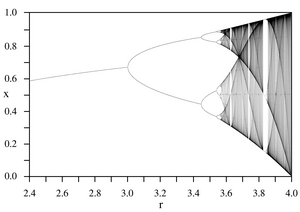
A graphical example of "tipping" points in a chaotic system is shown by the bifurcations in the following graph:


The system is perfect stable for r less than 3, enabling a false sense of security and ability to predict the system response for other values.  By r = 3.6, the system has become completely unstable and unpredictable with rapid further increases in instability as r increases from there.


There are many real-world physical examples of this such as turbulent versus laminar flow of a fluid in a pipe where linear increases of pump pressure lead to more-or-less linear increases in flow rate until a certain flow rate is hit, after which the flow becomes turbulent and massive increases in pump pressure give little or no increase in flow rate. Eventually the pipe will burst from the pressure.


What are the effects of chaos and complexity on Patterns of Sustainable Specialization and Trade [kling] as scale increases?

Winners and Losers From Free Trade

In the previous sections I have questioned whether or not free trade is even beneficial in aggregate, especially when considering resilience and mitigating the risk of huge supply chain bottlenecks. There is no doubt that some people are better positioned to take advantage of, or at least weather, the effects of free trade. This subtopic is more political than economic, in fact it's a hugely contentious area in the political arena, but whatever light economics can shed on this would still be helpful.

Because it's such a contentious topic, I could compile a list of a thousand references of various politicians, bureaucrats, and even economists who lament the damage to various groups due to free trade. I'll just list a couple of recent ones.

Charles Murray describes the damage to working class men during the last half century[murray]:
During the same half-century, American corporations exported millions of manufacturing jobs, which were among the best-paying working-class jobs. They were and are predominantly men’s jobs. In both 1968 and 2015, 70% of manufacturing jobs were held by males. 
During the same half-century, the federal government allowed the immigration, legal and illegal, of tens of millions of competitors for the remaining working-class jobs. Apart from agriculture, many of those jobs involve the construction trades or crafts. They too were and are predominantly men’s jobs: 77% in 1968 and 84% in 2015.
A recent paper by Autor, Dorn, and Hanson examines the effect of large changes in trade, focusing on trade with China. Here are some excerpts [dorn]
“Employment has certainly fallen in U.S. industries more exposed to import competition. But so too has overall employment in the local labor markets in which these industries were concentrated.”

“Without question, a worker’s position in the wage distribution is indicative of her exposure to import competition. In response to a given trade shock, a lower-wage employee experiences larger proportionate reductions in annual and lifetime earnings, a diminished ability to exit a job before an adverse shock hits, and a greater likelihood of exiting the labor market, relative to her higher-wage coworker. Yet the intensity of action along other margins of adjustment means that we will misrepresent the welfare impacts of trade shocks unless we also account for a worker’s local labor market, initial industry of employment, and starting employer.”

“Labor-market adjustment to trade shocks is stunningly slow, with local labor-force participation rates remaining depressed and local unemployment rates remaining elevated for a full decade or more after a shock commences.” While damage to various people in various groups in various regions is not necessarily enough to call for restrictions on free trade, it's also not possible to ignore the political unrest, social ramifications, and potential violence caused by these effects."
There is little more dangerous to a societal order than substantial groups of people who feel that they have little left to lose.

How does one trade of the aggregate economic gains (if any) of free trade with the (alleged) fact that regions and groups have been and will remain devasted? Is any of this quantifiable? In other words, can I know that the likelihood of me losing my job is at least offset by my children being better off due to free trade?

Knowledge and Free Trade

The local knowledge problem is described as follows[hayek]:

Today it is almost heresy to suggest that scientific knowledge is not the sum of all knowledge. But a little reflection will show that there is beyond question a body of very important but unorganized knowledge which cannot possibly be called scientific in the sense of knowledge of general rules: the knowledge of the particular circumstances of time and place. It is with respect to this that practically every individual has some advantage over all others because he possesses unique information of which beneficial use might be made, but of which use can be made only if the decisions depending on it are left to him or are made with his active coöperation. We need to remember only how much we have to learn in any occupation after we have completed our theoretical training, how big a part of our working life we spend learning particular jobs, and how valuable an asset in all walks of life is knowledge of people, of local conditions, and of special circumstances. To know of and put to use a machine not fully employed, or somebody's skill which could be better utilized, or to be aware of a surplus stock which can be drawn upon during an interruption of supplies, is socially quite as useful as the knowledge of better alternative techniques. And the shipper who earns his living from using otherwise empty or half-filled journeys of tramp-steamers, or the estate agent whose whole knowledge is almost exclusively one of temporary opportunities, or the arbitrageur who gains from local differences of commodity prices, are all performing eminently useful functions based on special knowledge of circumstances of the fleeting moment not known to others.
At least some of the argument about need for dispersed knowledge and action thereon has to do with actual local conditions, the “place” part of “time and place.” When a great deal of production has to do with agricultural, extracting energy from the earth, mining, and even manufacturing to some extent, local knowledge is critical for both efficiency and innovation. For example, I work with lettuce growers, and they plant a different lettuce hybrid seed each week to best match the expected weather conditions for that specific 12-week growing period for that batch of lettuce in that specific field. You can't get much more "time and place" specific than that.

But with much of the United States ecomomy having evolved to services, information, and knowledge, a great deal of the “place” part has been eliminated. Knowledge can move anywhere, often not requiring people to move with it, and often nearly instantaneous.

It often seems to me that this globalization of knowledge has almost turned Hayek's knowledge problem on its head. Instead of having an advantage of local knowledge, no individual or local group is able to have an adequate grasp of the competing activities of everyone else around the world, even in a relatively small niche. As a result, no individual or small group can compete without investment risk that's enormous compared with a few decades ago.

I have personally experienced this sort of effect. I may have a high degree of confidence that I'm the only one working on a certain innovation in robotics in a given region, but I'm unable to predict the status of this innovation world wide. Investors, however, want to know if there's a chance they'll be blindsided by some competing group in India, or Israel, or Ireland, or Italy, etc. and if so, will be far less likely to invest. This is exacerbated by the fact that if I'm even nanosecond later than other groups in filing relevant patents, my investors can be out of millions of dollars with no chance to be able to recover from their losses.

As the chaotic effects due to scale increase, investment risk also increases. It's easier to get investment for a venture that can provide a positive ROI and an exit strategy in a short time frame than for ventures that have a longer time horizon. This is partly inherent in the risk assessment and its effect on the subjective discount rate used in Net Present Value calculations which penalize longer time horizons. However, a substantial part of the risk analysis takes the chaotic nature of markets into account coupled with the limited visibility into global activities.

I think that part of slowing of worldwide investment and your colleague Tyler Cowen's Great Stagnation [cowen] are partly due to this sort of phenomenon. There's a lot money sitting, doing nothing, with nobody willing to pull the trigger to invest that money, because that money will be wasted if competing entities are working on the same thing. There are a huge and unlimited number of ventures that can be undertaken, but the risk of doing so due to globalization is astronomical relative to a few decades ago.

Might this new version of the knowledge problem be mitigated by reducing free trade?

Simple Alternative to Free Trade

I'm well aware that putting any sort of trade in the hands of governments and bureaucrats is not without substantial risk due to forces explained by Public Choice Theory[pct] and other factors. Nonetheless, international trade is already in the hands of governments and I think that simplifying government involvement, yet not completely freeing trade, is potentially a tenable approach.

As a result, I would propose an across the board tariff regime for goods and services coming into NAFTA. I'm not sure what the tariff rate would be and a horde of economists would need to figure that out, but for sake of argument, assume 15%. There would be no other regulations beyond security and military necessity (not allowing importation of nuclear weapons, for example).

This tariff would provide the "baffling" to dampen chaotic behavior of trade. At the same time, any area that truly has a local competitive advantage would still be able to trade with other areas and that would keep trading channels open. Industries would have companies in each of the areas to provide resilience against war and disaster. Knowledge and innovations could still be shared.

Even if none of the benefits above are true, there's not really a large economic downside. The revenue from tariffs would simply offset the revenues from other taxes and those lower other taxes would themselves lead to additional investment and innovation.

Are there other major downsides from an economic perspective? If so, what are those downsides and how big are they?

Summary

There are a number of issues in various subtopics of free trade that leave me far from convinced that global free trade is a great idea. I understand that "But Freedom!!!!" is a reply that you might respond with to any of the questions above regarding free trade, and I'm not unsympathetic to that response, but that is not an economic argument.

The main purpose of this email is to hopefully stimulate you to write about these subtopics on your blog in the future from an economic perspective. I would find it interesting and I think some of your other readers will as well.

Thanks,
Bret


References


[canis] http://www.fas.org/sgp/crs/misc/R41831.pdf

[cowen] http://www.amazon.com/Great-Stagnation-Low-Hanging-Eventually-eSpecial-ebook/dp/B004H0M8QS/ref=sr_1_3?s=digital-text&ie=UTF8&qid=1461494631&sr=1-3&keywords=tyler+cowen

[dorn] http://www.ddorn.net/papers/Autor-Dorn-Hanson-ChinaShock.pdf

[farber] http://seclists.org/interesting-people/2007/Jul/123

[fukushima] https://en.wikipedia.org/wiki/Fukushima_Daiichi_nuclear_disaster

[google] https://www.google.com/webhp?sourceid=chrome-instant&ion=1&espv=2&ie=UTF-8#q=free+trade+definition

[hayek] https://en.wikipedia.org/wiki/Local_knowledge_problem

Friedrich A. Hayek, "The Use of Knowledge", American Economic Review. XXXV, No. 4. pp. 519-30 (1945).

[johnson] https://en.wikipedia.org/wiki/Johnson_Electric

[kling] http://arnoldkling.com/essays/papers/PSSTCap.pdf

[matsuo] http://www.sciencedirect.com/science/article/pii/S0925527314002278

[niigata] http://www.japantimes.co.jp/news/2007/07/17/national/powerful-earthquake-slams-niigata

[pct] https://en.wikipedia.org/wiki/Public_choice

[roberts] http://cafehayek.com/2009/04/gifted-in-nepal.html

[ruelle] http://www.amazon.com/Chance-Chaos-David-Ruelle/dp/0691021007/ref=sr_1_1?ie=UTF8&qid=1397157389&sr=8-1&keywords=chance+and+chaos+ruelle