Search This Blog

Showing posts sorted by date for query postmodernism. Sort by relevance Show all posts

Tuesday, November 26, 2013

Postmodernism, it's continued relevance

In a recent post on this blog I linked to a Lee Harris column which asked "why isn't socialism dead?"  The key point was that socialism lives on in the dimension of myth.  The author concluded that piece:
This is why socialism isn't dead, and why in our own century it may well spring back into life with a force and vigor shocking to those who have, with good reason, declared socialism to be no longer viable. It is also why Georges Sorel is perhaps even more relevant today than he was a hundred years ago. He knew that it was hopeless to guide men by reason and argument alone. Men need myths -- and until capitalism can come up with a transformative myth of its own, it may well be that many men will prefer to find their myths in the same place they found them in the first part of the twentieth century -- the myth of revolutionary socialism.

This is the challenge that capitalism faces in the world today -- whether it will rise to the challenge is perhaps the most urgent question of our time, and those who refuse to confront this challenge are doing no service to reason or to human dignity and freedom. Bad myths can only be driven out by better myths, and unless capitalism can provide a better myth than socialism, the latter will again prevail.
I prefer to use a term other than capitalism as do most of the readers of this blog.  There are even bigger problems than word usage.  There is a combination of the myth of socialism and the propagation of a toxic idea meant to undermine the ability of a free society to defend itself.  Dr. Sanity offers the following:
 What are these "dangerous trends that began decades ago"? To understand what is happening in the world today, one must understand the a philosophy that has taken root in Western Civilization and brought us to this point in history--and, yes, ideas really matter; and when you are basing your society on bad ones, then you can expect bad things to happen.

The philosophy that is behind these dangerous trends is Postmodernism; and Barack Obama represents the culmination and embodiment of the perfect postmodern demagogue.


There have been prior posts on this blog   dealing with Postmodernism as well as  additional posts at at Dr. Sanity blog.  She continues:
 
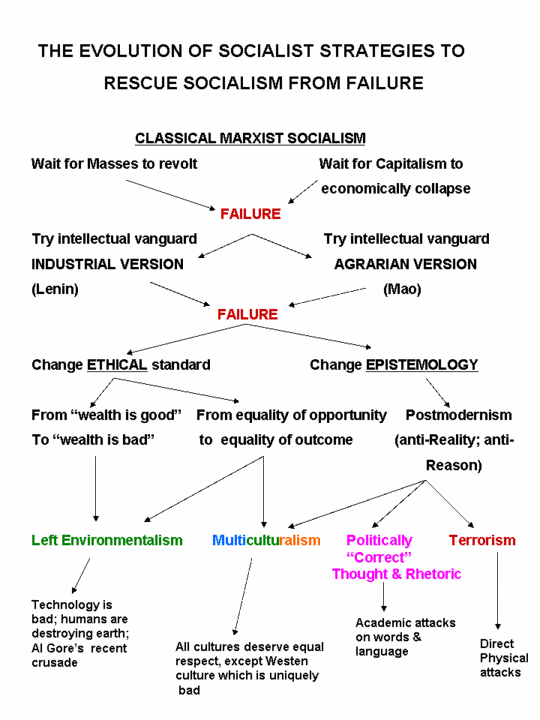
We can think of the four pillars--POLITICAL CORRECTNESS, MULTICULTURALISM, RADICAL ENVIRONMENTALISM, and TERRORISM-- as the foundation for both the socialist revival (particularly in the Western hemisphere recently) and for the rapid advancement of the Islamic Jihad and Islamic fundamentalism.

Below is a flow chart that has been adapted from Stephen Hick's book, Explaining Postmodernism (p. 173), which summarizes the evolution of these four strategies/pillars of leftist/progressive thought; and though I have written about it before, it is well worth repeating over and over again as the perfect postmodern storm that swirls around approaches a Category 5; and as reason, truth, and reality are belittled and ignored by our leaders:


The refusal to accept failure combined with the spawn of Postmodernism gives the radical left considerable ability to undermine freedom.

Friday, August 31, 2007

Gee Guys - could you do a better job?

In a previous post titled memetic infection I displayed what Eric Raymond calls suicidal memes meant to undermine Western Civilization. They certainly infected many Intellectuals. These ideas were part of an evolution of mistaken notions dating back to the 1700's. Some of the history and roots of these ideas are presented with differing points of emphasis in three books.

The Counter-revolution of Science: Studies on the Abuse of Reason by F.A. Hayek. He shows how some thinkers demonstrated perhaps the ultimate example of what Richard Feynman called fragile knowledge. In Intellectuals by Paul Johnson he makes the point:
By "intellectual", Johnson means scientists or artists who go well beyond their abilities and try to design new codes of behavior, new systems of government and new moral rules for the humankind. That is, people who, just because they are good at doing something, think they get the moral right (and duty) to tell the rest of the world how to conduct their affairs.
In Explaining Postmodernism: Skepticism and Socialism from Rousseau to Foucault Stephen Hicks traces these same ideas that having failed in the real world and have devolved into the philosophical deadend of Postmodernism. But they still won't die.

If this is not enough of a fisking of intellectuals, I came across a book titled Common Genius:
During the past half-century, the scholars and academics, descendants of those disparaged by Machiavelli, have failed abysmally to advance the lot of the poverty-stricken people of the Third World. They have relied mostly on handing out charity, much as they might give crumbs to beggars. And, being scholars, they have held conferences, written monographs, and given talks, none of which has helped one whit. One of the most damning records in intellectual history is this sixty-year failure to remedy the ongoing human misery in much of the world. So we must forget for a moment the abstract theories and ideologies that have failed, and seek the effectual truth. If economic history is to serve some practical purpose it must identify the fundamental lesson that has lain hidden beneath the jumble of history and academic jargon. Most of the academics who study and write about history have never been able to accept the truth, although it has always been there before their unbelieving eyes.

A major theme of these pages is that all historical progress has bubbled up from the bottom—from the actions of common men and women. A secondary theme is that most of history's evils have flowed from the top—from the intelligentsia, organized groups, and soft-science experts who arise in mature societies and are the pied pipers of their decline. In the final chapters, we will examine how the decline of free societies has often resulted from the transfer of authority and leadership from those who built the society to a destructive intelligentsia who arrive after the heavy lifting is done. The arrival of the intellectuals also marks the time when knowledge and decision-making appears to enter a steep decline. The notion that intellectuals are wise and should be listened to is a persistent, recurring, and insidious error that has doomed most past civilizations.

I do not mean to demean all people of intellect—most of them are great assets to their communities. However, there is reason to beware those with little practical experience in any field, who parade their "expertise" before the public, and operate primarily as critics rather than participants.

Any history of mankind and its successes must begin at the beginning; and in the beginning, there were no intellectuals. However, there were people struggling to exist and improve their lot in life, and mankind made magnificent strides, advancing from harsh and primitive tribal and nomadic life to complex and prosperous civilizations. The growing influence of intellectuals in the relatively recent past has served only to confuse, divert, and subvert that progress.


Political and religious freedom and economic opportunity have been exceedingly rare during these millennia. Since the first stirrings of civilized society in the Tigris-Euphrates Valley and the days of King Solomon, freedom and opportunity were only a dream, out of reach of the common man. Instead, his lot was to labor under tyranny and oppression that were ever present and that in much of the world still linger malevolently. This dream of freedom, the dream that became reality in America and has endured to this day, is borne of the uniquely human characteristics of man—his ability to reason, his natural curiosity, his instinct to innovate, his independence of spirit. These qualities, sometimes summed up as "free will," distinguish man from the beasts, and they set his destiny. Only one thing has stood in his way: the lust of other men to rule and appropriate for themselves all the good things in life.

Throughout history, such leaders have made life as difficult as possible for the bulk of humanity. The expression of man's genius had to be fought for, and opportunities for its release have been restricted to a few brief moments and places in time. Such moments were the "accidents" of history, but there was nothing accidental about what subsequently happened. The achievements were never pre-ordained but arose from a long-term struggle by ordinary people to advance, one step at a time, over thousands of years. But wherever individual men and women got even a little such opportunity, freedom and prosperity followed. They built it piece by piece, not by trying to apply utopian theories, but by solving one problem at a time and moving ever forward.

Now, this is a revolutionary idea and perhaps in a perverse way, will delight most of the average Joes out there who are pestered by those "beautiful people" who want to tell them what to do and how to do it. I know this discovery has emboldened me to set forth this hypothesis; a hypothesis passed on to me by my wife's uncle, a simple Polish immigrant named Harry Radzewicz. I suspect many of the best and brightest will scoff at my message, saying that I simplify too much, that things are much more complex than I can comprehend. But that is okay with me, for as observed earlier, it is better to seek the "effectual truth" than to build vast conceptual edifices or perpetuate grandiose theories that don't work.

An advantage of the Radzewicz Formula is its ability to simplify a complex question so that it is easily understood. It was explained to me as follows: "History's progress," I was told, "can actually be reduced to a simple equation. It's easy, like simple algebra, or Polish notation." He put it on paper: CM + S - O = EF

"CM, the common man, with Security, minus Oppression, equals Economic Freedom, and that leads to Prosperity. It also subsequently leads to Political Freedom."

And there it was—neat and simple. A fundamental principle missed by all the intellectuals. Deliberately missed, perhaps, because there is no "I" in the formula—intellectuals have never had anything to do with progress.
No grand designs and radical remakes of society please. Incremental improvement will do.

Update: I think this boils it down rather nicely:
Indeed, one could, without too much effort, extend the Long War analogy back to the end of the 18th Century and argue that the real struggle is between various rational egalitarianisms growing out of the Enlightenment and the French Revolution vs. the faith-based republicanism of the Anglosphere.
Update 2 [12/08/2007]: Fixed the link to "Common Genuis"

Wednesday, February 21, 2007

Undermining Freedom

Reality having failed to conform to the revolutionary vision of the collectivists known as communists and socialists, they sought instead to destroy the culture of Western free society. We have visited this idea before in a Eric Raymond's post titled Gramscian Damage. Here I excerpt an article titled Cultural Marxism.
There are two misconceptions held by many Americans. The first is that communism ceased to be a threat when the Soviet Union imploded. The second is that the New Left of the Sixties collapsed and disappeared as well.

Because the New Left lacked cohesion it fell apart as a political movement. However, its revolutionaries reorganized themselves into a multitude of single issue groups.

Both communism and the New Left are alive and thriving here in America. They favor code words: tolerance, social justice, economic justice, peace, reproductive rights, sex education and safe sex, safe schools, inclusion, diversity, and sensitivity. All together, this is Cultural Marxism disguised as multiculturalism.

By the end of WWI, socialists realized that something was amiss, for the world's proletariat had not heeded Marx's call to rise up in opposition to evil capitalism and to embrace communism instead.

Separately, two Marxist theorists-Antonio Gramsci of Italy and Georg Lukacs of Hungary-concluded that the Christianized West was the obstacle standing in the way of a communist new world order. The West would have to be conquered first.

The West would have to be de-Christianized, said Gramsci, by means of a "long march through the culture."

The new battleground, reasoned Gramsci, must become the culture, starting with the traditional family and completely engulfing churches, schools, media, entertainment, civic organizations, literature, science, and history.

In 1923, the Frankfurt School-a Marxist think-tank-was founded in Weimar Germany. Among its founders were Georg Lukacs, Herbert Marcuse, and Theodor Adorno.

The primary goal of the Frankfurt School was to translate Marxism from economic terms into cultural terms. It would provide the ideas on which to base a new political theory of revolution based on culture, harnessing new oppressed groups for the faithless proletariat. Smashing religion, morals, It would also build a constituency among academics, who could build careers studying and writing about the new oppression.

The end product was Cultural Marxism, now known in the West as multiculturalism.

A corresponding and diabolically crafted idea is political correctness. The strong suggestion here is that in order for one not to be thought of as racist or fascist, then one must not only be nonjudgmental but must also embrace the ‘new' moral absolutes: diversity, choice, sensitivity, sexual orientation, and tolerance. Political correctness is a Machiavellian psychological ‘command and control' device. Its purpose is the imposition of uniformity in thought, speech, and behavior.

Critical Theory is an ongoing and brutal assault via vicious criticism relentlessly leveled against Christians, Christmas, the Boy Scouts, Ten Commandments, our military, and all other aspects of traditional American culture and society.

Both political correctness and Critical Theory are in essence, psychological bullying.

"... it is only necessary to display an inhuman attitude toward people to be granted by those people the possessions of force."


Double-thinking ‘fence-sitters', otherwise known as moderates, centrists, and RINOs bear the imprint of these psychological ‘obedience' techniques.


At the merest hint of displeasure from the obedience-trainers, up goes the yellow flag of surrender upon which it is boldly written:
"I believe in nothing and am tolerant of everything!"
The linchpin of Cultural Marxism is cultural determinism, the parent of identity politics and group solidarity.

It is said that courage is the first of the virtues because without it fear will paralyze man, thus keeping him from acting upon his moral convictions and speaking truth. Thus bringing about a general state of paralyzing fear, apathy, and submission-the chains of tyranny-is the purpose behind psychopolitical cultural terrorism, for the communist Left's revolutionary agenda must, at all costs, be clothed in darkness.

The antidote is courage and the light of truth. If we are to win this cultural war and reclaim and rebuild America so our children and their children's children can live in a ‘Shining City on the Hill' where liberty, families, opportunity, free markets, and decency flourish, we must muster the courage to fearlessly expose the communist Left's revolutionary agenda to the Light of Truth. Truth and the courage to speak it will set us free.

An interesting perspective can be had of this from a philosophical and historical view by reading Stephen Hicks book Explaining Postmodernism.
This from a review:

The socialist intellectuals were in a quandary. They ought rationally to have abandoned their views, since their doctrine was fallacious in theory and disastrous in practice; but rationality is not a trait much in evidence among the socialistically inclined. If reason speaks against socialism, is not the solution obvious: out with reason! If reason provides no access to reality, but is rather a mask for power, the critique of socialism is disabled.

How, though, can socialists claim that reason is relative and at the same time aver an absolute belief in socialist politics? Are they not here caught in a contradiction that even they cannot dismiss? Hicks finds plausible two explanations of the contradiction. On one account, "absolutist politics are primary, while the relativism is a rhetorical strategy that is used to advance that politics"; on the other, "both the relativism and the absolutism coexist in postmodernism, but the contradictions between them simply do not matter psychologically to those who hold them" (p. 185). Hicks rejects the view that relativism is primary and the politics secondary. If it were true, "then postmodernists would be adopting political positions across the spectrum, and that is simply not happening" (p. 186).

Choose freedom or choose your flavor of tranny!

See also this diagram from the book of attempts to rescue socialist thought from failure. Of course Postmodernism and it's epistemological deadend are alive in academia but this book about Michael Polanyi is helpful for someone wishing to reconnect with reality.


Also, a book I will comment on more in the future, White Guilt by Shelby Steele, makes the observation that there is a growing opposition to this undermining of the culture from people with a renewed confidence in more traditional beliefs. Well, one can hope.